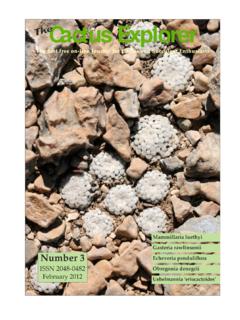
Transcription of T h e Cactus Explorer
1 Cactus ExplorerThe first free on-line Journal for Cactus and Succulent EnthusiastsTheEchinomastus johnsoniiMatucana myriacanthaEcheveria laui in habitatSclerocactus polyancistrusSucculents of Isla CedrosNumber 2 ISSN 2048-0482 November 2011 Cover Picture by Paul KlaassenDudleya pachyphytumin habitat on Isla de Cedros, Baja California Sur, Mexico. See page 27 Publisher: The Cactus Explorers Club, Briars Bank, Fosters Bridge, Ketton, Stamford, PE9 3BF Exploreris available as a PDF file downloadable from Editorial Team:Organiser:Graham Charles Adviser: Roy Mottram Hoxey Janeba Lowry expressed in the articles are those of the authors, and not necessarily those of the editorial of the Cactus Explorermay be freely distributed whilst the copyright of the text and pictures remainswith the authors.
2 Permission is required for any use of this material other than reading, printing or to ContributorsPlease consider the Cactus Exploreras the place to publish your articles. We welcome contributionsfor any of the regular features or a longer article with pictures on any aspect of cacti andsucculents. The editorial team is happy to help you with preparing your work. Please send yoursubmissions as plain text in a Word document together with jpeg or tiff images with themaximun resolution available. A major advantage of this on-line format is the possibility of publishing contributions quicklyand any issue is never full! We aim to publish your article within 3 months and the copy deadlineis just a few days before the publication date which is planned for the 10th of February, May,August and November.
3 Please note that advertising and links are freeand provided for thebenefit of readers. Adverts are placed at the discretion of the editorial team, based on theirrelevance to the Cactus Explorer ISSN 2048-0482 Number 2 November 20112 Regular FeaturesIntroduction3 News and Events4 Recent New Descriptions11In the Glasshouse17 Journal Roundup22 The Love of Books24 Society Page56 Retail Therapy57 ArticlesSucculents of Isla de Cedros27My Trip with Arthur 200633 Echeveria laui is in Care36 Matucana myriacantha high above the Rio Crisnejas40 Plea to Cactus Explorers44 Travel with the Cactus Expert (1)45A Day in the Quebrada de Tastil48 Echinomastus johnsonii52In thIsEdItIonThe source for on-line information about cacti and succulents is 2 November 2011 ISSN 2048-0482 The Cactus Explorer3 What a welcome!
4 I have been extremely encouraged by theresponse to the first issue of the CactusExplorer. Since its publication, I havereceived hundreds of emails from all aroundthe world saying how enjoyable the journal hasbeen to read and asking to be advised of futureissues. So, our challenge is to keep the contentsentertaining and relevant to your feel that the remit of the journal is stillevolving, but there is one thing I can certainlypromise. Cactus Explorerwill always befree as long as I am responsible for itsproduction!It is a pleasure to welcome Zlatko Janeba toour editorial team. Zlatko lives in the CzechRepublic and is well connected in the cactusworld. There is a long tradition of cactusexploration carried out by Czech people and itcontinues today. With Zlatko s help, we hopeto bring you articles about their is also our intention to present you withinformation about aspects of the hobby whichyou may not already have explored, forinstance unusual plants, unfamiliar habitatsand literature you may never have of the responses to the first editionhave come from traditional Cactus andSucculent Societies and clearly there is someconcern about the impact of this publication ontheir membership.
5 Our intention is that theCactus Explorerwill complement theactivities of established Societies, not replacethem. I also hope that we shall stimulateinterest in succulents amongst those who donot belong to any of the existing Societies,particularly the our next edition, there will be majorchanges to the rules of Botanical Nomenclatureallowing the publication of new names in on-line journals, like the Cactus Explorer , forthe first time. Roy Mottram, our expert onthese matters, explains the changes on page authority to publish nomenclaturalchanges in our publication is not to be takenlightly. The Cactaceae is already burdenedwith a vast number of superfluous names, andnames at a higher rank than the differencesexhibited by the proposed taxa justify. Withthis in mind, articles containing nomenclatoralinnovations submitted to this journal will besubject to review by the editorial group and/orother specialists before being accepted is our intention to publish articles aboutother succulents as well as cacti.
6 This issue hastwo such contributions, even though thehabitats concerned are in Cactus country. Ihope enthusiasts for succulents from otherparts of the world will share their adventureswith will see that this edition includes articlesfrom many contributors. I am very grateful tothem and encouraged by their willingness tocontribute. I hope to receive more articles fromthem as well as from new contributors in in England, our glasshouses are nowtucked up for the winter with a hope that itwill be less cold than last year. It is a time ofmixed feelings, the growing season havingcome to an end, but the promise of more freetime to read journals and books, visit habitats,or write an article for the Cactus there s a good idea!GrahamCharlesIntroduCtIonThe next issue of the Cactus Explorerisplanned for February 2012.
7 If you have notalready told me and would like to be advisedwhen it is available for download, pleasesend meyour E-mail address to be added tothe distribution list. Thank you for your interest and support!The Seventh Cactus Explorers ClubMeeting 2011 by Roland TebbenhamPhotographs by Trevor Wray and Roland TebbenhamA novice Explorer reports on the seventh intensiveweekend programme designed to share newinformation and appreciate the beauty of nature andplants from interesting places. The event wassupported by more than fifty enthusiasts, includingguest speakers and delegates from Brazil, CzechRepublic, Italy, Peru, Sweden and many parts of theUK. Nineteen sessions were planned spanning habitatsfrom the USA to Patagonia. Though focused onmembers of the Cactus family, other interesting plantswere designated honorary cacti for the weekend.
8 Manydelegates contributed expert opinions on plantidentities, observations on the presenter s intellect, orcommented on the quality of the plants politer interjections were recorded by the authorto illustrate the good-humoured atmosphere among theassembled company! Our first presentation was by Paul Hoxey, who spentseven days in NE Mexico during October after asummer of heavy rain. Memorable images included25cm diameter flat discs of Echinocactus texensiswithAncistrocactus scheeri and Ariocarpus trigonusat 200m. Bycontrast the cereoid Stenocereus pruinosusmakes largecolumns near Monterrey [NL]. Another contrast wasthe very cryptic Astrophytum caput-medusaefound byPaul under bushes. This led to a discussion on theclosest Astrophytum habitat probably A. asteriasinTexas. Paul featured favourite dwarf plants enjoyinggypsum substrates and canyon walls, wherecompetition is limited: Mammillaria candida, Aztekiumhintoniiand Ariocarpus retususwith white flowers, tingedpink.
9 Paul journeyed to N Zacatecas seeking Escobarialloydiiat 2200m, but did not find any plants. However,he showed Escobaria dasyacantha chaffeyi, Cylindropuntiatunicataand many other nice cacti including a 2m tallEchinocactus platyacanthus. Finally to limestone rockpans at 1200m in N Coahuila, where Paul concluded histalk with memorable images of a large population ofMammillaria luethyi. The fine images reminded theaudience why Mexico is rewarding exploration territoryfor cactophiles. Martin Lowry stepped up to tell us about his Boliviantrip with John Carr and a Brazilian botanist duringApril/May-2011. They found some unexpected plantsand others with differences that may revise started in the wet, hot tropical forests of the E Andesnear the Rio Pirai (in Santa Cruz), where they foundCleistocactus candelilla, which appeared distinct from As they journeyed west into thorn scrub thehabitats were dryer and they found Corryocactus sp.
10 ,Weingartia neocumingiisubsp. pulquinensisand Parodiacomarapana. The first honorary cacti featured; anEcheveria and a Bomaria [bulb]. Moving to higheraltitudes Austrocylindropuntia floccosawith many fruitswere seen above 4000m and Lobivia maximillianacaespitosaat 4600m: these are truly tough plants!Crossing the range we were challenged to identify acereoid growing at 2400m knowledgeable folk offered(correctly) Yungasocereus inquisivensis a tropical forestspecies here found further north and east thanpreviously. John Pilbeam enjoyed more Echeverias oncanyon cliffs at 3600m. Moving towards Sucre we sawmany Echinopsis, Parodia and Sulcorebutia plants, thelatter including S. purpureaat 3000m, corresponding toLau 331. South of Sucre in the area of the Rio Pilcomayoand its tributaries Martin commented that the originalnEws andEvEntsThe Cactus Explorer ISSN 2048-0482 Number 2 November Paul Klaassen showing plants of Jaroslav Snicer selling goodies grown in theCzech RepublicNumber 2 November 2011 ISSN 2048-0482 The Cactus Explorer5habitat of Cintia had mostly been destroyed byroadstone quarrying.