Transcription of Tāwharanui Regional Park - Auckland Council
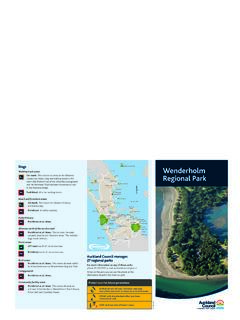
1 Please take your rubbish homeYour parks provide open space, fresh air, a home for native plants and animals, clean water, beauty and inspiration. Help keep them this way. No bins No rubbish Better parks DogsOpen sanctuary areas: Prohibited at all times. This covers all areas of the open sanctuary, parkland, campgrounds, foreshore and aras adjoining to the entrance of the park. This includes dogs inside : Prohibited at all times. This covers all areas of the beaches adjoining T wharanui Regional wharanui Regional ParkSet on a remote peninsula, T wharanui Regional Park boasts some of the Auckland region s most beautiful white sand beaches, rolling pastures, shingled bays, native coastal forest and regenerating wetlands.
2 It includes the T wharanui Open Sanctuary and the T wharanui Marine Reserve which borders the northern coast line. The 588-hectare Regional park was New Zealand s first integrated open sanctuary (mainland island) where farming, public recreation and conservation of native species combine. The name T wharanui refers to the abundant edible bracts of the kiekie vine . The iconic Anchor Bay is named after the anchor of the Phoenix, a vessel wrecked on the T wharanui coastline in 1879. T wharanui Open SanctuaryThe vision for T wharanui Regional Park is to create and maintain an open sanctuary that integrates conservation with recreation and farming; free from plant and animal pests; where native plants, birds and animals can live and breed successfully.
3 A coast to coast pest-proof fence keeps pests out of the open sanctuary. A pest eradication and monitoring programme ensures we maintain a pest-free haven for native can you help?Visitors to T wharanui can protect the open sanctuary in a number of ways. Before you enter the park, check your vehicles and camping gear to ensure there are no rodents hidden anywhere. Report sightings of rodents or other animal pests to the duty wharanui Marine ReserveThe T wharanui Marine Reserve borders the northern coastline. Yours to explore, the marine reserve provides a wonderful opportunity for diving or snorkelling in an unspoilt underwater environment.
4 In return we ask you to help us safeguard this by observing the no fishing and no taking , animals and birdsSignificant restoration and planting has been done with the help of volunteers and much more is planned. North Island brown kiwi, takah , bellbird, North Island robin, whitehead, New Zealand dotterel, reef heron, spotless crake, pateke, kakariki, saddleback and bittern are all flourishing behind the fence. More species will be reintroduced in the ori lived in this area for more than 800 years. Until the 1870s the park was occupied by a small hap (sub-tribe) of the Te Kawerau people called Ng ti Raup.
5 T wharanui provided a rich variety of marine and forest resources, symbolised by the saying: He wh t whara ki uta; he kiko t mure ki tai. The flowering bracts of the kiekie on the land; the flesh of the snapper in the sea. Waik k wai (Anchor Bay) provided a valued source of k k wai or red ochre, which was used for ceremonial and decorative people lived mainly around the catchment of the Mangatawhiri Stream. Near the park entrance was a significant p known as p nui and above the stream outlet is P -hi or lofty fortified settlement . After 1870 T wharanui was developed as a farm by the Martin, Jones and Young families.
6 Kauri timber was milled and shingle was extracted from the park, creating the so-called Jones Bay Lagoon. The Auckland Regional Authority (ARA) purchased the park from the Georgetti family in facilitiesPrime picnic spotsWith 588 hectares of Regional park you can easily find your own favourite spot to picnic with friends and family any time at T wharanui Regional Park. Feel free to bring your own gas barbecues. To help protect the open sanctuary please check all vehicles and equipment before entering the park to ensure it is free of pests, vermin and hazardous material and take rubbish and food scraps of 50 people or more are only allowed under special conditions and require a permit.
7 CampgroundsT wharanui has one basic, sheltered campground around 50m to 150m from the beautiful white sand beach. Remember when walking from the campground to the beach, stick to the tracks and you will help protect the dunes. There are restrictions and conditions that apply. Staying overnight in selected areasT wharanui has no Self-Containment Certificate (SCC) parking area. Campervans, vehicle units and caravans with a SCC must stay in the T wharanui all modes campground. Conditions apply. Other accommodationBook your bach escape at T wharanui Bach, which sleeps up to six people, and is located at Jones Bay near the entrance to the information on park facilities, conditions and restrictions and to make a booking: phone 09 301 0101, from the park use the contact phone at the notice board at the park office.
8 Following the on-site instructions or visit to get thereT wharanui Regional Park is an 85km or 80 minute drive from downtown Auckland . Take SH1 north to Warkworth. Follow the signs to Matakana. Just past Matakana, at the Omaha turn off, turn right. Drive along Takatu Road and the park is well sign-posted. For public transport information: phone Auckland Transport 09 366 6400 or visit 181611112 MirandaWaiukuP kenoClevedonWhitfordMatakawauPihaWaimauk uKaiauaHelensvilleWaitemat HarbourOrere PointWaihekeIslandHauraki GulfTasman SeaWait kereRangesRegionalPark Hunua Ranges Regional Park manaWhakanewhaT papakangaWhakat waiWaharauMuriwaiAuckland Botanic GardensAmburyAratakiVisitorCentreMt SmartStadiumMutuk roa(Hamlin s Hill)
9 WhituShakespearLong BayWenderholmMahurangiScandrettT wharanuiKeyRegional parklandTe raiP kiriAtiu CreekTawhitokinoWaitawaDuderManukauHarbo urMatakanaWarkworthWellsfordTe Rau P ririAuckland Council manages 27 Regional parksFor more information on any of these parks: phone 09 301 0101 or visit on the park you can use the phone at the park wharanui Regional Park20-PRO-0811 VolunteeringWe would love to have your help ith work in Regional and physical ability are no barriers as there are tasks and projects to suit all individuals and groups. For more information on volunteering: phone 09 301 0101 or visit T wharanui Open Sanctuary Society (TOSSI) is a not-for-profit organisation that works in partnership with Auckland Council at T wharanui Regional Park.
10 They are involved in volunteer programmes, fundraising, education and Sunday in the parkJoin us on the first Sunday of each month, where we ll kick off our day with a morning s work followed by a barbecue lunch. Afterwards enjoy a presentation prepared by the TOSSI team. For more information visit kauri for future generationsSCRUB all soil off your footwear and gear every time you enter or leave an area with with disinfectant after you have removed all on track and off kauri Regional Park Brochures_Tawharanui 15/02/20 2:27 PMPlease take your rubbish homeYour parks provide open space, fresh air, a home for native plants and animals, clean water, beauty and inspiration.