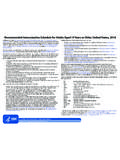
Transcription of Table 1 Recommended Adult Immunization Schedule by …
1 The Adult Immunization Schedule consists of figures that sum-marize routinely Recommended vaccines for adults by age groups (see Figure 1) and by medical conditions and other indications (see Figure 2), footnotes for the figures, and a Table of vaccine contraindications and precautions (see Table 1). Consider the following when reviewing the schedules on the following page: Figure 1 and 2 should be reviewed with the accompanying footnotes. The figures and footnotes display indications for which vac-cines, if not previously administered, should be administered unless noted otherwise. The Table of contraindications and precautions identifies populations and situations for which vaccines should not be used or should be used with caution. When indicated, administer Recommended vaccines to adults whose vaccination history is incomplete or unknown.
2 An increased interval between doses of a multidose vaccine series does not diminish vaccine effectiveness; it is not nec-essary to restart the vaccine series or add doses to the series because of an extended interval between doses. Combination vaccines may be used when any component of the combination is indicated and when the other compo-nents of the combination vaccine are not contraindicated. The use of trade names in the Adult Immunization Schedule is for identification purposes only and does not imply endorsement by the ACIP or populations that need additional considerations include: Pregnant women. Pregnant women should receive the teta-nus, diphtheria, and acellular pertussis vaccine (Tdap) dur-ing pregnancy and the influenza vaccine during or before pregnancy. Live vaccines ( , measles, mumps, rubella vac-cine [MMR]) are contraindicated.
3 Asplenia. adults with asplenia have specific vaccination rec-ommendations because of their increased risk for infection by encapsulated bacteria. Anatomical or functional asplenia includes congenital or acquired asplenia, splenic dysfunc-tion, sickle cell disease and other hemoglobinopathies, and splenectomy. Immunocompromised conditions. adults with immunosup-pression should generally avoid live vaccines. Inactivated vac-cines ( , pneumococcal vaccines) are generally acceptable. High-level immunosuppression includes HIV infection with a CD4 cell count <200 cells/ L, receipt of daily corticosteroid therapy with >20 mg of prednisone or equivalent for >14 days, primary immunodeficiency disorder ( , severe com-bined immunodeficiency or complement component defi-ciency), and receipt of cancer chemotherapy. Other immuno-compromising conditions and immunosuppressive medications to consider when vaccinating adults can be found in IDSA Clinical Practice Guideline for Vaccination of the Immunocompromised Host (see Clin Infect Dis.)
4 2014;58:e44 100 at 32212256011). Additional information on vaccinating immu-nocompromised adults is in General Best Practice Guidelines for Immunization (see ).Report suspected cases of reportable vaccine-preventable dis-eases to the local or state health all clinically significant postvaccination events to the Vaccine Adverse Event Reporting System at or by telephone, 800-822-7967. All vaccines included in the Adult Immunization Schedule , except 23-valent pneumococcal polysaccharide and zoster vaccines are covered by the Vaccine Injury Compensation Program. Information on how to file a vaccine injury claim is available at ensation or by telephone, 800-338-2382. Submit questions and comments to CDC through or by telephone, 800-CDC-INFO (800-232-4636), in English and Spanish, 8:00 8:00 ET, Monday Friday, excluding following abbreviations are used for vaccines in the Adult Immunization Schedule (in the order of their appearance).
5 Notes for Recommended Adult Immunization Schedule , United States 2018 IIV inactivated influenza vaccineRIV recombinant influenza vaccineTdap tetanus toxoid, reduced diphtheria toxoid, and acellular pertussis vaccineTd tetanus and diphtheria toxoidsMMR measles, mumps, and rubella vaccineVAR varicella vaccineRZV recombinant zoster vaccineZVL zoster vaccine liveHPV vaccine human papillomavirus vaccinePCV13 13-valent pneumococcal conjugate vaccinePPSV23 23-valent pneumococcal polysaccharide vaccineHepA hepatitis A vaccineHepA-HepB hepatitis A and hepatitis B vaccinesHepB hepatitis B vaccineMenACWY serogroups A, C, W, and Y meningococcal vaccineMenB serogroup B meningococcal vaccineHib Haemophilus influenzae type b vacci