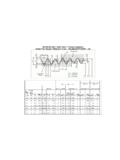
Transcription of Tapping Drill Char T 339 - Construction Supply
1 Tapping Drill CharTUNC Unified National CoarseThis thread form was introduced in 1948 as an attempt to standardise thread forms in the USA, Canada and the UK. The thread profile of UNC is the same as for metric threads and is described in the JIS B0206 standard. The thread is described by its major diameter and the number of threads per inch of length (TPI). This thread series is commonly used in the mass production of bolts, screws and nuts. It is used for threading into lower tensile strength materials (bronze, brass, aluminium and plastics) to obtain the best resistance stripping of the internal thread. It is also used on quick assembly or disassembly or if corrosion or slight damage is Unified National FineThis thread form was introduced in 1948 as an attempt to standardise thread forms in the USA, Canada and the UK.
2 The thread profile of UNF is the same as for metric threads and is described in the JIS B0206 standard. The thread is described by its major diameter and the number of threads per inch of length (TPI). When used on external threads this series has greater tensile stress area than coarse threads of the same size. Fine series threads will resist stripping out better than coarse threads in areas where the external and mating internal threads METRIC Coarse and FineAngle of thread is 60 . The crest is flat and the thread has clearance at the root allowing external thread and internal thread to engage well. Larger root radius and lower thread height enable easy screw thread processing and increase thread screw strength.
3 The major diameter of external thread and pitch are specified by a simple numerical value (most commonly measured in millimeters).BSW British Standard WhitworthThis thread form was developed by Sir Joseph Whitworth in 1841. The thread form has rounded roots and crests and is specified in BS84:1956. The thread angle for BSW is 55 as opposed to 60 in Metric and Unified British Standard FineThis thread form was based upon the British Standard Whitworth (BSW) but has a finer thread (more threads per inch for a given diameter). The thread form was first introduced in 1908 and is specified in BS84:1956. When used on external threads this series has greater tensile stress area than coarse threads of the same size.
4 Fine series threads will resist stripping out better than coarse threads in areas where the external and mating internal threads are subjected to loads equal to or greater than the capacity of the screw or bolt. Fine threads are also used where the length of engagement is limited or where wall thickness demands a fine (UNIFIED NATIONAL EXTRA FINE)gUiDElinEs FOR UsINg A hAND wRENch TO TAp mETAL OR pLAsTIc Secure workpiece and Drill hole using correct size Tapping Drill as shown on this chart. Select suitable lubricant see chart below. Secure tap in wrench and place tap squarely in hole. Use downward pressure and turn clockwise (anti-clockwise if using a Left Hand tap) until resistance is felt.
5 Once started tap will draw itself into the workpiece and there is no need for downward pressure. Screw the tap slowly into the hole, backing off occasionally when tap becomes difficult to turn. When Tapping deep holes it s advisable to periodically remove the tap completely from the hole and clean out all the chips. NEVER FORCE TAP - breakage may Taps have a lead of six to eight threads and are used as a starting tap in difficult or high precision holes. This general purpose tap is designed for use in medium tensile materials and is for hand Taps have a lead of four to five threads and are used in most general purpose applications to cut a thread true to a pre-drilled pilot hole. This general purpose tap is designed for use in medium tensile materials and is for hand or general Taps have a lead of two threads and are used to ensure minimum thread run-out when Tapping to the bottom of a blind hole.
6 Bottoming Taps are typically preceded by the use of a Taper or Intermediate Tap. This general purpose tap is designed for use in medium tensile materials and is for hand or general anD MaChinE TapsMETriC COarsE (IsO)METriC FinE (IsO)METriC sparK plUg (IsO) BsW (BRITIsh sTANDARD whITwORTh)MaChinE TapsWhile every effort has been made to ensure the accuracy of the information herein, Bordo International Pty Ltd accepts no liability for any loss or damage either to direct or consequential arising out of or in relation to the use or application of the said information or products referred to herein. / galVanising (IsO) + + + + + (IsO) (BRITIsh sTANDARD FINE) BEING TAPPEDSUITABLE LUBRICANTS teel, brass & bronzeMedium oilAluminiumKeroseneCast IronDry or soluble (UNIFIED NATIONAL FINE)UnC (UNIFIED NATIONAL cOARsE) Point Taps are used for machine Tapping blind and through holes where there is sufficient clearance to accommodate chips.
7 Manufactured from super tough HSS-Co this modern design tap uses straight flutes supplemented by angular cutting faces at the point to produce a fine finish on the threads. Shallower flutes achieve a stronger cross section allowing the tap to withstand greater cutting Flute Taps are used for machine Tapping in all blind hole applications, especially in soft metals that produce long stringy swarf such as aluminium, copper and magnesium. Manufactured from super tough HSS-Co this modern design tap uses the shear action provided by the spiral flutes to draw the swarf out of the hole which minimises swarf clogging when Tapping deeper (BRITIsh sTANDARD pIpE g-sERIEs) (BRITIsh sTANDARD pIpE TApER)npT (NATIONAL pIpE ThREAD TApERED) (DRYsEAL)npTF (DRYsEAL TApER)are subjected to loads equal to or greater than the capacity of the screw or bolt.
8 Fine threads are also used where the length of engagement is limited or where wall thickness demands a fine British Standard PipeBSPF (G Series) This series is a pipe thread which is used mainly for mechanical coupling. The angle of thread is mainly 55 however for the US method some threads have a 60 angle. It is specified according to JIS and ISO British Standard Pipe TaperThis is based on the Whitworth thread form - a symmetrical V-thread with an angle of 55 . BSPT has been widely adopted internationally for sealing and interconnecting pipe ends by mating an external (male) with an internal (female) thread. The thread diameter increases along the length of the thread allowing the coupled pipes to form a seal when torqued as the flanks of the threads compress against each other.
9 The taper is 1:16, meaning that for each 16 mm increase in the distance from the end, the diameter increases by 1 (Dryseal Taper) National Pipe Taper FuelNPTF is a semi-compatible variant of NPT, designed to provide a more leak free seal without the use of teflon tape or other sealant compound. NPTF threads are the same basic shape but with crest and root heights adjusted for an interference fit, eliminating the spiral leakage National Pipe Thread TaperedNPT is a US standard for tapered threads used to join pipes and fittings. ANSI/ASME standard covers threads of 60-degree form with flat crests and roots. The taper on NPT threads allows them to form a seal when torqued as the flanks of the threads compress against each other.
10 However a clearance remains between the crests and roots of the threads, resulting in a leakage around this spiral. This means that NPT fittings must be made leak free with the aid of thread seal tape or a thread sealant compound. For each 12 increase in distance from the end, the diameter increases by 3/4 .NPSF (Dryseal) National Pipe Straight FuelAnother variation of the Dryseal thread is the NPSF. It is used for internal threads and an NPTF external thread can be screwed into it to provide both a satisfactory mechanical connection and hydraulic seal. A combination of a parallel and tapered thread would not appear to be ideal but it is widely used. Many quick disconnect couplers for example have the NPSF thread and are recommended by the manufacturer for use with NPT and