Transcription of TASK FORCE RESILIENT FINAL REPORT - United …
1 Task FORCE RESILIENT FINAL REPORT April 2013. ii Table of Contents Introduction .. i Table of Table of Figures .. v Foreword .. 1. Executive Summary .. 3. Task FORCE RESILIENT FINAL 7. I. Task .. 7. II. 7. III. Resilience and suicide Prevention Efforts .. 8. navy suicide Prevention and Resilience Efforts .. 8. suicide in the navy .. 8. History of navy suicide Prevention .. 9. navy Resilience Policy and 9. navy Resilience and suicide Prevention Programs ..10. Case Studies ..15. Other Efforts Within DoD ..18. The DoD Task FORCE on the Prevention of suicide ..18. The Defense suicide Prevention Office (DSPO) ..19. The Defense Centers of Excellence for Psychological Health and Traumatic Brain Injury (DCoE).
2 19. Air FORCE ..21. Marine Corps ..22. Summary of DoD efforts ..23. Efforts Outside of DoD ..23. Penn Resiliency Program (PRP) ..23. Department of Veterans Affairs (VA) Study: Predicting Post-Deployment Mental Health Substance Abuse and Services Needs ..24. New Mexico suicide Intervention Jed Foundation ..25. Summary of Non-DoD Efforts ..25. iii IV. General Findings ..26. navy suicide rates are historically lower than national and DoD rates but are trending upward indicating a problem ..26. suicide protective factors and their relationship to military service needs to be better The current navy operating environment and operational tempo do not appear to directly increase the risk of suicide .
3 27. navy suicides are not unique to specific generations but generational data can inform resilience and suicide prevention efforts ..27. suicide is not connected to service accession waivers ..29. suicide clustering is rare and existing navy guidance already incorporates best practices with regard to its prevention ..29. Resiliency training can have a positive effect on individual readiness and may reduce the risk of suicide over time ..29. Comprehensive care for the caregiver must be a critical element of navy suicide prevention efforts ..31. A continuous chain of care for at-risk Sailors must be included as an element of navy suicide prevention efforts ..31. V. Specific Findings and Recommendations.
4 33. Organization ..33. Training ..37. Assessment ..38. Care ..39. Learning and Culture VI. Conclusion ..43. Appendix A Plan of Action and Milestones .. A-1. Appendix B Program Assessment .. B-1. Appendix C - Chaplain Corps Specific Recommendations .. C-1. Appendix D DoD Task FORCE D-1. Appendix E BUMED REPORT Recommendations .. E-1. Appendix F Bibliography .. F-1. Appendix G Critical iv Table of Figures Figure 1: navy Tier 1 Program Figure 2: navy Tier 2 Program Figure 3: Overall Program Assessment ..14. Figure 4: NECC Resiliency Results ..18. Figure 5: navy , DoD, and National suicide Rates ..26. Figure 6: Notional Design of 21st Century Sailor Office ..34. v vi Foreword The navy defines resiliency as the process of preparing for, recovering from, and adjusting to life in the face of stress, adversity, trauma, or tragedy.
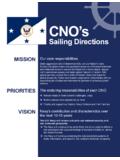
5 1 Academic studies contend that there is an inherent connection between resilience and suicide prevention and that resilience can be learned. 2 However, there is no accepted way to measure individual resilience or agreement on levels of resilience required to inoculate a person against suicide . suicide has been studied longer and to a far greater extent than resiliency. Recognizing this, Task FORCE RESILIENT focused its efforts on understanding navy suicide and current prevention efforts to provide navy leadership with recommendations that build resiliency and prevent suicide . 1. 2. Executive Summary Introduction The three tenets of the Chief of Naval Operations' Sailing Directions are: Warfighting First, Operate Forward, and Be Ready.
6 Building resilience and preventing suicide are essential to producing a FORCE that is always ready to operate forward and execute its warfighting mission. The Vice Chief of Naval Operations (VCNO) established Task FORCE RESILIENT on 22 January 2013 to review navy resiliency efforts as well as suicide related events in order to increase resilience and reduce suicides. In executing its analysis the Task FORCE received fleet input and expert opinions. The Task FORCE examined: suicide rates, trends, and high risk groups; suicidal risk factors and causal agents; the latest scientific literature on resilience and suicide prevention; navy resiliency efforts; and Department of Defense (DoD) and civilian resiliency and suicide prevention efforts.
7 suicide in the navy The Task FORCE found that the most typical profile for a navy suicide involves an enlisted white male between the ages of 17-24. However, recent data confirms that anyone of any age or rank can become susceptible to suicide . Relationship difficulties with spouse or significant other, legal and/or disciplinary problems, health problems, and a history of psychiatric problems lead the list of factors and stressors related to suicide . Firearms are the primary method used in navy suicides and that rate is rising. Alcohol is a factor in just over a third of suicides. Sleep deprivation is a common factor and a concern, as nearly half our Sailors in the fleet today get less than five hours of sleep per night.
8 Hospital Corpsman and nuclear power ratings currently have a heightened incidence of suicide . Resilience and suicide Prevention Programs navy suicide prevention efforts are governed by OPNAVINST but the Task FORCE found no policy governing resilience in the navy . navy Tactics, Techniques and Procedures Publication NTTP 1-15M, Combat and Operational Stress Control, does, however, provide doctrinal guidance for resiliency efforts. Despite the lack of an overarching resilience policy, the navy has no fewer than 123 programs specifically designed to build resilience, prevent suicide , or enable those ends. All contribute positively to navy wellness, but they typically address niche needs and are not necessarily coordinated as part of a strategic plan.
9 This lack of strategic coordination reduces effectiveness and produces inefficiencies. The Task FORCE found that DoD resilience and suicide prevention efforts outside the navy can guide and inform navy programming. The FINAL REPORT of the DoD's Task FORCE on the Prevention of suicide by Members of the Armed Forces provides valuable insight and actionable recommendations for preventing suicide . Other Service programs include elements 3. suitable for use by the navy such as a strong emphasis on resilience programming, community involvement, small unit leadership, recruit screening, and tiered/targeted training initiatives. Programs outside the DoD also hold promise for informing navy efforts. Task FORCE RESILIENT examined these various efforts and initiatives and shaped its recommendations accordingly.
10 General Findings The Task FORCE discovered a variety of general findings during analysis that informed many of its specific recommendations. These included the following: navy suicide rates are historically lower than national and DoD rates but are trending upward indicating a problem. suicide protective factors and their relationship to military service needs to be better understood. The current navy operating environment and operational tempo do not appear to directly increase the risk of suicide . navy suicides are not unique to specific generations but generational data can inform resilience and suicide prevention efforts. suicide is not connected to service accession waivers. suicide clustering is rare and existing navy guidance already incorporates best practices with regard to its prevention.