Transcription of TB042 - UNDERSTANDING CONVENTIONAL AND …
1 UNDERSTANDING CONVENTIONAL & HVLP spray Guns Technical Bulletin TB042 Category: Parex USA General Keywords: spray Guns What are the components of a pressure feed system? A pressure feed system consists of; a pressure feed spray gun, a pressure feed tank, cup or pump, an air filter/regulator, appropriate length & diameter of air and fluid hoses and an adequate air compressor. Air Atomizing spray Guns What happens when the trigger is pulled? The trigger operates in two stages. Initial trigger movement opens the air valve, allowing atomizing air to flow through the gun. Further movement of the trigger opens the fluid needle, allowing fluid material to flow. When the trigger is released, the fluid flow stops before the atomizing air flow. This lead/lag time in the trigger operation, assures a full spray pattern when the fluid flow starts. It also assures a full pattern until the fluid flow stops, so there is no coarse atomization. How is the pressure feed gun adjusted for spraying?
2 Open spreader adjustment valve for maximum pattern size. Open fluid adjustment screw (counter clockwise) until maximum needle travel is achieved. Opening beyond that point will lessen the internal spring tension and leakage at the fluid tip may result. How is the pressure feed gun balanced for spraying? 1 Using control knob on fluid regulator, set fluid pressure at 5 to 10 psi. 2 Using control knob on air regulator, set air atomization pressure at 30-35 psi. 3 spray a test pattern (fast pass) on a piece of paper, cardboard, or wood. From that test pattern, determine if the particle size is small enough and uniform throughout the pattern to achieve the required finish quality. If particle size is too large or is giving too much texture in the finish, turn the atomization pressure up in 3 to 5 psi increments until particle size and texture of finish is acceptable. 4 spray a part with these settings. If you are not able to keep up with the production rate required or if the finish is starved for material, increase the fluid pressure (or use a larger capacity fluid tip) with the fluid regulator control knob in 2 to 4 psi increments until required wet coverage is accomplished.
3 5 Remember, as you turn up the fluid pressure the particle size will increase. Once the coverage required is obtained, it will be necessary to re-adjust the atomization pressure in 3 to 5 psi increments as explained in step 3 to insure required particle size and finish texture is achieved. 6 If using HVLP, using an Air Cap Test Kit , verify that the air cap pressure in not above 10 psi if required by a regulatory agency. What is an external mix gun? This gun mixes and atomizes air and fluid outside the air cap. It can be used for applying all types of materials, and it is particularly desirable when spraying fast drying paints such as lacquer. It is also used when a higher quality finish is desired. What is an internal mix cap? This gun mixes air and material inside the air cap, before expelling them. It is usually used where low air pressures and volumes are available, or where slow-drying materials are being sprayed. A typical example is spraying flat wall paint, or outside house paint, with a small compressor.
4 Internal mix guns are rarely used for finishing when a fast-drying material is being sprayed, or when a high quality finish is required. What is HVLP? HVLP, or High-Volume/Low Pressure, uses a high volume of air (typically between 15-26 CFM) delivered at low pressure (10 PSI or less at the air cap) to atomize paint into a soft, low-velocity pattern of particles. In most cases, less than 10 psi is needed in order to atomize. Proper setup utilizes no more fluid and air pressure than is needed to produce the required quality and a flow rate that will meet production requirements. As a result, far less material is lost in overspray, bounce-back and blowback than with CONVENTIONAL air spray . This is why HVLP delivers a dramatically higher transfer efficiency (the amount of solids applied as a percent of solids sprayed) than spray systems using a higher atomizing pressure. The HVLP spray gun resembles a standard spray gun in shape and operation. Models that use high inlet pressure (20-80 psi) and convert to low pressure internally within the spray gun are called HVLP conversion guns.
5 Some HVLP models, particularly those using turbines to generate air, bleed air continuously to minimize back-pressure against the air flow of the turbine. The air cap design is similar to that of a standard spray gun, with a variety of air jets directing the atomizing air into the fluid stream, atomizing it as it leaves the tip. HVLP is growing in popularity and new environmental regulations are requiring it for many applications. HVLP can be used with any low-to-medium solids materials that can be atomized by the gun, including two-component paints, urethanes, acrylics, epoxies, enamels, lacquers, stains, primers, etc. What is the function of the air cap? The air cap directs compressed air into the fluid stream to atomize it and form the spray pattern. There are various styles of caps to produce different sizes and shapes of patterns for many applications. What are the advantages of the multiple jet cap? This cap design provides better atomization of more viscous materials.
6 It allows higher atomization pressures to be used on more viscous materials with less danger of split spray pattern. It provides greater uniformity in pattern due to better equalization of air volume and pressure from the cap. It also provides better atomization for materials that can be sprayed with lower pressures. How should an air cap be selected? The following factors must be considered: a) Type, viscosity and volume of material to be sprayed b) Size and nature of object, or surface, to be sprayed (Multiple, or larger, orifices increase ability to atomize more material for faster painting of large objects. Fewer, or smaller, orifices usually require less air, produce smaller spray patterns and deliver less material. These caps are designed for painting smaller objects and/or using slower speeds. c) Material feed system used - pressure, siphon or gravity d) Size of fluid tip to be used (Most air caps work best with certain fluid tip/needle combinations.
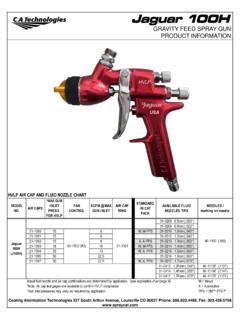
7 E) Volume of air in cubic feet per minute (CFM) and pressure in pounds per square inch (PSI) available. What is the function of the fluid tip and needle? They restrict and direct the flow of material from the gun into the air stream. The fluid tip forms an internal seat for the tapered fluid needle, which reduces the flow of material as it closes. The amount of material that leaves the front of the gun depends upon the viscosity of the material, the material fluid pressure and the size of the fluid tip opening provided when the needle is unseated from the tip. fluid tips are available in a variety of sizes to properly handle materials of various types, flow rates and viscosity s. What is the nozzle combination? In practice, the air cap, fluid tip, needle and baffle are selected as a unit, since they all work together to produce the quality of the spray pattern and finish. These four items, as a unit, are referred to as the nozzle combination.
8 How are nozzle combinations selected? Five basic considerations are involved in selecting the nozzle combination: Type and viscosity of material being sprayed Physical size of object being finished Desired speed/finish quality Gun model being used Available air volume (CFM) and pressure (PSI) from compressor 1. The type and viscosity of the material being sprayed is the first factor to consider. Rule of thumb: The lower the viscosity of the material, the smaller the of the fluid tip. 2. The physical size of the object to be painted must also be considered. As a general rule, use the largest possible spray pattern consistent with the object size. Remember that different air caps deliver various pattern characteristics. This can reduce both spraying time and the number of gun passes. 3. The next consideration in evaluating nozzle combinations is the speed with which thefinish will be applied, and the desired level of quality.
9 For speed and uniform coverage, choose a nozzle combination which produces a pattern as wide as possible. For finish coat work, quality is the deciding factor. Choose a nozzle combination which produces a fine atomization and a smaller pattern size, thereby giving greater application control. 4. The model of the gun itself will limit the selection of nozzle combination. For a pressure feed gun, the amount of material discharged depends upon material viscosity, the inside diameter of the fluid tip, the length and size of hose and the pressure on the material container or pump. If the fluid tip opening is too small, the paint stream will be too high. If the fluid tip opening is too large, you will lose control over the material discharging from the gun. 5. Available air supply is the last factor to consider. Pressure feed air caps consume between and CFM, depending on air pressure applied. If your air supply is limited, because of an undersized compressor, or many other air tools are in use at once, the gun will be starved for air, producing incomplete atomization and a poor finish.
10 What are the criteria for selecting a pressure feed nozzle? While the fluid discharge in ounces per minute from a suction feed gun is relatively stable (largely because it is determined by atmospheric pressure), the fluid discharge from a pressure feed gun depends more upon the size of the inside diameter of the fluid tip and the pressure on the paint container or pump. The larger the opening, the more fluid is discharged at a given pressure. If the fluid tip ID is too small for the amount of material flowing from the gun, the discharge velocity will be too high. The air, coming from the air cap, will not be able to atomize it properly causing a center-heavy pattern. If the fluid tip opening is too large, material discharge control will be lost, often resulting in a split pattern. The fluid tip/air cap combination must be matched to each other and to the job at hand. spray gun catalogs include charts to help you match them properly.