Transcription of Teaching and Learning Strategies - SDERA
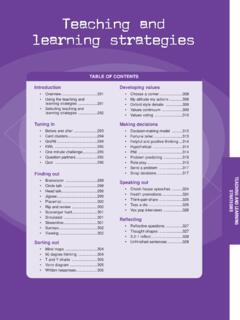
1 Teaching and Learning StrategiesTeaching and Learning Strategies 2013 School Drug Education and Road AwareFOUNDATION Teaching and Learning Strategies | 161 The interactive Teaching and Learning Strategies described in this section are used to engage students in the resilience and wellbeing, drug education and road safety content included in each focus areas of this resource. Strategies are indicated in bold text in the Learning activities . Teachers should refer to this section of the resource for an explanation of the purpose and how to implement the strategy with their Strategies aim to promote critical and reflective thinking, research and evaluation skills that will help students to take positive action to protect, enhance and advocate for their own and other s health, wellbeing and safety.
2 Students use personal and social capability to work collaboratively with others in Learning activities , to appreciate their own strengths and abilities and those of their peers and develop a range of interpersonal skills such as communication, negotiation, team work, leadership and an appreciation of diverse Learning activities and Strategies have been organised under the basic elements of an inquiry process: yTuning in Strategies provide opportunity for students to explore their current knowledge, attitudes and values about health and safety issues.
3 While working independently or collaboratively, students can use suggested graphic organisers to record and share information. Teachers will also be able to use evidence gathered from students responses to plan a program to cater for the needs of all students. yFinding out Strategies help students identify gaps in their existing knowledge and understanding of key health, safety and resilience and wellbeing concepts, and work collaboratively to gather information through self-directed investigation.
4 Students will be able to use the information gathered to generate and communicate ideas and record responses. ySorting out Strategies encourage students to sort, analyse, organise, review, compare and contrast information to further develop and consolidate their knowledge, understandings, skills, attitudes and values. Summarising key information and clarifying relationships or associations between information and ideas will assist students to draw conclusions and apply their understandings. yReflecting Strategies allow students to identify, discuss and consider changes in their understandings, skills, attitudes and values.
5 These elements are also fundamental to the decision-making process in the Health and Physical Education Learning Area and reflect self-management, social management, self-awareness and self-management skills. INTRODUCTION 2013 School Drug Education and Road AwareFOUNDATION FOCUS AREA 1: Resilience and Wellbeing | 31 yConduct a shared reading (refer to page 167) of the story Alexander and the Terrible Horrible, No Good, Very Bad Day. Alternatively a video clip of the story is available at In this story the author normalises rather than personalises the fact that everyone has bad times in their lives.
6 Show the cover of the book and flick through the illustrations. Ask the class to predict what the story might be about and identify the characters in the story. Read the story to the each bad thing happens:How could Alexander have felt better? (For example, Alexander could have accepted that not being able to sit next to the window in the car was just bad luck.) Has anything like this ever happened to you? How did you feel?What feelings did Alexander have?Would laughing about this have made Alexander feel better?
7 What kind of day do you think Alexander will have tomorrow? Have you ever had a bad day because you were feeling sad or angry or worried? Did that feeling last forever or go away? What does that tell us about bad days and bad feelings? (That everyone has bad things happen at some time and those times don t last forever.) yWrite on the board bad luck and something Alexander did . Read the headings to the class. Explain that when something happens to Alexander in the story the class must decide if it was because of something he did or was just bad luck.
8 Activity 1 Everyone has good days and bad daysPreparation `Alexander and the Terrible Horrible, No Good, Very Bad Day (Judith Viorst, 1999, Scholastic Press, NSW) `Dot stickers `One finger puppet `Craft materials class set `Family information sheet Creating resilient kids together photocopy one per student or upload on school website `Family information sheet Resilience skills to practise photocopy one per studentTUNING IN yRead the story again. When each event happens, stop reading and ask for a student volunteer to vote by placing a coloured dot under the corresponding heading.
9 (Alternatively, students could use a marker and draw a tick.) At the end of the story, count the coloured dots and discuss whether Alexander s bad day was mostly due to bad luck or the things that Alexander did. To summarise the discussion remind students that bad things don t usually last for long and that it s normal for everyone to have a bad day at some time. yExplain to the class that having positive thoughts can be used to cope with a problem or stressful situation. Use a finger puppet to model what Alexander could have done or said to himself to feel better.
10 For example: Oh well, I didn t get anything from the cereal box, maybe I will next time. yHave students suggest how Alexander could have dealt with the other bad situations in the story. Use the finger puppet to repeat their suggestion to the class. Show students how to make their own finger puppet using the craft materials. Sit students with a partner. Read aloud one of the bad situations from the story. Have students use their finger puppets to practice using positive thoughts that would help cope with the situation.