Transcription of Teaching ESL/EFL Reading and Writing
1 Teaching ESL/EFLR eading and WritingUsing a framework based on principles of Teaching and learning, this guidefor teachers and teacher trainees provides a wealth of suggestions for help-ing learners at all levels of proficiency develop their Reading and writingskills and fluency. By following these suggestions, which are organizedaround four strands meaning-focused input, meaning-focused output,language-focused learning, and fluency development teachers will beable to design and present a balanced program for their ESL/EFL Reading and Writing , and its companion text, Teaching ESL/EFL Listening and Speaking, are similar in format and thekinds of topics covered, but do not need to be used together. Drawing onresearch and theory in applied linguistics, their focus is strongly hands-on,featuring easily applied principles, a large number of useful Teaching techniques, and guidelines for testing and Certificate, Diploma, Masters and Doctoral courses for teachers ofEnglish as a second or foreign language include a Teaching methods com-ponent.
2 The texts are designed for and have been field tested in S. P. Nation is Professor of Applied Linguistics in the School ofLinguistics and Applied Language Studies at Victoria University inWellington, New & Applied Linguistics Professional SeriesEli Hinkel, Series EditorNation Teaching ESL/EFL Reading and WritingNation/Newton Teaching ESL/EFL Listening and SpeakingKachru/Smith Cultures, Contexts, and World EnglishesMcKay/Bokhosrt-Heng International English in its Sociolinguistic Contexts:Towards a Socially Sensitive EIL PedagogyChristison/Murray, Eds Leadership in English Language Education: TheoreticalFoundations and Practical Skills for Changing TimesMcCafferty/Stam, Eds Gesture: Second Language Acquisition and ClassroomResearchLiu Idioms: Description, Comprehension, Acquisition, and PedagogyChapelle/Enright/Jamison, Eds Building a Validity Argument for the Text ofEnglish as a Foreign Language Kondo-Brown/Brown, Eds Teaching Chinese, Japanese, and Korean HeritageStudents: Curriculum Needs, Materials, and AssessmentsYoumans Chicano-Anglo Conversations: Truth, Honesty, and PolitenessBirch English L2 Reading : Getting to the Bottom, Second EditionLuk/Lin Classroom Interactions as Cross-cultural Encounters: Native Speakers inEFL LessonsLevy/Stockwell CALL Dimensions: Issues and Options in Computer AssistedLanguage LearningNero, Ed.
3 Dialects, Englishes, Creoles, and EducationBasturkmen Ideas and Options in English for Specific PurposesKumaravadivelu Understanding Language Teaching : From Method to PostmethodMcKay Researching Second Language ClassroomsEgbert/Petrie, Eds CALL Research PerspectivesCanagarajah, Ed. Reclaiming the Local in Language Policy and PracticeAdamson Language Minority Students in American Schools: An Education inEnglishFotos/Browne, Eds New Perspectives on CALL for Second Language ClassroomsHinkel Teaching Academic ESL Writing : Practical Techniques in Vocabulary andGrammarHinkel/Fotos, Eds New Perspectives on Grammar Teaching in Second LanguageClassroomsHinkel Second Language Writers Text: Linguistic and Rhetorical FeaturesVisit for additional information on titles in the ESL& Applied Linguistics Professional SeriesTeaching ESL/EFLR eading and WritingI.
4 S. P. NationFirst published 2009by Routledge270 Madison Ave, New York, NY 10016 Simultaneously published in the UKby Routledge2 Park Squar e, Milt on Park, Abingdon, Oxon OX14 4 RNRoutledge is an imprint of the Taylor & Francis Group, an informa business 2009 Routledge, Taylor & FrancisAll rights reserved. No part of this book may be reprinted or reproduced or utilized in any formor by any electronic, mechanical or other means, now known or hereafter invented, includingphotocopying and recording, or in any information storage or retrieval system, withoutpermission in Writing from the Notice: Product or corporate names may be trademarks or registered trademarks,and are used only for identification and explanation without intent to of Congress Cataloging-in-Publication DataNation, I. S. ESL/EFL Reading and Writing / I. S. P. cm. (ESL & applied linguistics professional series)Includes bibliographical English language Study and Teaching Foreign English language Rhetoric Study and English teachers Training 4 dc222008011762 ISBN10: 0 415 98967 1 (hbk)ISBN10: 0 415 98968 X (pbk)ISBN10: 0 203 89164 3 (ebk)ISBN13: 978 0 415 98967 1 (hbk)ISBN13: 978 0 415 98968 8 (pbk)ISBN13.
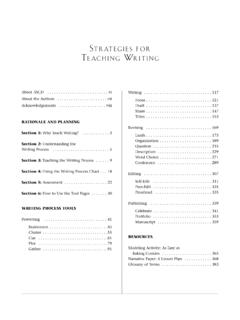
5 978 0 203 89164 3 (ebk) To purchase your own copy of this or any of Taylor & Francis or Routledge scollection of thousands of eBooks please go to This edition published in the Taylor & Francis e-Library, 0-203-89164-3 Master e-book ISBNC ontentsPrefaceix1 Learning to Read in Another Language1 Learning to Read in the First Language2 Learning to Read in Another Language5 Principles for Teaching Reading62 Learning to Recognise and Spell Words9 Prerequisites for Formal Reading Instruction9 Phonics and the Alphabetic Principle13 The Role of Phonics in a Reading Programme14 Spelling: Productive Phonics15 Learning to Spell18 Spelling and Meaning-focused Input18 Spelling and Meaning-focused Output18 Spelling and Language-focused Learning19 Designing a Focused Spelling Programme223 Intensive Reading25 Focuses in Intensive Reading27 Features of a Good Intensive Reading Exercise28 Are Comprehension Questions Good Reading Exercises?
6 29 Comprehension of the Text32 The Focus of Comprehension Questions34 Standardised Reading Procedures37 Vocabulary37 Grammar Features in the Text40vCohesive Devices44 Genre Features47 Handling the Exercises48 The Role of Teaching Exercises484 Extensive Reading49 Understand the Goals and Limitations of Extensive Reading50 Find Your Learners Present Vocabulary Level51 Provide Plenty of Interesting and Appropriate Reading Texts52 Set, Encourage and Monitor Large Quantities of Extensive Reading53 Support and Supplement Extensive Reading with Language-focusedLearning and Fluency Development54 Help Learners Move Systematically Through the Graded Reader Levels55 Simplified and Unsimplified Texts57 Other Ways of Supporting Extensive Reading58 The Extensive Reading Programme605 Reading Faster61 The Nature and Limits of Reading Speed62 The Nature of Fluency Development64 The Nature of Fluency Development Activities65 Increasing Oral Reading Speed66 Increasing Careful Silent Reading Speed68 Increasing Silent Expeditious Reading Speed70 Frequently Asked Questions About Reading Speed716 Assessing Reading75 Motivating75 Measuring Achievement77 Diagnosing Problems79 Measuring Reading Proficiency83 Issues in Making and Using Reading Comprehension Tests917 Helping Learners Write93 Principles for Teaching
7 Writing93 Designing Tasks95 Experience Tasks96 Bringing Tasks Within the Learners Experience96 Making Sure Learners have the Experience to do a Task97 Shared Tasks98 Guided Tasks100 Independent Tasks109 Using the Four Kinds of Tasks110vi Contents8 The Writing Process113 The Parts of a Writing Programme113 Meaning-focused Writing113 The Parts of the Writing Process114 Considering the Goals of the Writer and Model of the Reader115 Gathering Ideas117 Organising Ideas119 Ideas to Text119 Reviewing119 Editing120 Diagnosing Control of the Parts of the Writing Process123 Diagnosing from the Written Product1239 Topic Types127 The Topic Type Hypothesis127 Topic Types and Writing130 Topic Types and Reading131 Limitations of the Topic Type Approach13410 Responding to Written Work137 Motivating137 Improving the Quality of Writing138 Measuring Proficiency in Writing146 Conclusion149 Appendix 1 Spelling and Pronunciation Pointsof Correspondence151 Appendix 2A List of Conjunction Relationships161 References163 Index169 Contents viiPrefaceThis book (and its companion book Teaching ESL/EFL Listening andSpeaking) is intended for teachers of English as a second or foreign lan-guage.
8 It can be used both for experienced teachers and for teachers intraining. In its earlier forms this book has been used on graduate diplomaand Masters level courses, and with teachers in book has two major features. First, it has a strong practicalemphasis around one hundred Teaching techniques are described in thebook. Second, it tries to provide a balanced programme for developingthe skills of Reading and Writing . It does this by using a framework calledthe four strands. These are called strands because they run through thewhole course. They are the strands of meaning-focused input, meaning-focused output, language-focused learning, and fluency a well-balanced language programme covering the four skills of listen-ing, speaking, Reading , and Writing , each of the four strands should haveroughly equal amounts of time.
9 The organisation of the book largelyreflects these four have attempted to write the book using clear and simple possible, technical terms have been avoided. However, in a fewcases, with terms such as phonics, topic type, and extensive Reading , technicalterms have been used and explained in the text. This book thus does notrequire any previous knowledge of second language acquisition theory orlanguage Teaching 1 compares first and second language Reading . The first sixchapters look at Reading , and the last four at Writing . Chapters 2 and 3focus on beginning Reading . Special attention is given to phonics and thereixis a very useful related appendix of spelling sound 4 and 5 look at extensive Reading and fluency. Chapter 6 looks atassessing Reading , paying particular attention to the reasons for 7 presents a range of ways for supporting Writing and Chapter 8examines the Writing process.
10 Chapter 9 has relevance for both Reading andwriting. It looks at topic types which describe the kinds of informationcontained in different kinds of texts. Chapter 10 examines a range of waysthat can be used to respond to written a result of working through this book, teachers should be able todesign a well-balanced Reading and Writing course which provides a goodrange of opportunities for learning. The teacher s most important job is toplan so that the learners are learning useful things, so that the best condi-tions for learning occur, and so that they are getting a balance of learningopportunities. This book should help teachers do possible, the ideas in this book are research based. This isreflected in the principles which are described at the end of Chapter 1 andwhich are referred to throughout the book. The idea which lies behindthese principles is that it is not a wise idea to follow closely a particularmethod of language Teaching , such as communicative language teachingor the direct method.