Transcription of teaching of maths prelims
1 POSITION PAPERNATIONAL FOCUS GROUPONTEACHING OFMATHEMATICS POSITION PAPERNATIONAL FOCUS GROUPONTEACHING OFMATHEMATICS1. 2 First EditionMach 2006 Chaitra 1928PD 5T BS National Council of EducationalResearch and Training, 2006Rs. on 80 GSM paper with NCERT watermarkPublished at the Publication Departmentby the Secretary, National Council ofEducational Research and Training, SriAurobindo Marg, New Delhi 110 016 andprinted at Bengal Offset Works, 335, KhajoorRoad, Karol Bagh, New Delhi 110 005 ISBN 81-7450-539-3 ALL RIGHTS RESERVED No part of this publication may be reproduced, stored in a retrieval system ortransmitted, in any form or by any means, electronic, mechanical, photocopying,recording or otherwise without the prior permission of the publisher. This book is sold subject to the condition that it shall not, by way of trade, be lent, re-sold, hired out or otherwise disposed of without the publisher s consent, in any formof binding or cover other than that in which it is published.
2 The correct price of this publication is the price printed on this page, Any revisedprice indicated by a rubber stamp or by a sticker or by any other means is incorrectand should be OF THE PUBLICATION DEPARTMENT, NCERTNCERT CampusSri Aurobindo MargNew Delhi 110 016108, 100 Feet RoadHosdakere Halli ExtensionBanashankari III StageBangalore 560 085 Navjivan Trust 380 014 CWC CampusOpp. Dhankal Bus StopPanihatiKolkata 700 114 CWC ComplexMaligaonGuwahati 781 021 Publication TeamHead, Publication:P. RajakumarDepartmentChief Production:Shiv KumarOfficerChief Editor:Shveta UppalChief Business:Gautam GangulyManagerEditor:Bijnan SutarProduction Officer: Arun ChitkaraCover and LayoutShweta RaoTeaching ofMathematicsThe main goal of mathematics education in schools is the mathematisation of the child s of thought and pursuing assumptions to logical conclusions is central to the mathematicalenterprise.
3 There are many ways of thinking, and the kind of thinking one learns in mathematicsis an ability to handle abstractions, and an approach to problem of schooling has important implications for mathematics being a compulsory subject of study, access to quality mathematics education isevery child s right. We want mathematics education that is affordable to every child, and at thesame time, enjoyable. With many children exiting the system after Class VIII, mathematics educationat the elementary stage should help children prepare for the challenges they face further in our vision, school mathematics takes place in a situation where: (1) Children learn to enjoymathematics, (2) Children learn important mathematics , (3) mathematics is a part of children s lifeexperience which they talk about, (4) Children pose and solve meaningful problems, (5) Childrenuse abstractions to perceive relationships and structure, (6) Children understand the basic structureof mathematics and (7) Teachers expect to engage every child in the other hand, mathematics education in our schools is beset with problems.
4 We identifythe following core areas of concern: (a) A sense of fear and failure regarding mathematics amonga majority of children, (b) A curriculum that disappoints both a talented minority as well as thenon-participating majority at the same time, (c) Crude methods of assessment that encourageperception of mathematics as mechanical computation, and (d) Lack of teacher preparation andsupport in the teaching of mathematics . Systemic problems further aggravate the situation, in thesense that structures of social discrimination get reflected in mathematics education as well. Especiallyworth mentioning in this regard is the gender dimension, leading to a stereotype that boys arebetter at mathematics than analysis of these problems lead us to recommend: (a) Shifting the focus of mathematicseducation from achieving narrow goals to higher goals, (b) Engaging every student with a senseof success, while at the same time offering conceptual challenges to the emerging mathematician,(c) Changing modes of assessment to examine students mathematization abilities rather thanprocedural knowledge, and (d) Enriching teachers with a variety of mathematical shift in focus we propose is from mathematical content to mathematical learningenvironments, where a whole range of processes take precedence.
5 Formal problem solving, useof heuristics, estimation and approximation, optimisation, use of patterns, visualisation,representation, reasoning and proof, making connections, mathematical communication. GivingEXECUTIVE SUMMARY viimportance to these processes also helps in removing fear of mathematics from children s crucial implication of such a shift lies in offering a multiplicity of approaches, procedures,solutions. We see this as crucial for liberating school mathematics from the tyranny of the oneright answer, found by applying the one algorithm taught. Such learning environments inviteparticipation, engage children, and offer a sense of terms of assessment, we recommend that Board examinations be restructured, so that theminimum eligibility for a State certificate be numeracy, reducing the instance of failure in the other hand, at the higher end, we recommend that examinations be more challenging,evaluating conceptual understanding and note that a great deal needs to be done towards preparing teachers for mathematicseducation.
6 A large treasury of resource material, which teachers can access freely as well as contributeto, is badly needed. Networking of school teachers among themselves as well as with universityteachers will it comes to curricular choices, we recommend moving away from the current structureof tall and spindly education (where one concept builds on another, culminating in universitymathematics), to a broader and well-rounded structure, with many topics closer to the ground .If accommodating processes like geometric visualisation can only be done by reducing content,we suggest that content be reduced rather than compromise on the former. Moreover, wesuggest a principle of postponement: in general, if a theme can be offered with better motivationand applications at a later stage, wait for introducing it at that stage, rather than go for technicalpreparation without due vision of excellent mathematical education is based on the twin premises that all studentscan learn mathematics and that all students need to learn mathematics .
7 It is thereforeimperative that we offer mathematics education of the very highest quality to all R. Ramanujam (Chairperson)Institute of Mathematical Science4th Cross, CIT CampusTharamani, Chennai 600 113 Tamil NaduDr. Ravi SubramanianHomi Bhabha Centre for Science Purao Marg, MankhurdMumbai 400 008 MaharashtraProf. Amitabha MukherjeeCentre for Science Education and CommunicationUniversity of DelhiDelhi 110 007Dr. Farida A. KhanCentral Institute of EducationUniversity of DelhiDelhi 110 007Mr. R. Athmaraman35, Venkatesh AgraharamMaylapur, Chennai 600 004 Tamil NaduShri Basant Kr. MishraHeadmasterGovernment High SchoolKonark, PuriOrissaMEMBERS OF NATIONAL FOCUS GROUP ONTEACHING OF MATHEMATICSProf. SachdevPrincipal InvestigatorNonlinear Studies Group(Department of mathematics )Indian Institute of ScienceBangalore 560 012 KarnatakaMs.
8 Arati BhattacharyyaAcademic OfficerBoard of Secondary BamunimaidanGuwahati 781 021 AssamProf. Surja KumariPPMED, NCERTSri Aurobindo MargNew Delhi 110 016Dr. SinghReader in MathematicsDepartment of Education in Science andMathematics (DESM), NCERT,Sri Aurobindo MargNew Delhi 110 016Dr. Kameshwar RaoLecturer in MathematicsDepartment of Education in Science andMathematics (DESM), NCERT,Regional Institute of Education (NCERT)BhubaneswarOrissaviiiProf. Hukum Singh (Member Secretary)Professor of MathematicsHead, PPMEDNCERTSri Aurobindo MargNew Delhi 110 016 InviteesShri Uday SinghLecturerDepartment of Education in Science and mathematics (DESM)NCERT, Sri Aurobindo MargNew Delhi - 110 016 Shri Praveen K ChaurasiaLecturerDepartment of Education in Science and mathematics (DESM)NCERT, Sri Aurobindo MargNew Delhi - 110 016 Shri Ram AvatarReaderDepartment of Education in Science and mathematics (DESM)NCERT, Sri Aurobindo MargNew Delhi - 110 016 Prof.
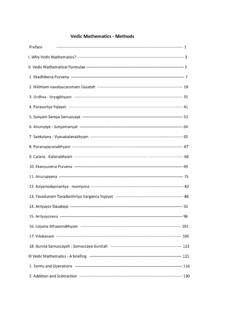
9 V. P. GuptaDepartment of Elementary EducationNCERT, Sri Aurobindo MargNew Delhi - 110 016 Prof. Shailesh A. ShiraliPrincipalAmber Valley Residential Road, MugthihallaiChikmanglur - 577 201, KarnatakaProf. R. BalasubramaniamDirectorInstitute of Mathematical Science, ChennaiDr. D. S. RajagopalanDirectorInstitute of Mathematical Science, ChennaiDr. V. S. SunderDirectorInstitute of Mathematical Science, ChennaiDr. K. N. RaghavanDirectorInstitute of Mathematical Science, ChennaiDr. Kaushik MajumdarDirectorInstitute of Mathematical Science, ChennaiDr. M. MahadevanDirectorInstitute of Mathematical Science, Chennai1. GOALS OF mathematics EDUCATION ..12. A VISION STATEMENT ..23. A BRIEF HISTORY ..34. PROBLEMS IN teaching AND LEARNING OF mathematics .. Fear and Failure .. Disappointing Curriculum .. Crude Assessment.
10 Inadequate Teacher Preparation .. Other Systemic Problems ..75. RECOMMENDATIONS .. the Higher Goals .. for All .. Support ..136. CURRICULAR CHOICES .. Stage .. Primary Stage .. Stage .. Secondary Stage .. and Mathematicians ..197. CONCLUSION ..19 References ..20 CONTENTSE xecutive Summary ..vMembers of National Focus Group on teaching of mathematics ..vii11. GOALS OF mathematics EDUCATIONWhat are the main goals of mathematics educationin schools? Simply stated, there is one main goal the mathematisation of the child s thoughtprocesses. In the words of David Wheeler, it is more useful to know how to mathematise than toknow a lot of mathematics to George Polya, we can think of twokinds of aims for school education: a good and narrowaim, that of turning out employable adults who(eventually) contribute to social and economicdevelopment; and a higher aim, that of developingthe inner resources of the growing child2.