Transcription of Teaching Persuasive Reading and Writing
1 High School Persuasive WritingHigh School Persuasive Reading1 Teaching PersuasiveReading and WritingA Sample Unit of Lessons and Strategiesfor High School TeachersJefferson County Public SchoolsVersion School Persuasive WritingHigh School Persuasive Reading2 INTRODUCTIONThis unit was developed to give starting points for Teaching Persuasive Reading andWriting. Ninth and tenth graders are working toward the KCCT assessment. Theyshould be able to read and comprehend Persuasive materials well by the end of the 10thgrade. Eleventh and twelfth graders should continue to read Persuasive texts as modelsfor transactive writings they will write in classes across the Reading texts referenced in this unit include a variety of Persuasive readings fromadvertisements to anthology texts to JCPS student writings. The unit s student writingsneed to be used as samples rather than models of proficient Writing .
2 You should also beon the lookout for Persuasive writings in school publications, newspapers, and periodicalsthat you can use with your students, even after this unit is final product of the unit s Writing instruction is a Persuasive letter emphasizing thetechniques and strategies a writer uses for Persuasive Writing . People write persuasiveletters to convince others to think a certain way and/or take an action. Persuasive lettersare written daily to a variety of audiences, including businesses, government officials,parents, and school personnel. They call for actions that range from voting for or againstproposed legislation to replacing a defective product with a new one. While similar toeditorials and letters to the editor, Persuasive letters differ in that they address a morespecific audience than a general readership of a publication.
3 This genre lends itself wellto use in other content classes as well as English. It is good to remind your students andtheir content teachers to be on the lookout for opportunities that allow them to respond tothe events and issues of their world with Persuasive is expected you will use these lessons with your own personal style added and with theneeds and interests of your students in mind. Feel free to adapt these lessons for yourindividual classroom needs. The length of the lessons will vary due to your school sindividual time schedule. Work with the activities in chunks of time, not necessarilyclass period to class period. We have incorporated the Writer s Notebook and designedthis unit around the workshop model that exposes students to a variety of strategies,allows the students to practice them, and encourages student choice through using seeds from the Notebook they use in their final have also included a Word Wall in this unit as a way to accomplish word work, oneof the components of our JCPS Five-Block Literacy Model.
4 As you introduce a high-frequency word that relates to the unit, print it on a paper strip, talk about its definitionwith the class, and place it on the wall with the other unit words. Review the wordthroughout the unit, especially as it occurs in other lessons. Remember to use readingand Writing instruction as an intentional way to help your students develop vocabulary School Persuasive WritingHigh School Persuasive Reading3 Table of ContentsLesson 1 The Purpose of PersuasionLesson 2 What Really Ticks You Off?Lesson 3 Introducing Reading StrategiesLesson 4 Using a Think-Aloud to Understand Persuasion Lesson 5 Premise and Supporting StatementsLesson 6 Distinguishing Fact from Opinion;Choosing a Topic for a Persuasive LetterLesson 7 Fallacies and Logical RelevanceLesson 8 Audience and Opposing ArgumentsLesson 9 Characteristics of an Effective Persuasive LetterLesson 10 Strategies for Answering Open Response QuestionsOpen Response QuestionLesson 11 Weaving Personal Stories into Persuasive WritingLesson 12 Using Transitions in Persuasive WritingLesson 13 Looking at Leads and ConclusionsLesson 14 Using Connotative Language to Set ToneLesson 15 Using Connotative Language to Set ToneLesson 16 Basic Letter Writing SkillsExtensions/Accommodationsfor ECE and Other Diverse LearnersHigh School Persuasive WritingHigh School Persuasive Reading4 Immerse Students in Persuasive Reading and Writing Collect samples of Persuasive Writing for class file (advertisements, editorials, letters,speeches, etc.)
5 Use the Writer s Notebook as a place for gathering seed ideas that students canlater develop into published pieces. The following entries allow students to look at avariety of Persuasive techniques and various forms of persuasion they encounter ineveryday life:Watch the evening news, or browse newspapers or magazines. Brainstorm a listof changes you d like to see in your home, school, community, and/or bothers you? What message would you give to a person who could affect achange of policy in this area?Look in the local newspaper. Find an advertisement for a product you would liketo purchase. Why is this ad effective or not effective? Be prepared to share yourad with your a series of adjectives you might use to sell an object you now specific facts about your school that you could use in a flyer to persuadeeighth grade students to attend your high school.
6 Look at your student handbookor planner for suggestions (courses offered, activities, dress code, etc.).Think about the last time you asked your parents, teacher, or boss for a favor or aprivilege. What arguments did you use? Were your arguments effective? Whyor why not?Finding a job requires you to sell yourself to your employer. How could youconvince an employer that you are the best candidate for the job? Includespecifics and qualities you possess. Create a class Word Wall for new vocabulary introduced in this unit. Leave CoreContent terms on the wall for frequent reference. On a regular basis, allow students to write persuasively on topics they feelpassionately about. Avoid cookie cutter assignments where all students must writeon the same topic. Provide a multitude of opportunities for student publication of Persuasive Writing : Your View column in the Courier-Journal The Best column in the Courier-Journalschool newspaperletters to school council/principalpublic service spots for broadcast on school television networkHigh School Persuasive WritingHigh School Persuasive Reading5letters of application to prospective employers and prospective colleges Create a wall of published student authors and their Writing .
7 Share with students your own Persuasive Writing that s been used to achieve real-world results. High School Persuasive WritingHigh School Persuasive Reading6 ADDRESSING STUDENTS NEEDS IN THE WRITER S WORKSHOP:AN OVERVIEWThis unit was designed to prepare students to draft a Persuasive letter. To honor the needsof writers we suggest the following guidelines to use with your students as they apply thewriting process of prewriting, drafting, revising, editing and Honor students learning styles. Some students like to draft in pencil, some in pen,and some will choose to word process their drafts. Some students will like to draft athome and use class time to conference. Some students will be intimidated by thecomputer and will need instruction and Allow library time and access to Internet for Your time should be used to conference with individual students.
8 Draw students attention back to the checklist found in this unit entitled Characteristics of an EffectivePersuasive Letter. 4. Encourage students to evaluate their work against the Kentucky Holistic mini-lessons that address students problems with sentences, language, Establish time throughout the unit for revision using strategies such as peerconferencing and teacher Reading their written text aloud is an editing strategy that students can use tounderstand the need for punctuation. As they read aloud, they can hear the places wherethey need to insert commas, periods, or other marks of punctuation, based on the flow ofthe School Persuasive WritingHigh School Persuasive Reading7 UNIT: Persuasive Reading & WritingTOPIC: The Purpose of PersuasionLESSON 1 OBJECTIVE: Students will identify the purpose of Persuasive techniquesused in Students will locate, evaluate, and apply information for arealistic will identify a variety of Persuasive andpropaganda techniques and explain how each is : Persuasive techniques (Require students to define and place on a Word Wall strip for classroomdisplay.)
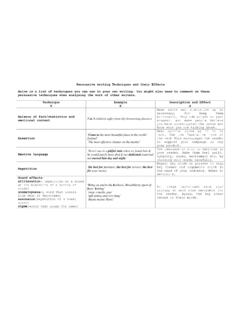
9 RESOURCES AND MATERIALS: Several ads from popular magazines Manila folders containing ads using various Persuasive techniques for groupactivity Individual Student Handouts of Persuasive Techniques chart Overhead Transparency of Persuasive Techniques Reflective notebookTEACHING STRATEGIES AND ACTIVITIES: Writer s NotebookWhat does it mean to persuade someone? List several methods one might employ topersuade another. Explain how these methods might be effective in the art of persuasion? ShareInvite students to share their thinking. As they do, list key ideas and/or concepts ofpersuasion students mention on the overhead or student-generated ideas, guide students toward the following explanation ofpersuasive Writing : Persuasion is about convincing the reader or listener to think or act in a certain way. High School Persuasive WritingHigh School Persuasive Reading8 Mini Lesson: Emotional Appeals (Distribute copies of Persuasive Techniques chart) Perhaps the first step to understanding persuasion is to recognize the role it plays in oureveryday lives.
10 Advertisers attempt to persuade consumers each day using a variety oftechniques known as emotional appeals. 1. Review chart with One-by-one, hold up several different ads using various emotional appeals whileasking your students to state which technique(s) they think are at play in the them to refer to the chart. Divide the class into groups of three. Give each group a manila folder of pre-selectedads. As the groups examine the ads, they are to identify specific examples ofpersuasive techniques depicted in the ads. After adequate time, ask groups to select a reporter to share the ads and the group sidentification of Persuasive techniques used in them. Writer s NotebookReturn to whole class. Refer students back to the purpose of persuasion. Invitestudents to compose a reflection on one of the ads they looked at, using the followingprompt: Explain what the ad was attempting to get the viewer to do.