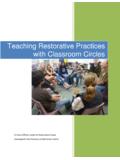
Transcription of Teaching Restorative Practices with Classroom Circles
1 Amos Clifford, Center for Restorative Process Developed for San Francisco Unified School District Teaching Restorative Practices with Classroom Circles Teaching Restorative Practices with Classroom Circles ii Table of Contents Introduction: Teaching Restorative Practices with Classroom Circles .. 1 Part One: Restorative Practices and the Skills of Circle Keeping .. 3 Restorative Community in the Classroom .. 4 Goals for Students .. 4 Goals for Teachers .. 5 Goals for Classroom Community .. 5 What is Restorative Justice? What are Restorative Practices ? .. 6 Evolution of a Restorative Classroom and School Climate .. 8 Circle Dialogue and Circle Keeping .. 9 The Shape of the Circle .. 9 Every Voice Heard: How to Use the Talking Piece .. 10 A Circle Keeper s Toolkit .. 11 Focus the Circle with High-Quality Prompting Questions.
2 12 The Circle has a Center .. 13 Respecting Each One s Experience: The Principle of Non-Interference .. 13 Building Trust in the Circle .. 14 Guidelines are Cornerstones of Trust .. 16 Agreements are Also Cornerstones of Trust .. 17 Mandated Reporting, Agreements, and Trust .. 17 Community Building (Proactive) and Response to Harms: Two Circle Themes .. 18 Sequence of Events in a Circle .. 19 Part Two: Varieties of Circle Formats and Circles for Building Community .. 21 Varieties of Circle Formats .. 21 Basic Circle .. 21 Popcorn Circle .. 21 Fishbowl (Witness) Circle .. 22 Spiral Circle .. 22 Feedback 22 Wheelhouse Circle .. 22 Small Group/Student Circle Leaders .. 22 Building Connections, Building Community .. 23 Teaching Restorative Practices with Classroom Circles iii Goals for Community-Building Circles .. 23 Implicit Questions of Connection.
3 23 Basic Connection: The Check-in Round .. 24 Responsive Circle .. 24 Story of the Day .. 24 Something Special .. 25 The Guest House Circle .. 26 Loving the Questions Circle .. 27 Thanksgiving Circle .. 28 Energy Management: Calming Activities .. 29 Part Three: Restorative Circles in the Classroom : Teaching Skills and Setting Things Right .. 30 Teaching Restorative Concepts and Dialogue: Overview of the Teaching Circles .. 31 Lesson 1 Overview Introduction to Circles .. 32 Lesson Plan 1 Introduction to Circles .. 33 Lesson 2 Overview Agreements .. 37 Lesson Plan 2 Agreements .. 38 Lesson 3 Overview Restorative Justice and the Chips Scenario .. 41 Lesson Plan 3 Restorative Justice and the Chips Scenario .. 42 Lesson 4 Overview The Issues that Affect Us .. 47 Lesson Plan 4 The Issues that Affect Us .. 48 Lesson 5 Overview Fishbowl Circle Discussions.
4 51 Lesson Plan 5 Fishbowl Circle Discussions .. 52 Using Punitive and Restorative Approaches Together .. 57 Lesson 6 Overview Exploring Conflicts, Expressing Affection .. 58 Lesson Plan 6 Exploring Conflicts, Expressing Affection .. 59 Lesson 7 Overview Maintaining Our Community .. 62 Lesson Plan 7 Maintaining Our Community .. 63 1 Introduction: Teaching Restorative Practices with Classroom Circles Because of our class Circles , students accepted more responsibility for their roles in both creating and solving the problems. It became much easier to encourage students to solve their problems themselves; in part because I gained more confidence that students had the skills to do so, but also in part because of how the project shifted the way I communicate with my students. --Fourth Grade Teacher his manual supports the Teaching of Restorative Practices and skills in your Classroom .
5 Restorative Practices are a framework for building community and for responding to challenging behavior through authentic dialogue, coming to understanding, and making things right. This manual describes how to hold Restorative Circles in classrooms. It contains step-by-step instructions for Circles that build community, teach Restorative concepts and skills, and harness the power of Restorative Circles to set things right when there is conflict. Using these methods consistently will help to create calmer, more focused classrooms. Teachers who use these methods often find that the overall proportion of time dedicated to managing behavior is reduced. This means more instructional time becomes available. It also means that students (and teachers) have happier, more peaceful experiences of their school Restorative thinking is a significant shift from punishment-oriented thinking.
6 People, including students, who are invited into Restorative dialogue are sometimes confused by the concept of making things right. Their default response to the question What can we do to make things right? often has to do with punishment. It is said that children live what they learn. When what they have learned is that troublesome behavior demands a punishment-oriented response that is how they will live. But Restorative Practices invite different ways of responding. These new ways must be learned through experience. The activities in this manual give students the necessary experiences to support a shift toward Restorative ways of thinking and behaving. 1 One of the best resources for research on Restorative Practices is the International Institute of Restorative Practices , online at T Teaching Restorative Practices with Classroom Circles 2 Restorative Justice brings persons harmed by crime and the person who harmed them, along with affected family and community members, together in dialogue that aims to build understanding, explore how the crime has impacted those involved, including the community, and develop agreements for what will be done to make things right.
7 The result: truly meaningful justice for all involved. These dialogues take place with participants sitting in circle, so they are sometimes called circle dialogues. Like students, teachers and administrators also find it challenging to make the shift to Restorative ways of thinking. Even when we understand the value and concepts of Restorative justice, it can be very difficult to move from theory to practice. This manual invites those who lead the lessons it describes teachers and other adults in the room to also be participants, to use the methods themselves to experience Restorative Practices . The activities in this manual have been shaped by students who showed up in Circles in ways that were brilliant, touching, and inspired. Each activity has gone through several iterations of development, and we encourage you to modify them as well.
8 Adapting them to your Teaching style and the needs and circumstances of your students and your school, is completely in the spirit of Restorative justice, which seeks above all to do what is right in the particular circumstances where it is used. If something in here doesn t feel quite right to you, modify it; make it right. It is our hope that your time in circle with these activities will help deepen your understanding of Restorative Practices . We hope you will find that after you work through a dozen or so of these activities you will see significant results. We wish you success as you work to build a positive, supportive, friendly and just Classroom environment. Classroom Circles are the foundation of this process. Teaching Restorative Practices with Classroom Circles 3 Part One: Restorative Practices and the Skills of Circle Keeping Restorative Practices build community and can help set things right when the integrity of the community is challenged by harmful behaviors.
9 When people come together for Restorative interactions they sit in Circles . Circle dialogue is a fundamental element of Restorative dialogue. Classroom Circles support the two main goals of Restorative Practices : building community; and responding to harms through dialogue that sets things right. Teaching Restorative Practices with Classroom Circles 4 Restorative Community in the Classroom Restorative Practices cultivate a culture in which everyone feels like they belong. They build a particular sense of community in which every member--students, teacher, parent volunteers, aides--feel that they are seen, heard, and respected. The activities in this manual are sequenced to support steady growth in the understandings and skills needed to support authentic dialogue and problem solving. They emphasize fairness through understanding, and including everyone who is immediately affected by challenging circumstances in discovering the solutions.
10 Goals for Students 1. Students will learn to value and regularly use pro-active, positive ways to build and maintain a peaceful Classroom community. 2. Students will develop and enhance positive and supportive connections with peers. 3. Students will develop an understanding of the principles and vocabulary of Restorative justice. 4. Students will learn how to participate in circle dialogues, including the four circle guidelines. 5. Students will learn to use and respect a talking piece. 6. Students will learn how to use Restorative questions to support conflict resolution and other types of communication. 7. Students will learn to identify who is affected by misbehaviors, and how. 8. Students will contribute to developing appropriate ideas for how to make things right when harms have occurred. 9. Students will learn how and when to ask for a Restorative circle.