Transcription of Technical Bulletin - Vecom
1 Number: 2005/18 November 2005 SURFACE FINISHING STAINLESS STEEL IN THE FOOD & PHARMACEUTICAL INDUSTRIES Introduction Stainless steel is the most favoured material in the food and pharmaceutical industries. Whatever grade of stainless steel is specified, the surface finish is most important and yet sometimes neglected. A smooth surface results in less dirt adhesion and therefore less bacteria and is easier to clean. This means less chance of corrosion. After equipment has had many years of use and standards of cleanliness need to be maintained, refurbishment work on older plant and validation certification are increasingly requested in today s market. Mechanical surface preparation The first step may be mechanical polishing to bring the surface to a higher standard.
2 Progressive, multi directional mechanical polishing is most important, working from a 180 grit to 240 grit to 320 grit to achieve a step-by-step uniform finish. The use of compounds to provide a final smooth shiny finish should be avoided as this only embeds deposits, which will later have to be removed. The right finish Badly polished material can have an inferior corrosion resistance to the original 2B. The microscopic ledges created by a coarse polish can harbour dirt, which will cause staining, initiate corrosion sites and produce consistently poor swab results. This is not a problem in mild conditions, but research, using accelerated salt spray tests, has shown that an Ra value (roughness) of no more than can be tolerated. A finish of Ra is considered a benchmark, with some pharmaceutical vessels specified with an Ra of electropolished.
3 Welding / Fabrication When stainless steel is welded, a scale is formed and on either side is a heat-affected zone, which may show a blue/straw colour. This area is rich in metal oxides that possess very little corrosion resistance and will readily corrode. This effect is reduced by the use of correct backing gas procedures. When controls are not achieved, or the level of corrosion resistance needs to be optimized, then the pipes and bends should be pickled and passivated (see also TB 2005-11). Iron contamination A major cause of corrosion in service is iron contamination, which can arise from a variety of sources. These include using tools made of carbon steel or abrasives that contain iron and any tool that has previously been used on non stainless steel.
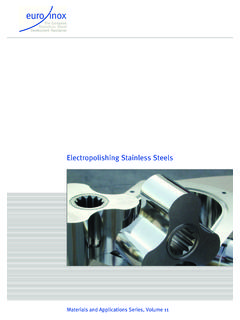
4 Cross contamination can also arise from grindings and debris created whilst working close by on steel, either in the workshop, or on site. Chemical surface treatments are necessary to remove these deposits. Technical Bulletin electropolishing As part of the restoration process, the entire vessel or specific items can be electropolished to restore critical area surface cleanliness. electropolishing is limited to items that can be removed off site as electropolishing on site often involves considerable logistical problems, which may only be cost effective on larger projects. (See for more information about electropolishing TB 2004-08). Cleanliness Internals After fabrication and assembly, a final on site cleaning may be requested before commissioning.
5 This will serve to remove all traces of grease and iron contamination. An acid or alkaline based detergent will be circulated through the pipelines and spray balls on the vessels, followed by a passivation treatment with either Nitric or Citric Acid. This procedure is often carried out by specialist companies who will conduct a site survey to determine flow directions and prepare a Method Statement and Risk Assessment. Some sensitive items of equipment will have to be removed or bypassed. The use of off line pumps may be suggested, although many CIP systems will have adequate pumping capabilities. Once rigged up with temporary pumps, hoses and circulation tanks, a pressure test is carried out to verify the system integrity. After cleaning, the waste acid and acidic rinse water will be disposed of through an authorised waste disposal company.
6 Externals For a final clean, an acid based cleaner such as Vecinox Stainless Steel Cleaner will remove light oil and grease marks, watermarks and scuffmarks from footwear. It will restore a shiny finish. Vecom can carry out mechanical polishing, electro polishing, pickling, passivation, on site cleaning and waste water treatment. Author: Aylott (Manager Vecom UK) Reactions and/or questions: e-mail: You will find Vecom in the Netherlands (Maassluis, Rotterdam, Bergen op Zoom, Heerlen, Enschede, Hoogezand) - Belgium (Ranst, Mouscron) - Germany (Hamburg, Wetzlar) - United Kingdom (Bury, Barnsley, Sheffield) and Denmark (L sning)