Transcription of Technical Information - ClassNK
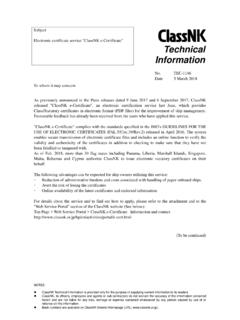
1 NOTES: ClassNK Technical Information is provided only for the purpose of supplying current Information to its readers. ClassNK , its officers, employees and agents or sub-contractors do not warrant the accuracy of the Information contained herein and are not liable for any loss, damage or expense sustained whatsoever by any person caused by use of or reliance on this Information . Back numbers are available on ClassNK Internet Homepage (URL: ). Subject Technical Information Amendment to the ClassNK Rules and Guidance related to computer based systems No. TEC-1145 Date 28 February 2018 To whom it may concern ClassNK has informed the requirements related to computer based systems by ClassNK Technical Information TEC-1114 issued on 16 June 2017. After issuing of the Technical Information , ClassNK reviewed the contents of the Technical Information and has issued TEC-1145 alternatively.
2 The ClassNK Technical Information TEC-1114 is revoked by this Technical Information . IACS UR E22( ) specifies requirements related to composition and function of computer based systems used for machinery systems such as monitoring systems. These requirements have already been incorporated to Rules and Guidance of NIPPON KAIJI KYOKAI (hereinafter referred as "the Society"). Since the necessity for security measures which reduce risks specific to computer based systems such as computer viruses has been increasing in recent years, IACS discussed way to clarify requirements and adopted UR E22( ) in June 2016, which specifies responsibilities of stakeholders, security measures for software (SW) and hardware (HW) and quality management for said systems. Accordingly, relevant requirements in the Society's Rules and Guidance were amended and what concerned organizations shall address are informed.
3 [Summary of Rules] These rules apply to SW and HW for automatic or remote control systems. Additional test or type approval* may be required for the SW and the HW up to effect of their failures. The effect is defined with three categories and the requirements under each category are applied accordingly. Furthermore, responsibilities and roles of owner, system integrator and supplier to comply with the rules are set out. In particular, system integrator is a new assigned stakeholder and shall take a responsibility of integrating systems. However, in case where any system integrator is not assigned, shipyard shall take the roles during construction. 1. System Categories Computer based systems shall be assigned category III, II or I in accordance with and Table of Annex , Part D of the Guidance for the Survey and Construction for Steel Ships. (To be continued) ClassNK Technical Information No.
4 TEC-1145 2 Table System categories in Annex , Part D of the Guidance for the Survey and Construction for Steel Ships Category Effects Typical system functionality I Those systems, failure of which will not lead to dangerous situations for human safety, safety of the vessel and/or threat to the environment. - Monitoring function for informational or administrative tasks II Those systems, failure of which could eventually lead to dangerous situations for human safety, safety of the vessel and/or threat to the environment. - Alarm and monitoring functions - Control functions which are necessary to maintain the vessel in its normal operational and habitable conditions III Those systems, failure of which could immediately lead to dangerous situations for human safety, safety of the vessel and/or threat to the environment. - Control functions for maintaining the vessel s propulsion and steering - Vessel safety functions While the concept of these categories has already been incorporated into the rules, machinery and systems to which the rules are applied are added due to the amendments.
5 Examples of systems assigned category III or II are shown in the Notes of the Table. Further, following machinery and systems are generally assigned category III or II. Category III System Examples of detailed machinery and system Main propulsion systems Engine control system, Engine remote control system, Main boiler control system, CPP control system, Electric propulsion control system Steering system control systems Steering system, Azimuth thruster Electric power systems Generator engine control system, Electric power converter (for electric propulsion ship , etc.) Safety systems Fire detection and fighting system, Flooding detection and fighting system, Internal communication system, System involved in operation of life saving appliances equipment Other systems Dynamic positioning system, Drilling system Category II Liquid cargo transfer control systems Cargo control system ( cargo control console, cargo valve remote control system, cargo machinery emergency shut-down system), Reliquefaction system, Inert gas generator (including nitrogen generator), Oil discharge monitoring and control system Fuel oil treatment systems Viscosity control system, Fuel oil purifier (To be continued) ClassNK Technical Information No.
6 TEC-1145 3 Stabilization and ride control systems Fin stabilizer, Jetfoil Alarm and monitoring systems for propulsion systems Engine alarm and monitoring system (including data logger) Other systems Ballast transfer valve remote control system, Oily water separator, Oil content meter, Waste oil incinerator, Sewage treatment plant, Aux. boiler control system, Ballast water treatment system, SOx/NOx scrubber, NOx exhaust gas recirculation system The above machinery/systems are examples and the other computer based systems not listed above may be subject to the rules. Therefore, as for the other machinery/systems, system category is to be confirmed to the Society individually. 2. Roles of Stakeholder In the amended rules, each stakeholder shall be assigned as owner, system integrator or supplier and their responsibilities, roles, etc. are generally set out. As for details of the roles and the stakeholder to be assigned, contents mentioned in to shall be followed in principle.
7 System Integrator (before delivery) It is defined that system integrator is responsible for the integration of systems and products into the system and providing the integrated system. Before delivery of vessels, system integrator shall be assigned in case where several systems intercommunicated and controlled one another are to be integrated or one integrated system controlling several systems is existing ( fuel gas control system on LNG carriers (fuel gas return valve control system, GCU/main boiler fuel gas control system, etc.)), and owner or shipyard nominates some organization as system integrator ( manufacturer of integrated system) as found necessary. Otherwise, suppliers (manufacturer in general) shall provide/install their own systems on board. Assigned system integrator shall manage suppliers of system/machinery and address followings: - To confirm if systems/machinery are type-approved and require suppliers to obtain type approval and submit necessary documents - To submit documents and test procedures listed in the attached table - To carry out onboard testing in final integrated environment - To take over necessary documents, Information , etc.
8 To owner ( list of computer based systems and risk assessment report as requested by owner) Shipyard In general, shipyard should be owner before delivery of vessel and make contract with each supplier. Further, shipyard is requested to make a list of computer based systems upon confirming to suppliers and submit it to the Society. Category of each machinery/system is also specified in the list after discussing with each supplier and machineries/systems assigned category I are included. (To be continued) ClassNK Technical Information No. TEC-1145 4 In case where system integrator (before delivery) is not assigned by owner, shipyard is to take the role of system integrator and address followings: - To confirm if systems/machinery are type-approved and require suppliers to obtain type approval and submit necessary documents - To submit test procedure and carry out onboard testing in final integrated environment (in case where several systems intercommunicated and controlled one another are to be integrated, one integrated system controlling several systems is existing, etc.)
9 - To take over necessary documents, Information , etc. to owner ( list of computer based systems and risk assessment report as requested by owner) Supplier As mentioned in Part 1., machinery/systems to which the rules are applied are added such that machinery/systems for which type approval or product test at shop has not been required may newly obtain type approval or pass product test. Suppliers of system/machinery assigned category III or II finally shall address followings: - To apply for type approval - To submit documents and test procedures listed in the attached table - To carry out shop test in the presence of the Surveyor - To carry out simulation test before final integration on board (simulation test to check safe interaction with all other systems is to be carried out before integration on board (at shop or on board)) As for machinery/systems assigned category I, the above are not required and no additional action is necessary.
10 In the rules, it is specified that the exact category is dependent upon the risk assessment for all operational scenarios. Therefore, regardless of examples in Part 1., in case where supplier considers that system/machinery is to be assigned category I upon analysing detailed control system, failure effect, etc., risk assessment report to determine category is to be submitted. In case where the risk assessment report is accepted by the Society, no additional action is necessary. Further, the risk assessment report is to be submitted in case where machinery/system is to be provided with NK class vessel for the first time and it is not necessary to be re-submitted for following NK class vessels in case where control system and risk assessment result for machinery/system as well as relevant machinery/system are unchanged up to differences of specification for each vessel.