Transcription of Technical R-508B Guidelines - Refrigerants
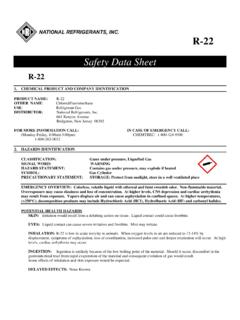
1 R-508B Safety Data Sheet R-508B 1. CHEMICAL PRODUCT AND COMPANY IDENTIFICATION PRODUCT NAME: R-508B OTHER NAME: Trifluoromethane, Hexafluoroethane USE: Refrigerant Gas DISTRIBUTOR: National Refrigerants , Inc. 661 Kenyon Avenue Bridgeton, New Jersey 08302 FOR MORE INFORMATION CALL: IN CASE OF EMERGENCY CALL: (Monday-Friday, 8:00am-5:00pm) CHEMTREC: 1-800-424-9300 1-800-262-0012 2. HAZARDS IDENTIFICATION CLASSIFICATION: Gases under pressure, Liquefied Gas SIGNAL WORD: WARNING HAZARD STATEMENT: Contains gas under pressure, may explode if heated SYMBOL: Gas Cylinder PRECAUTIONARY STATEMENT: STORAGE: Protect from sunlight, store in a well ventilated place POTENTIAL HEALTH HAZARDS Inhalation of high concentrations of vapor is harmful and may cause heart irregularities, unconsciousness, or death.
2 Intentional misuse can be fatal. Vapor reduces oxygen available for breathing and is heavier than air. Liquid contact can cause frostbite. HUMAN HEALTH EFFECTS: Human health effects of overexposure by inhalation may include nonspecific discomfort such as nausea, headache, or weakness; temporary nervous system depression with anaesthetic effects such as dizziness, headache, confusion, incoordination, and loss of consciousness; or with gross overexposure, possibly temporary alteration of the heart s electrical activity with irregular pulse, palpitations, or inadequate circulation. Individuals with preexisting diseases of the central nervous or cardiovascular system may have increased susceptibility to the toxicity of excessive exposure.
3 Eye or skin contact with the liquid may cause frostbite. CARCINOGENICITY INFORMATION: None of the components present in this material at concentrations equal to or greater than are listed by IARC, NTP, OSHA or ACGIH as a carcinogen. 3. COMPOSITION / INFORMATION ON INGREDIENTS INGREDIENT NAME CAS NUMBER WEIGHT % Trifluoromethane 75-46-7 30-50 Hexafluoroethane 76-16-4 50-70 R-508B _____ SDS: R-508B Page 2 of 5 Current Issue Date: May 2018 COMMON NAME and SYNONYMS R-508B ; HFC508B There are no impurities or stabilizers that contribute to the classification of the material identified in Section 2 4.
4 FIRST AID MEASURES SKIN: Flush with water. Treat for frostbite if necessary. EYES: Flush with water. Call a physician if frostbite occurs. INHALATION: IF HIGH CONCENTRATIONS ARE INHALED: Immediately remove to fresh air. Keep persons calm. Call a physician. If not breathing, give artificial respiration. If breathing is difficult, give oxygen. INGESTION: Ingestion is not considered a potential route of exposure. NOTES TO PHYSICIAN: Because of possible disturbances of cardiac rhythm, catecholamine drugs, such as epinephrine, should be considered only as a last resort in life-threatening emergencies. 5. FIRE FIGHTING MEASURES FLAMMABLE PROPERTIES FLASH POINT: Will not burn FLAMMABLE LIMITS IN AIR, % BY VOLUME LEL: Not Applicable UEL: Not Applicable FIRE AND EXPLOSION HAZARDS: Use water spray or fog to cool containers.
5 Cylinders are equipped with temperature and pressure relief devices but may still rupture under fire conditions. Decomposition may occur, producing HF, CO and possibly COF2. EXTINGUISHING MEDIA: Use media appropriate for surrounding material. FIRE FIGHTING INSTRUCTIONS: Self-contained breathing apparatus (SCBA) is required if cylinders rupture or release under fire conditions. Water runoff should be contained and neutralized prior to release. 6. ACCIDENTAL RELEASE MEASURES SAFEGUARDS (Personnel) NOTE: Review FIRE FIGHTING MEASURES and HANDLING (PERSONNEL) sections before proceeding with clean- up. Use appropriate PERSONAL PROTECTIVE EQUIPMENT during clean up.
6 ACCIDENTAL RELEASE MEASURES Material evaporates at atmospheric pressure (vaporizes). Ventilate area especially low places where heavy vapors might collect. Remove open flames. R-508B _____ SDS: R-508B Page 3 of 5 Current Issue Date: May 2018 7. HANDLING AND STORAGE HANDLING (Personnel): Avoid contact with liquid with eyes and prolonged skin exposure. Use with sufficient ventilation to keep employee exposure below recommended limits. STORAGE: Clean, dry area. Do not heat above C (125 F) INCOMPATIBILITIES: Freshly abraded aluminum surfaces at specific temperatures and pressures may cause a strong exothermic reaction.
7 Chemically reactive metals: potassium, calcium, powdered aluminum, magnesium, and zinc. 8. EXPOSURE CONTROLS / PERSONAL PROTECTION ENGINEERING CONTROLS: Normal ventilation for standard manufacturing procedures is generally adequate. Local exhaust should be used when large amounts are released. Mechanical ventilation should be used in low places. PERSONAL PROTECTIVE EQUIPMENT Neoprene rubber or leather gloves should be used when handling liquid. Chemical splash goggles should be worn when handling liquid. Under normal manufacturing conditions, no respiratory protection is required when using this product. Self- contained breathing apparatus (SCBA) is required if a large spill or release occurs.
8 EXPOSURE Guidelines INGREDIENT NAME ACGIH TLV OSHA PEL OTHER LIMIT Trifluoromethane None None *1000 ppm TWA (8 & 12hr) Hexafluoroethane None None *1000 ppm TWA (8 & 12hr) * = Workplace Environmental Exposure Level (AIHA) 9. PHYSICAL AND CHEMICAL PROPERTIES PHYSICAL DATA COLOR: Clear, colorless FORM: Liquefied Gas ODOR: Slight ethereal BOILING POINT: -88 C (-126 F) VAPOR DENSITY: (Air = ) % VOLATILES: 100 WT % ODOR THRESHHOLD: Not established FLAMMABILITY: Not applicable LEL/UEL: None/None RELATIVE DENSITY: g/cm3 at 25 C PARTITION COEFF (n-octanol/water) Not applicable AUTO IGNITION TEMP: Not Determined DECOMPOSITION TEMPERATURE.
9 >250 C VISCOSITY: Not applicable R-508B _____ SDS: R-508B Page 4 of 5 Current Issue Date: May 2018 10. STABILITY AND REACTIVITY CHEMICAL STABILITY: Material is stable. However, avoid open flames and high temperatures. DECOMPOSITION: This product can be decomposed by high temperatures (open flames, glowing metal surfaces, etc.) forming HF, COF2 or CO. These materials are toxic and irritating. Contact should be avoided. POLYMERIZATION: Polymerization will not occur. 11. TOXICOLOGICAL INFORMATION ANIMAL DATA TRIFLUOROMETHANE: LC50 : Inhalation 4 hr.
10 (rat) - > 663,000 ppm Material is untested for skin and eye irritancy, and for animal sensitization. Effects from single high inhalation exposure to Trifluoroemethane include anaesthetic effects, and nonspecific effects such as weight loss were observed at concentrations >22%. No cardiac sensitization was observed in dogs after breathing 800,000 ppm for periods of 5-10 minutes following epinephrine challenge. In another test, dogs exposed to up to 30% or up to 50% (with additional oxygen), had no positive responses. No cardiac sensitization occurred in baboons exposed by inhalation to 10%, 30%, 50%, 70% Trifluoromethane before or after an epinephrine challenge; there was a dose-related decrease in heart rates and differences in respiratory rates during exposure.