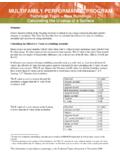
Transcription of Technical Topic – New Buildings Calculating the U …
1 This information is provided as a summary to the Technical topics discussion in November 2008 MULTIFAMILY PERFORMANCE PROGRAMT echnical Topic New Buildings Calculating the U-value of a Surface Summary Proper characterization of the building envelope is critical to any energy reduction plan that includes changes in insulation. This Tech Tip describes how to calculate the effective U-value of a building assembly and discusses de-rating insulation. Calculating the Effective U-Value of a building Assembly Many people are more familiar with R-values than with U-values because insulation comes labeled with R-value ratings. R-value expresses the resistance to heat transfer. The U-value is the rate of heat transfer per unit area per degree of temperature difference, and is the inverse of the R-value. That is, U=1/R and R=1/U. If different cross-sections through a building assembly such as a wall, roof, or floor have different R-values, the effective R-value for that surface must be calculated by first Calculating the U value of each different cross-section.
2 TREAT and eQuest offer libraries with R-values for different building surfaces. Here is how those R-values can be calculated for a wood frame stucco wall with nominal 2 x 4 framing, fiberglass batt insulation. The R-value at a cross-section through the insulation is higher than the R-value of the insulation itself: Material R value1 Outside air film2 Stucco Gypsum board Batt insulation (nominal rating) Gypsum board Inside air film2 Total R U value The R-value of a cross-section at the framing is lower than the R-value of the insulation. Material R value1 Outside air film2 Stucco Gypsum board wood (nominal 2 x 4 ) Gypsum board Inside air film2 Total R U value 1 R-values for insulation and building materials can be found in ASHRAE Fundamentals as well as many sources on the Internet.
3 2 Different modeling tools handle air films differently. For TREAT, calculate R-values without interior or exterior air films, as they will be added later. For eQuest, omit the exterior air film from your calculation. For other tools, consult your manual. This information is provided as a summary to the Technical topics discussion in November 2008 MULTIFAMILY PERFORMANCE PROGRAMT echnical Topic New Buildings Calculating the U-value of a Surface Assume (per ASHRAE ) that the studs, plates, sills and headers are 25% of the total area of a wood-framed wall, while the cavity insulation is 75% of the total area. The effective U-value of this wall assembly would be calculated as: Effective U-value = ( x ) + ( x ) = The effective R-value for the wall assembly is 1 = 10, lower than the nominal R-value of the insulation. ASHRAE Standard contains a series of tables that show the effective R-value of different wall, roof, and floor assemblies, including both cavity and continuous insulation.
4 If you are considering a building whose construction is not described in the TREAT or eQuest libraries or the ASHRAE Standard tables, you can calculate its R-value using the procedure described previously. ASHRAE Fundamentals contains R-values for many building materials; these values are also widely available on the Internet. In addition, Oak Ridge National Laboratory offers free R-value calculation software at +walls/AWT/ Assumptions about the fraction of the total surface area that is insulated (compared to the fraction that consists of framing members) have a large effect on the effective U-value of the surface. According to Oak Ridge National Laboratory (ORNL), framing factors such as studs, wall/wall (corners), wall/roof, wall/floor, wall/door, and wall/window connections can occupy 10% to 40% of the wall area. Appendix A of ASHRAE recommends the following assumptions for wood-framed Buildings .
5 Construction type Material % of surface area Attic roof with wood joists, Standard framing (insulation tapers at perimeter) Full-depth insulation Half-depth insulation Joists 85% 5% 10% Attic roof with wood joists, Advanced framing Full-depth insulation Joists 90% 10% Single-rafter roof (ceiling and roof attached to the same rafter) Full-depth insulation Joists 90% 10% Wood-framed walls, Standard framing (16 on center) Insulated cavity Studs, plates and sills Headers 75% 21% 4% Wood-framed walls, Advanced framing (24 on center) Insulated cavity Studs, plates and sills Headers 78% 18% 4% This information is provided as a summary to the Technical topics discussion in November 2008 MULTIFAMILY PERFORMANCE PROGRAMT echnical Topic New Buildings Calculating the U-value of a Surface Metal Wall Studs The attached table, reproduced from ASHRAE Standard , Appendix A presents measured R-values for wall insulation installed between steel framing.
6 Metal framing presents a special situation because of metal s high thermal conductivity. To calculate the overall U value for a wall with metal studs, use the R-value from this table and add the R-values of the rest of the wall assembly ( masonry, interior gypsum board, interior and exterior airfilms), using the procedure described previously. The table below excerpts ASHRAE Standard , Appendix A, Table , which provides measured R-values for metal framed roofs. As with metal-framed walls, you should add the R-values of air films and construction materials to this base value. Effective Insulation/Framing Layer R-Values for Roof and Floor Insulation Installed Between Metal Framing (4 ft on center) Rated R-value of Insulation Framing/Cavity R-Value 55 If your insulation is an intermediate R-value between those provided in the table, it is legitimate to interpolate between the framing/cavity R-values shown in the table.
7