Transcription of TeenScreen Primary Care
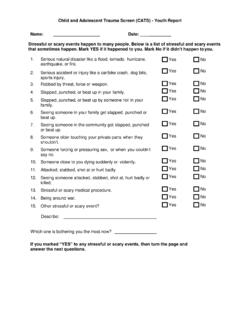
1 TeenScreen Primary Care Screening Questionnaire OverviewPSC-Y, PHQ-9, CRAFFTTe enScre en Pr imary CareTeenScreen Pr imary Care1 This document is designed to provide additional information about the screening questionnaires offered through TeenScreen Primary Care. Information about administering, scoring, interpreting the screening results, the psychometrics and research references are provided for each of the questionnaires offered through TeenScreen Primary Contents1 Pediatric Symptom Checklist for Youth (PSC-Y) A broad mental health checkup Health Questionnaire Modified for Teens (PHQ-9 Modified) depression screening Substance use screening questionnaire .. 72 Pediatric Symptom Checklist (PSC-Y)OverviewThe Pediatric Symptom Checklist for Youth (PSC-Y) is a 35-item self-completion screening questionnaire designed to detect a broad range of behavioral and psychosocial problems in youth.
2 It includes questions that focus on internalizing, externalizing and attention problems. Two additional questions regarding suicidal thinking and attempts have been added to the PSC-Y. The questionnaire takes less than five minutes to complete and score, and it can be scored by a nurse, medical technician or other office staff prior to the patient s exam with the Primary care provider (PCP).AdministrationIt is recommended that parents are informed that a mental health checkup will be administered as part of the exam. In order to obtain honest answers, patients should be left alone to complete the PSC-Y in a private environment and should be informed of their rights regarding confidentiality before the questionnaire is PSC-Y comes in the form of a tear-off pad and is available in both English and Spanish.
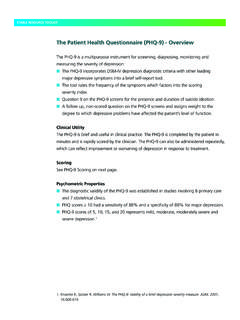
3 You may choose to distribute a copy of the questionnaire to patients in the waiting or exam room as the patient comes in for their appointment. 3 Scoring and Interpreting the ResultsBelow are the scoring instructions for the PSC-Y:PSC-Y Psychometric CharacteristicsPSC-Y Prevalence: 14% of 13-18 year olds in a school-based health center located in a small city scored positive on the PSC-Y. 20% of 9-14 year olds in an inner-city public school scored positive on the Prevalence: 3% of 11-18 year olds endorsed the suicide ideation question added to the PSC-Y in a Primary care sample. 2% of 11-18 year olds endorsed the suicide attempt question added to the PSC-Y in a Primary care Psychometrics: 94% Sensitivity 88% Specificity 12% False Positive 6% False Negative Patient Health Questionnaire Modified for Teens (PHQ-9 Modified)OverviewThe PHQ-9 Modified for Teens is a 13-item self-completion screening questionnaire designed to detect symptoms of depression and suicide risk in adolescents.
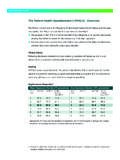
4 In addition to the 9 core items that ask about symptoms of depression , there are two items that inquire about the severity of symptoms (or impairment) and two additional items that ask about suicide risk. The questionnaire takes less than five minutes to complete and score, and it can be scored by the doctor, nurse, medical technician or other office staff prior to the patient s exam with the PCP. The PHQ-9 Modified is derived from the PHQ-9 that is used for adults. Both the American Academy of Pediatrics and the Preventive Services Task Force recommends that depression screening be conducted is recommended that parents are informed that depression screening will be administered as part of the exam. In or-der to obtain honest answers, patients should be left alone to complete the PHQ-9 Modified in a private environment and should be informed of their rights regarding confidentiality before the questionnaire is PHQ-9 Modified comes in the form of a tear-off pad and is available in both English and Spanish.
5 You may choose to distribute a copy of the questionnaire to patients in the waiting or exam room as the patient comes in for their and Interpreting the ResultsBelow are the scoring instructions for the PHQ-9 Modified:PHQ-9 Psychometric CharacteristicsThe PHQ-9 Modified offered through TeenScreen Primary Care is a version of the adult PHQ-9 that has been slightly adapted (see below under Important Information). The adult version of the PHQ-9 has been studied and demonstrated good criterion and construct validity among adolescents, with high levels of sensitivity and specificity in this age group. A PHQ-9 score of > 11 has the following sensitivity and specificity for detecting youth meeting DSM-IV criteria for major depression in the prior month1: Sensitivity Specificity False Positive False Negative1 Richardson, , McCauley, E.
6 , Grossman, , McCarty, , Richards, J., Russo, , Rockhill, C., Katon, W. (2010). Evaluation of the Patient Health Questionnaire-9 Item for Detecting Major depression Among Adolescents. Pediatrics, November 1, Information:Diagnostic criteria for a major depressive episode are slightly different for adults and children or adolescents in the DSM-IV-TR. In addition to the symptoms presented by adults, adolescents may experience irritability, and failure to meet expected weight gains should be considered. The PHQ-9 Modified is a version of the adult PHQ-9 that has been adapted to reflect these symptomatologic differences. The PHQ-9 Modified item 1 includes the assessment of irritable mood and item 4 includes weight loss. These modifications are minor and do not involve symptom recent study has shown that the adult version of the PHQ-9 has satisfactory psychometric properties in adolescents (Richardson et al.)
7 , 2010). To date, no study has published psychometric data on the PHQ-9 Modified. However, as the PHQ-9 and PHQ-9 Modified are identical with the exception of 2 additional symptoms added to the PHQ-9 Modified version (in Questions 1 and 4), it is reasonable to apply cutoff scores derived from the PHQ-9 in an adolescent CR A FFT is a brief substance and alcohol use screening questionnaire that can be used in conjunction with the other mental health screening questionnaires offered by TeenScreen Primary Care. The CR A FFT is recommended by the American Academy of Pediatrics Committee on Substance A buse for use with adolescents, ages 11-21. The questionnaire takes less than five minutes to complete and score, and it can be scored by the doctor, nurse, medical technician or other office staff prior to the patient s exam with the PCP.
8 AdministrationIt is recommended that parents are informed that a behavioral health screening questionnaire will be administered as part of the exam. In order to obtain honest answers, patients should be left alone to complete the CR A FFT in a private environment and should be informed of their rights regarding confidentiality before the questionnaire is CRAFFT comes in the form of a tear-off pad and is available in both English and Spanish. You may choose to distribute a copy of the questionnaire to patients in the waiting or exam room as the patient comes in for their appointment. 7 Scoring and Interpreting the ResultsBelow are the scoring instructions for the CR AFFT:CR AFFT Psychometric CharacteristicsThe CR A FFT screening questionnaire is a valid means of screening adolescents for substance-related problems and disorders, which may be common in some general clinic populations.
9 The following was taken from the CR A FFT s validation study conclusions:A CRAFFT score of 2 or higher was optimal for identifying any problem (sensitivity, ; specificity, ; positive predictive value, ; and negative predictive value, ), any disorder (sensitivity, ; specificity, ; positive predictive value, ; and negative predictive value, ) and dependence (sensitivity, ; specificity, ; positive predictive value, ; and negative predictive value ). Approximately one fourth of participants had a CRAFFT score of 2 or higher. Validity was not significantly affected by age, sex, or InformationTo obtain additional information about the CRAFFT and download the entire CRAFFT Toolkit, visit: Developed by Substance Abuse Services.
10 Provider Guide: Adolescent Screening, Brief Intervention, and Referral to Treatment Using the CR AFFT Screening Tool. Boston, MA. Massachusetts Department of Public Health, Knight, , Sherritt, L., Shrier, , Harris, , Chang, G. Validity of the CRAFFT substance abuse screening test among adolescent clinic patients. Archives of Pediatric Adolescent Medicine, (2002), 156(6), Symptom Checklist (PSC) Validation Articles1. Jellinek, M., Evans, N. and Knight, R. B. Use of a behavior checklist on a pediatric inpatient unit. 1979. Journal of Pediatrics, 94: 156-158. 2. Jellinek, M., Murphy, and Burns, B. Brief psychosocial screening in outpatient pediatric practice. 1986, Journal of Pediatrics, 109: 371-378. 3. Murphy, & Jellinek, Screening for psychosocial dysfunction in economically disadvantaged and minority group children: further validation of the Pediatric Symptom Checklist.