Transcription of TEKS Snapshot – Grade 8 Science
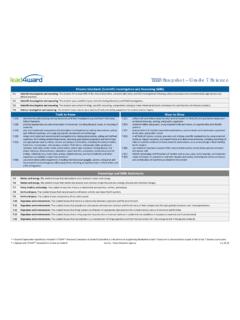
1 TEKS Snapshot Grade 8 Science Source: Texas Education Agency Process Standards (Scientific Investigation and Reasoning Skills) Scientific investigation and reasoning. The student, for at least 40% of instructional time, conducts laboratory and field investigations following safety procedures and environmentally appropriate and ethical practices. Scientific investigation and reasoning. The student uses scientific inquiry methods during laboratory and field investigations. Scientific investigation and reasoning. The student uses critical thinking, scientific reasoning, and problem solving to make informed decisions and knows the contributions of relevant scientists.
2 Scientific investigation and reasoning. The student knows how to use a variety of tools and safety equipment to conduct Science inquiry. STAAR Tools to Know Ways to Show 40% of items will be dual coded (A) demonstrate safe practices during laboratory and field investigations as outlined in the Texas Safety Standards (B) practice appropriate use and conservation of resources, including disposal, reuse, or recycling of materials (A) plan and implement comparative and descriptive investigations by making observations, asking well-defined questions, and using appropriate equipment and technology (B)
3 Design and implement comparative and experimental investigations by making observations, asking well-defined questions, formulating testable hypotheses, and using appropriate equipment and technology (A) use appropriate tools to collect, record, and analyze information, including lab journals/notebooks, beakers, meter sticks, graduated cylinders, anemometers, psychrometers, hot plates, test tubes, spring scales, balances, microscopes, thermometers, calculators, computers, spectroscopes, timing devices, and other equipment as needed to teach the curriculum (B)
4 Use preventative safety equipment, including chemical splash goggles, aprons, and gloves, and be prepared to use emergency safety equipment, including an eye/face wash, a fire blanket, and a fire extinguisher (C) collect and record data using the International System of Units (SI) and qualitative means such as labeled drawings, writing, and graphic organizers (D) construct tables and graphs, using repeated trials and means, to organize data and identify patterns (E) analyze data to formulate reasonable explanations, communicate valid conclusions supported by the data, and predict trends (A) in all fields of Science , analyze, evaluate, and critique scientific explanations by using empirical evidence, logical reasoning, and experimental and observational testing, including examining all sides of scientific evidence of those scientific explanations, so as to encourage critical thinking by the student (B)
5 Use models to represent aspects of the natural world such as an atom, a molecule, space, or a geologic feature (C) identify advantages and limitations of models such as size, scale, properties, and materials (D) relate the impact of research on scientific thought and society, including the history of Science and contributions of scientists as related to the content Knowledge and Skills Statements Matter and energy. The student knows that matter is composed of atoms and has chemical and physical properties. Force, motion, and energy.
6 The student knows that there is a relationship between force, motion, and energy. Earth and space. The student knows the effects resulting from cyclical movements of the Sun, Earth, and Moon. Earth and space. The student knows characteristics of the universe . Earth and space. The student knows that natural events can impact Earth systems Earth and space. The student knows that climatic interactions exist among Earth, ocean, and weather systems Organisms and environments. The student knows that interdependence occurs among living systems and the environment and that human activities can affect these systems.
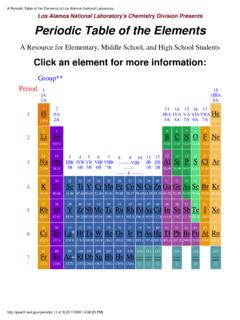
7 Rptg Cat STAAR Readiness Standards Supporting Standards 1 Matter and Energy 14 (A) describe the structure of atoms, including the masses, electrical charges, and locations, of protons and neutrons in the nucleus and electrons in the electron cloud (B) identify that protons determine an element s identity and valence electrons determine its chemical properties, including reactivity (C) interpret the arrangement of the Periodic Table, including groups and periods, to explain how properties are used to classify elements (D) recognize that chemical formulas are used to identify substances and determine the number of atoms of each element in chemical formulas containing subscripts (E) investigate how evidence of chemical reactions indicate that new substances with different properties are formed (F) recognize whether a chemical equation containing coefficients is balanced or not and how that relates to the law of conservation of mass (C) diagram the flow of energy through living systems, including food chains, food webs, and energy pyramids (A)
8 Identify that organic compounds contain carbon and other elements such as hydrogen, oxygen, phosphorus, nitrogen, or sulfur (B) distinguish between physical and chemical changes in matter in the digestive system (C) differentiate between elements and compounds on the most basic level (A) compare metals, nonmetals, and metalloids using physical properties such as luster, conductivity, or malleability (B) calculate density to identify an unknown substance TEKS Snapshot Grade 8 Science Source: Texas Education Agency Rptg Cat STAAR Readiness Standards Supporting Standards 2 Force, Motion and Energy 12 (A) demonstrate and calculate how unbalanced forces change the speed or direction of an object s motion (C) investigate and describe applications of Newton s law of inertia, law of force and acceleration, and law of action-reaction such as in vehicle restraints, sports activities, amusement park rides, Earth s tectonic activities, and rocket launches (B) differentiate between speed, velocity, and acceleration (A)
9 Contrast situations where work is done with different amounts of force to situations where no work is done such as moving a box with a ramp and without a ramp, or standing still (A) compare and contrast potential and kinetic energy (C) calculate average speed using distance and time measurements (D) measure and graph changes in motion (C) demonstrate energy transformations such as energy in a flashlight battery changes from chemical energy to electrical energy to light energy 3 Earth and Space 14 (A) model and illustrate how the tilted Earth rotates on its axis, causing day and night, and revolves around the Sun causing changes in seasons (B) demonstrate and predict the sequence of events in the lunar cycle (A) describe components of the universe , including stars, nebulae, and galaxies, and use models such as the Hertzsprung-Russell diagram for classification (B) relate plate tectonics to the formation of crustal features (C)
10 Interpret topographic maps and satellite views to identify land and erosional features and predict how these features may be reshaped by weathering (C) relate the position of the Moon and Sun to their effect on ocean tides (B) recognize that the Sun is a medium-sized star near the edge of a disc-shaped galaxy of stars and that the Sun is many thousands of times closer to Earth than any other star (C) explore how different wavelengths of the electromagnetic spectrum such as light and radio waves are used to gain information about distances and properties of components in the universe (D) model and describe how light years are used to measure distances and sizes in the universe (A) describe the historical development of evidence that supports plate tectonic theory (A) recognize that the Sun provides the energy that drives convection within the atmosphere and oceans, producing winds and ocean currents (B)