Transcription of Ten Principles for Developing Affordable Housing
1 10 PAH Cover 4/30/07 11:11 AM Page Covr1. Ten Principles for Developing Affordable Housing Urban Land $ Institute 10 Principles Aff Hsg 4/30/07 11:39 AM Page i Ten Principles for Developing Affordable Housing Alexa Bach Prema Katari Gupta Richard Haughey George Kelly Michael Pawlukiewicz Michael Pitchford The Urban Land Institute gratefully acknowledges the financial support of the Fannie Mae Foundation in underwriting this project. 10 Principles Aff Hsg 4/30/07 11:39 AM Page ii About ULI the Urban ULI Project Staff Land Institute Rachelle L. Levitt The mission of the Urban Land Institute is to Executive Vice President, Information Group provide leadership in the responsible use of Publisher land and in creating and sustaining thriving Dean Schwanke communities worldwide. ULI is committed to: Senior Vice President, Publications and Awards Bringing together leaders from across the Richard M. Haughey fields of real estate and land use policy to Director, Multifamily Development exchange best practices and serve community Project Director needs.
2 Michael Pawlukiewicz Fostering collaboration within and beyond Director, Environmental and policy Education ULI's membership through mentoring, dialogue, and problem solving; John K. McIlwain Senior Resident Fellow for Housing Exploring issues of urbanization, conserva- ULI/J. Ronald Terwilliger Chair for Housing tion, regeneration, land use, capital formation, and sustainable development; Alexa Bach Former Scholar-in-Residence Advancing land use policies and design prac- tices that respect the uniqueness of both built George Kelly and natural environments; Former Scholar-in-Residence Sharing knowledge through education, Prema Katari Gupta applied research, publishing, and electronic Scholar-in-Residence Recommended bibliographic listing: media; and Nancy H. Stewart Bach, Alexa, Prema Katari Gupta, Richard Sustaining a diverse global network of local Director, Book Program Haughey, George Kelly, Michael Pawlukiewicz, practice and advisory efforts that address cur- Managing Editor and Michael Pitchford.
3 Ten Principles for Devel- rent and future challenges. oping Affordable Housing . Washington, : Libby Howland ULI the Urban Land Institute, 2007. Established in 1936, the Institute today has Manuscript Editor more than 35,000 members from 90 countries, ULI Order #T40: Packet of Ten Betsy VanBuskirk representing the entire spectrum of the land Art Director ULI Order #T41: Single Copy use and development disciplines. Professionals Book and Cover Design represented include developers, builders, prop- International Standard Book Number: 978-0-87420-978-5 erty owners, investors, architects, public offi- Craig Chapman cials, planners, real estate brokers, appraisers, Director, Publishing Operations Copyright 2007 by ULI the Urban Land Institute attorneys, engineers, financiers, academics, 1025 Thomas Jefferson Street, students, and librarians. ULI relies heavily on Suite 500 West the experience of its members. It is through Washington, 20007-5201. member involvement and information resources Printed in the United States of America.
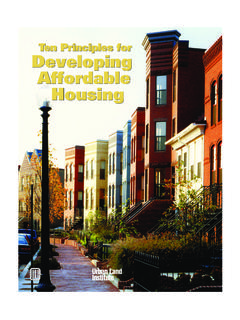
4 All that ULI has been able to set standards of rights reserved. No part of this book may be excellence in development practice. reproduced in any form or by any means, elec- tronic or mechanical, including photocopying The Institute has long been recognized as Cover photograph: The Townhomes on Capitol and recording, or by any information storage one of the world's most respected and widely Hill, Washington, (Bob Narod/Corcoran and retrieval system, without written permis- quoted sources of objective information on Jennison Companies). sion of the publisher. urban planning, growth, and development. ii 10 Principles Aff Hsg 4/30/07 11:39 AM Page iii Participants Chair Rick Gentry Barry Merchant Senior Vice President, Asset Management policy Analyst J. Michael Pitchford National Equity Fund Virginia Housing Development Authority President Chicago, Illinois Richmond, Virginia community Preservation and Development Corporation Renee Glover Tom Murphy Washington, CEO Senior Resident Fellow, Urban City of Atlanta Housing Authority Development Workshop Participants Atlanta, Georgia ULI the Urban Land Institute Washington, Milton Bailey Mossik Hacobian Former Executive Director Executive Director Mark Silverwood Housing Finance Agency Urban Edge Housing Corporation President Washington, Boston, Massachusetts Silverwood Associates Reston, Virginia Michael Bodaken Kil Huh President Former Director, Practice Development Alexander Viorst National Housing Trust Fannie Mae Foundation Managing Director Washington, Washington, MMA Financial Washington, Sheila Crowley Marty Jones President President Michael Wiencek National Low-Income Housing Coalition Corcoran Jennison Companies President Washington, Dorchester.
5 Massachusetts Wiencek + Associates Architects + Planners PC. Kathy Dougherty Ellen Lazar Gaithersburg, Maryland Vice President Senior Vice President, Housing and Edgewood Management Corporation community Initiatives Joyce Woodson Silver Spring, Maryland Fannie Mae Foundation Councilmember Washington, City of Alexandria Susan Dewey Alexandria, Virginia Executive Director Maureen McAvey Virginia Housing Development Authority Executive Vice President Richmond, Virginia ULI the Urban Land Institute Washington, This report was conceived by the ULI. Jim Edmonson President John McIlwain Affordable Housing Council, the mem- UniDev LLC Senior Resident Fellow, Housing bers of which formulated these princi- Bethesda, Maryland ULI the Urban Land Institute ples for the development of Affordable Washington, Conrad Egan Housing as well as reviewed and edited President/CEO drafts of the Ten Principles report. National Housing Conference Washington, iii 10 Principles Aff Hsg 4/30/07 11:39 AM Page iv Introduction T he explosive appreciation in Housing prices from the late 1990s to the mid- 2000s created significant wealth for people fortunate enough to own their own home.
6 In many markets, double-digit appreciation year after year created home equity that homeowners tapped to pay off other debt, remodel their homes, take vacations, and buy new cars. By the mid-2000s, Housing price appreciation had slowed to more traditional rates, but home prices remained quite high in most mar- kets. Over the same period, incomes were stagnant, taking median-price Housing out of the range of median-income households. Several other factors combined to create what could be described as an Affordable Housing crisis in many regions of the country. First, resources for the support of Affordable Housing became more limited with the continuing decentralization of fed- eral Housing programs to the states. Secondly, many Affordable Housing units were lost to expiring uses (the conversion of subsidized developments to market-rate Housing ), the conversion of Affordable rental developments to condominiums, and demolition. The growing local community opposition to any new development has also played a role in that it tends to focus particularly on multifamily Housing , which can be more Affordable than single-family Housing , and on Affordable Housing developments with public subsidies.
7 The convergence of these trends has limited the Housing options of many people with low and moderate incomes. Many are forced to pay a larger and larger share of their income for Housing ; to crowd into shared apartments, townhouses, or single- family homes; or to find Housing in distant suburbs located far from their jobs. Some are forced to combine all three options to pay a lot to live in a crowded house in exurbia. It doesn't have to be this way. Communities can support the development of hous- ing for people and families at a variety of income levels. And they should, in fact, because doing so makes sense from an economic development perspective. The availability of decent Housing that is close to work and Affordable for the jobholders upon which the proper functioning of the local economy depends is essential to the community 's economic health. All communities need teachers, firefighters, police officers, municipal employees, health care workers, contractors, landscapers, and retail salespersons, to list just a few essential service workers.
8 Unfortunately, many communities fail to ensure that such workers have safe, Affordable Housing opportunities within a reasonable dis- tance from their work. The residents of many of these communities not only pas- sively accept this reality, but also actively oppose proposals to provide such hous- iv 10 Principles Aff Hsg 4/30/07 11:39 AM Page v MITHUN ARCHITECTS + DESIGNERS + PLANNERS. ing. Their opposition to the local development of Affordable Housing may not serve High Point in Seattle, Washington, is a mixed- income, new urbanist, HOPE VI community . the self-interest they believe they are protecting. It is not only a community 's essential service workers who stand in need of afford- able Housing . The market for Affordable Housing is diverse and does not correspond with many people's outdated stereotypes about who lives in Affordable Housing . Peo- ple in all stages of the life cycle need such Housing . The adult children of commu- nity residents who are just starting out in their careers need Affordable Housing options.
9 The parents of residents, who may be on a fixed income, might need low- maintenance, Affordable Housing . Disabled people, including war veterans who suf- v 10 Principles Aff Hsg 4/30/07 11:39 AM Page vi fered injuries that have affected their ability to work, need and deserve safe and Affordable Housing . Ten Principles for Developing Affordable Housing seeks to help those who wish to develop Housing for low- and moderate-income households understand what it takes to make Affordable Housing projects happen. It also seeks to help policy makers and community leaders understand the Principles behind the production of Affordable Housing . It is hoped that this understanding will lead to the creation of effective Affordable Housing policies and programs and to the fostering of a climate that is more supportive of the development of Affordable Housing . Professionals with diverse and deep experience in the field of Affordable Housing participated in the identification of the ten Principles outlined here, beginning with the Urban Land Institute's Affordable Housing Council under the leadership of Mike Pitchford and later under the leadership of Marty Jones.
10 The work of the council took place over the course of several ULI fall and spring meetings, and culminated in a one-day Affordable Housing workshop held at ULI's headquarters on March 29, 2006 at which participants (listed on page iii) refined and illuminated the Principles . This publication, we hope, succinctly summarizes the knowledge and experience of the experts who created it. Their collective experience in the Affordable Housing industry totals hundreds of years. We further hope that it will encourage the devel- opment of more Affordable Housing as part of localities' efforts to achieve balanced, healthy, and sustainable communities. vi 10 Principles Aff Hsg 4/30/07 11:39 AM Page 1. Ten Principles for Developing Affordable Housing Inspire Leadership Build community Support and Trust Learn the Alphabet .. and Do the Math Know Your Market and Your Customers Nurture Partnership Select Sites for Opportunity and Choice Strive for Healthy, Balanced Communities Use Design to Foster community , Safety, and Pride Empower the Residents Orchestrate Sustainability 10 Principles Aff Hsg 4/30/07 11:39 AM Page 2.