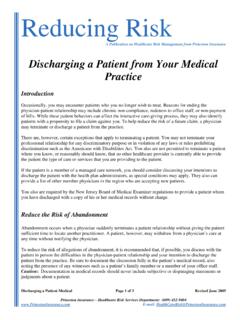
Transcription of TERMINATING A PROVIDER–PATIENT …
1 TERMINATING A provider PATIENT relationship Medical Protective Clinical Risk Management Department SEPTEMBER 2014 For questions, products, or services, please contact 800 4 MEDPRO or visit This document should not be construed as medical or legal advice. Since the facts applicable to your situation may vary, or the laws applicable in your jurisdiction may differ, please contact your attorney if you have any questions related to your legal obligations or rights, application of state or federal laws, contract interpretation, or other legal questions that may potentially impact the applicability of the information provided in this document. The Medical Protective Company. 2014. All rights reserved. CONTENTS INTRODUCTION .. 3 OBJECTIVES .. 3 CONSIDERATIONS FOR TERMINATING THE provider PATIENT relationship .. 3 Documentation .. 3 Timing .. 4 Payment Issues .. 4 Behavior Contracts .. 5 THE PROCESS .. 5 Contractual and Legal Obligations .. 5 Notification .. 5 Drafting the Notification Letter.
2 5 Sending the Notification 6 Documenting the Notification .. 7 Other Considerations .. 7 CONCLUSION .. 7 RESOURCES .. 8 APPENDIX A. SAMPLE TERMINATION LETTER ( provider INITIATED) .. 9 APPENDIX B. SAMPLE TERMINATION LETTER (PATIENT INITIATED) .. 10 Guideline: TERMINATING a provider Patient relationship 3 INTRODUCTION Healthcare providers have the right to treat the patients they wish to treat. They also have the right to terminate relationships with patients for a variety of reasons, such as: Numerous attempts at communication have proven unsuccessful. The patient has repeatedly refused to obtain needed screening or treatment. The patient is persistently rude or belligerent to providers and/or staff. The patient and the provider are simply too different, in any multitude of ways, to be able to work as a team. However, providers should use caution when discharging from their care patients who are members of a protected class. Federal and state laws prohibit discrimination based on race, religion, color, etc.
3 , and other laws such as the Americans with Disabilities Act (ADA) also may apply. When confronted with a situation in which these laws might be applicable, providers should seek legal advice. OBJECTIVES The objectives of this guideline are to: Review important considerations for TERMINATING a provider patient relationship , such as documentation, timing, payment issues, and behavior contracts; Emphasize the importance of developing a formal termination process that establishes a framework for discharging patients from the practice; Discuss the essential components of drafting, sending, and documenting notifications of termination; and Review other termination considerations, such as using no schedule lists, following-up with patients who initiate termination of the relationship , and establishing administrative oversight. CONSIDERATIONS FOR TERMINATING THE provider PATIENT relationship Documentation When the provider patient relationship becomes untenable, the provider should review the patient's record before deciding to discharge the patient.
4 Although it is true that healthcare professionals can terminate a relationship with a patient, it also is wise for the provider to have objective and factual documentation that supports the decision. Guideline: TERMINATING a provider Patient relationship 4 For example: Have patient instructions and education been documented in the patient s record? Have patient complaints or accusations against the practice, or inappropriate remarks to providers or staff, been documented? These issues should be objectively noted in the record; use quotation marks where relevant to preserve the patient's actual statements. Does documentation objectively note that the provider and staff have attempted to resolve the problems or address the issues? Has the provider consistently documented treatment recommendations and warnings to the patient about possible negative effects of noncompliance? (Note: Noncompliance should be documented at the time it occurs, not when the patient sustains an injury.)
5 If the record provides no support for the decision to terminate the relationship , then the provider might be wise to continue treating the patient, at least until such time as the documentation supports the decision. Timing Timing of the termination might be critical in the defense of any allegation of patient abandonment. Abandonment is generally when a healthcare provider terminates the provider patient relationship without reasonable notice or in a manner that denies a patient necessary medical care. As such, TERMINATING the relationship at a critical juncture in patient care is not recommended. Also, if the provider is the sole practitioner of a certain specialty in an area or is practicing in a rural area, it may take longer to ensure a patient has appropriate care, which may result in a longer notice period prior to TERMINATING the relationship . Payment Issues Termination of a provider patient relationship can be problematic if the reason for discharge is nonpayment of bills.
6 Before taking this step, the provider should first verify whether a contract ( , MCO, HMO, or PPO) obligates the continued provision of care. If the patient is not undergoing active treatment, the provider may advise the patient, either by phone or letter, that a payment plan must be established and followed or the patient will be discharged from the practice. The patient should be given adequate time to respond; however, if no response is forthcoming, a termination letter can be sent. If the nonpaying patient is in the midst of active treatment, such as a course of chemotherapy or dental work, the provider should seek legal advice before sending any notice of termination. Guideline: TERMINATING a provider Patient relationship 5 Behavior Contracts In some instances, even though a patient or family might be problematic, the provider may not be ready to terminate the relationship . In these cases, the provider might want to consider using a behavior contract with the patient or family.
7 A behavior contract can help preserve the provider patient relationship , or if the behavior contract is not followed it can support the decision to terminate the relationship . For more information, please see Medical Protective s guideline on behavior contracts (log in with your username and password at ). THE PROCESS Healthcare practices should develop formal processes for termination of the provider patient relationship to avoid allegations of patient abandonment. Part of the process should include careful consideration of the termination and review of the patient s record prior to discharge actions. Contractual and Legal Obligations Healthcare providers should review managed care contracts or other procedural documents prior to withdrawing from a patient s care. Managed care organizations (MCOs) may require compliance with additional steps before a provider can unilaterally discharge a patient from his or her care. For example, the MCO may require warning letters or an extended waiting period to ensure that the patient has adequate time to select another provider from the MCO panel.
8 Often, the MCO will seek to refer the patient to another provider within its network. Additionally, some state health programs may have special grievance procedures that healthcare providers must follow. Each practice should research contractual and legal requirements before finalizing their discharge policies. Notification Once a decision has been made to discharge a patient from the practice, the practice will need to notify the patient of the termination in writing. Drafting the Notification Letter The notification letter should be professional and nonconfrontational, and it should set a tone that aims to maintain the best possible relationship with the patient. The tone should focus on the long-term benefit for the patient. Guideline: TERMINATING a provider Patient relationship 6 Generally, the provider is under no obligation to provide a reason for withdrawing from the patient's care. Some providers may wish to do so, but the statement should be brief. It should not be argumentative or punitive in tone.
9 The letter should clearly state the date upon which the termination will become effective, and it should commit the provider to helping the patient through the transition period by offering to provide emergency care only for a specified time, , 30 days. In most instances, this allows the patient sufficient time to obtain the services of another provider . However, because state requirements and patient needs differ, your local professional society may be able to offer guidance as to how long it might take a patient to transition to another provider s care. During the transition period, the patient will remain the responsibility of the original treating provider . Whenever possible, include resources in the notification letter that the patient can use to access another provider . Local hospitals, medical/dental societies, or public health services may provide the names of practitioners who are accepting new patients . The patient s insurance panel may also provide names of available practitioners.
10 Generally, it is not a good idea to refer the patient directly to another provider . The notification letter also should describe the process for transferring or forwarding records, and it should include a record release authorization form. The patient should be informed that, once a written authorization is received, copies of medical/dental records will be forwarded to the new provider . Some organizations charge a reasonable fee for copying records. If your practice plans to impose a fee, review federal and state regulations first. HIPAA and most state laws limit the amount that can be charged for duplication and searching services. Further, HIPAA prohibits charging patients for handling fees, chart-pulling fees, or per-page fees in excess of the direct cost of materials. Because the circumstances for provision of record copies may vary, the provider should evaluate whether a charge makes sense relative to the patient. If the provider intends to charge for copying records, he or she should clearly state this information in the notification letter.