Transcription of Test Description and Validation Summary - …
1 VersantTM English Test Test Description and Validation Summary 2011 Pearson Education, Inc. or its affiliate(s). Page 2 of 31 Table of Contents 1. Introduction .. 3 2. Test Description .. 3 Test Design .. 3 Test Administration .. 4 Telephone Administration .. 4 Computer Administration .. 4 Test Format .. 4 Part A: Reading .. 4 Part B: Repeat .. 5 Part C: Short Answer Questions .. 6 Part D: Sentence Builds .. 6 Part E: Story Retelling .. 6 Part F: Open Questions .. 7 Number of Items .. 7 Test Construct .. 8 3. Content Design and Development .. 10 Vocabulary Selection .. 10 Item Development .. 11 Item Prompt Recording .. 11 Voice Distribution .. 11 Recording Review .. 11 4. Score Reporting .. 12 Scores and Weights .. 12 Score Use .. 14 Score Interpretation .. 14 5. Validation .. 14 Validity Study Design .. 15 Validation Sample .. 15 Internal Validity .. 15 Standard Error of Measurement .. 16 Reliability .. 16 Dimensionality: Correlation between Subscores.
2 17 Correlations between the Versant English Test and Human Scores .. 19 Relationship to Known Populations: Native and Non-native Group 20 Relationship to Scores of tests with Related Constructs .. 21 6. Conclusions .. 23 7. About the Company .. 24 8. References .. 24 9. Appendix: Test Paper .. 27 2011 Pearson Education, Inc. or its affiliate(s). Page 3 of 31 1. Introduction The Versant English Test, powered by Ordinate technology, is an assessment instrument designed to measure how well a person understands and speaks English. The Versant English Test is intended for adults and students over the age of 15 and takes approximately 15 minutes to complete. Because the Versant English Test is delivered automatically by the Versant testing system, the test can be taken at any time, from any location by phone or via computer. A human examiner is not required. The computerized scoring allows for immediate, objective, and reliable results that correspond well with traditional measures of spoken English performance.
3 The Versant English Test measures facility with spoken English, which is a key element in English oral proficiency. Facility in spoken English is how well the person can understand spoken English on everyday topics and respond appropriately at a native-like conversational pace in English. Academic institutions, corporations, and government agencies throughout the world use the Versant English Test to evaluate the ability of students, staff, and officers to understand spoken English and to express themselves clearly and appropriately in English. Scores from the Versant English Test provide reliable information that can be applied to placement, qualification and certification decisions, as well as monitor progress and measure instructional outcomes. 2. Test Description Test Design The Versant English Test may be taken at any time from any location using a telephone or a computer.
4 During test administration, the Versant testing system presents a series of recorded spoken prompts in English at a conversational pace and elicits oral responses in English. The voices of the item prompts are from native speakers of English from several different regions in the , providing a range of speaking styles. The Versant English Test has six item types: Reading, Repeats, Short Answer Questions, Sentence Builds, Story Retelling, and Open Questions. All item types except for Open Questions elicit responses that can be analyzed automatically. These item types provide multiple, fully independent measures that underlie facility with spoken English, including phonological fluency, sentence construction and comprehension, passive and active vocabulary use, listening skill, and pronunciation of rhythmic and segmental units. Because more than one item type contributes to each subscore, the use of multiple item types strengthens score reliability.
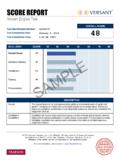
5 The Versant testing system analyzes the candidate s responses and posts scores to a secure website usually within minutes of the completed test. Test administrators and score users can view and print out test results from a password-protected website. The Versant English Test provides numeric scores and performance levels that describe the candidate s facility in spoken English that is, the ability to understand spoken English on everyday topics and to respond appropriately at a native-like conversational pace in intelligible English. The Versant English Test score report is comprised of an Overall score and four diagnostic subscores: Sentence Mastery, Vocabulary, Fluency, and Pronunciation. Together, these scores describe the candidate s facility in spoken English. 2011 Pearson Education, Inc. or its affiliate(s). Page 4 of 31 Test Administration Administration of a Versant English Test generally takes about 15 minutes over the telephone or via a computer.
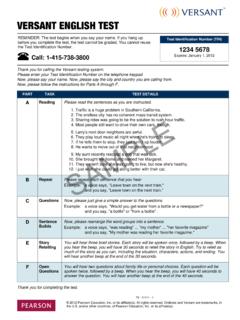
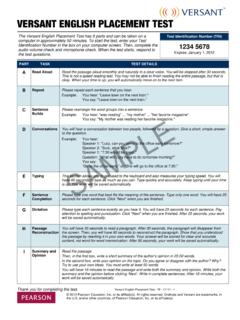
6 It is best practice (even for computer delivered tests ) for the administrator to give a test paper to the candidate at least five minutes before starting the test (see Appendix). The candidate then has the opportunity to read both sides of the test paper and ask questions before the test begins. The administrator should answer any procedural or content questions that the candidate may have. The delivery of the recorded item prompts is interactive the system detects when the candidate has finished responding to one item and then presents the next item. Telephone Administration Telephone administration is supported by a test paper. The test paper is a single sheet of paper with material printed on both sides. The first side contains general instructions and an explanation of the test procedures. These instructions are the same for all candidates. The second side has the individual test form, which contains the phone number to call, the Test Identification Number (TIN), the spoken instructions written out verbatim, item examples, and the printed sentences for Part A: Reading.
7 The individual test form is unique for each candidate. When the candidate calls the Versant testing system, the system will ask the candidate to use the telephone keypad to enter the Test Identification Number that is printed on the test paper. This identification number is unique for each candidate and keeps the candidate s information secure. A single examiner voice presents all the spoken instructions for the test. The spoken instructions for each section are also printed verbatim on the test paper to help ensure that candidates understand the directions. Candidates interact with the test system in English, going through all six parts of the test until they complete the test and hang up the telephone. Computer Administration For computer administration, the computer must have an Internet connection and Pearson s Computer Delivered Test (CDT) software (available at ). The candidate is fitted with a microphone headset.
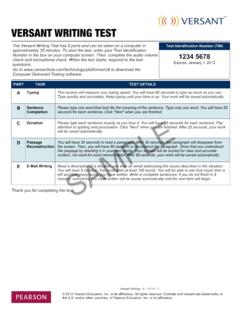
8 The CDT software prompts the candidate to adjust the volume and calibrate the microphone before the test begins. The instructions for each section are spoken by an examiner voice and are also displayed on the computer screen. Candidates interact with the test system in English, speaking their responses into the microphone. When a test is finished, the candidate clicks a button labeled, End Test . Test Format The following subsections provide brief descriptions of the item types and the abilities required to respond to the items in each of the six parts of the Versant English Test. Part A: Reading In this task, the candidate reads printed, numbered sentences, one at a time, as prompted. For telephone administration, the sentences are printed on the test paper. For computer administration, the sentences are displayed on the computer screen. Reading items are grouped into sets of four sequentially coherent sentences, as in the examples below.
9 2011 Pearson Education, Inc. or its affiliate(s). Page 5 of 31 Examples: Presenting the sentences as part of a group helps the candidate disambiguate words in context and helps suggest how each individual sentence should be read aloud. The computer screen or test paper contains three groups of four sentences ( , 12 items). Candidates are prompted to read eight of the twelve sentences in a random order. The system tells the candidate which of the numbered sentences to read aloud ( , Now, please read sentence 7. ). After the candidate has read the sentence (or has remained silent for a period of time), the system prompts him or her to read another sentence from the list. The sentences are relatively simple in structure and vocabulary, so they can be read easily and in a fluent manner by literate speakers of English. For candidates with little facility in spoken English but with some reading skills, this task provides samples of their pronunciation and reading fluency.
10 The readings appear first in the test because, for many candidates, reading aloud presents a familiar task and is a comfortable introduction to the interactive mode of the test as a whole. Part B: Repeat In this task, candidates are asked to repeat sentences that they hear verbatim. The sentences are presented to the candidate in approximate order of increasing difficulty. Sentences range in length from three words to 15 words. The audio item prompts are spoken in a conversational manner. Examples: To repeat a sentence longer than about seven syllables, a person must recognize the words as spoken in a continuous stream of speech (Miller & Isard, 1963). Highly proficient speakers of English can generally repeat sentences that contain many more than seven syllables because these speakers are very familiar with English words, phrase structures, and other common syntactic forms. If a person habitually processes five-word phrases as a unit ( the really big apple tree ), then that person can usually repeat utterances of 15 or 20 words in length.