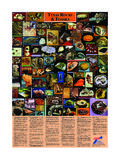
Transcription of TEXAS ROCKS & FOSSILS
1 3567891213141516171819323536373839404142 4344454647484950525354555657656364665868 596062806921272920 TEXAS Department of Transportation1. Abundant in many TEXAS localities, fossil seashells are found in avariety of settings, from blackland prairies to rocky hillsides. Indi-vidual specimens like these are usually from the Cretaceous pe-riod of some 100 million years ago. They may be actual fossilspecimens, molds as shown in number 23, or casts like the heartcockle pictured here. Fossil snails, scallops, whelks, tusk shellsand corals are also commonly found. Pictured FOSSILS from 3/4inch to 7 inches; all Central These fossilized marine pelecypods are sprinkled with shinyspecks of marcasite, a mineral chemically identical to iron Pennsylvanian FOSSILS in limestone dating from the Paleozoicera some 300 million years ago. McCulloch Track of a theropod dinosaur from Dinosaur Valley State Parknear Glen Rose in North Central TEXAS . The site contains a hostof tracks made from some 100 million years ago in limey mud,now turned to Replica of the 12-foot-high, 50-foot-long Tyrannosaurus Rex,whose tracks are preserved in stone in Dinosaur Valley StatePark (see number 4).
2 The creature was once the world s largestland Crinoidal limestone, often composed almost entirely of FOSSILS , isfound in North Central, Central and West TEXAS , dating from thePennsylvanian period. The plant-like animals grew in prehistoricseas, with long stems like columns of discs. Such stem frag-ments are the most frequent fossil finds. Burnet and Llano Fossil seashells may be found singly, as in numbers 1 and 2, asintegral parts of stone as in numbers 3 and 6, or cemented inknobby chunks as pictured here. Hays Petrified wood derives from conditions where plant material isburied before it decays. As slow, underground decay occurs, wa-ter-borne minerals replace the organic structure cell by cell, pro-ducing a mineral copy of the original plant, even to knotholes aspictured here. Fayette Fossilized palm wood is the official state stone of TEXAS . It isfound in a variety of mineral types and colors; see numbers 12,21 and 32. Fayette Fossilized cycad stem (8 inches), a once-abundant prehistoricplant group that resembled palms.
3 McMullen or Live Oak Countynear Petrified wood is classified as agatized, carbonized, silicified,opalized or other, according to the kind of mineral that replacedthe wood fibers. This example is wood replaced by malachite, agreen copper mineral. Jones County in North Central Dot patterns called straws identify these specimens as petrifiedpalm wood. They re always apparent in crosscut sections. Forlongitudinal section appearance, see number 21; also see num-bers 9, 31 and Opalized wood formed when silica with high water content re-placed the original material. See number 36 for more about Cretaceous marine FOSSILS from a cave along the Colorado Riverin Travis County. The county is bisected by a major geologicalfeature, the Balcones Typical fossil coral. Over millions of years, skeletons of thesemarine animals were calcified into enormous layers of rock. Theyinhabited inland seas that once covered far West Halite, also known as common table salt, forms crystals in dry un-derground areas.
4 Huge salt domes lie under the coastal plainsand in West TEXAS . Marion This agate type is sometimes called Christmas agate becauseof its red, green and white colors. Despite the uneven, channeledappearance, the primary surface is actually flat and polished. BigBend region. Also see numbers 18, 26 and TEXAS agate. When cut and polished its beauty and characteris-tics are easily recognized, but in its natural state it is far fromspectacular and requires a practiced eye to find and judge as toquality. West TEXAS . Also see numbers 17, 26 and A tumble-polished silicified fern bud from Live Oak County. GulfCoast region of South Another example of lustrous opalized wood. Fayette County. Alsosee number Longitudinal section (with the grain) of petrified palm wood inwhich the straws are not evident. Also see numbers 9,12, 31and This section of agatized wood from Fayette County shows evi-dence of tree rings. Various types of petrified woods are found invirtually every part of TEXAS .
5 Also see numbers 8, 10, 11,13, Another example of FOSSILS in limestone (also see numbers 3 and6) are these bivalve molds. This stone is a popular building ma-terial seen in commercial structures throughout much of While marine FOSSILS are the most abundant in TEXAS , others likethis fossilized animal bone are not uncommon. Galena, or lead ore, is a heavy, shiny lead sulfide soft enough tomark paper. Some specimens break into perfect cubes whenstruck. Quitman Mountains, Hudspeth TEXAS plume agate is found in colors from black through a virtualrainbow of other colors. West TEXAS . Also see numbers 17, 18,and Rock gypsum is a fine-grained, translucent to opaque stone of-ten found in layers along the canyons of the TEXAS High Coiled gypsum on cinnabar. Gypsum is a soft, common mineralassociated with sedimentary ROCKS , although it can also occur asa result of volcanic action. This growth of gypsum on cinnabar(see number 78) is from an area near Terlingua in Packsaddle schist, near Packsaddle Mountain in Llano County,probably formed deep within the earth during the Precambrianera more than 600 million years ago.
6 Schist tends to split easilyalong thin, usually parallel lines in layers called A nodule of banded blue agate from near Alpine in West specimens are not uncommon throughout much of thelength of the Rio Grande. Also see numbers 17,18, and A favorite material for lapidary work is petrified palm sections show the straws pattern, while longitudinalcuts may exhibit branching tree-like forms. Also see numbers9,12, 21 and Petrified palm wood in its many forms and colors is most plenti-ful in a broad band along the length of the Gulf Coast section,about a hundred miles inland from the present Grange A form of gypsum, selenite crystals are similar to, but softer thancalcite and not as brittle. Found in rock cavities of several SouthTexas and Gulf Coast counties, formed by solutions in contactwith surrounding ROCKS . Port Isabel area. Also see numbers 34and Another color variety of selenite crystal are these rosettes fromPalo Duro Canyon in the TEXAS High Plains.
7 Also see numbers33 and Fluorite crystals, colors range from clear to purple, blue, pink,green, brown and white. Found in Central TEXAS (Burnet County)and in the Eagle Mountains, Hudspeth County, West Common opal, a silicon dioxide like quartz, flint, and agate, iswithout the crystalline structure of those harder minerals. It is ac-tually an amorphous hardened gel with high water content. Texasspecimens may be white yellow, red, blue, brown or and West In mankind s history, flint has been used for tools and weaponsbecause it fractures into sharp, useful edges. Usually formed asnodules in limestone, this common blue-gray type is abundantthroughout TEXAS . Also see number In its natural state, topaz may resemble a transparent piece ofglass, small pieces may appear frosted from tumbling action instreams. Associated with granite outcropping, topaz is somewhatheavier than quartz, which it resembles. Central TEXAS . Also seenumber Topaz is the TEXAS state gemstone, and the finest gem-qualityspecimens are from Mason County, Central These black, greasy-to-touch molybdenite flakes are from WestTexas streambeds in Hudspeth Technically, jasper is an impure cryptocrystalline variety of quartzrelated to agate, chert and flint.
8 For laymen, a fundamental differ-ence is that jasper is virtually opaque while agate is translucentto nearly transparent . West TEXAS and the length of the Graphite ore in schist ROCKS . As are diamonds, graphite is purecarbon, but is extremely soft, black, and slippery feeling. Its bestknown use is, of course, as the writing medium in ordinary lead pencils, but it is also used as a lubricant, a pigment, and can en-dure the intense heat of smelting that would consume Llanite is a type of TEXAS pink granite found nowhere else in theworld. Llanite s uniqueness results from crystals of sky-bluequartz mingled with the granite s rusty-pink feldspar and Hematite, an iron oxide ore, is abundant in Northeast TEXAS . Per-haps surprisingly, similar iron-ore specimens varying from blackto steel gray may often be found in many other parts of Goethite, another form of iron ore, is distinguished from hematite(number 44) by its higher water content. Smith Selenite is among the more common minerals of TEXAS , but ahost of impurities and conditions of formation produce an aston-ishing variety of shapes and colors.
9 Jim Hogg County. Also seenumbers 33 and Calcite is another common TEXAS mineral, ranging from transpar-ent, rhomb-shaped crystals to specimens such as number 56,and types of travertine, number 59. Real Alibates flint was prized by ancient man for tools and near Lake Meredith in the TEXAS High Plains for about12,000 years, it was traded over much of North TEXAS finest specimens of gem-quality epidote are found in Cen-tral TEXAS area between Fredericksburg and Novaculite is a chalcedonic rock popular for whetstones when cutin slabs. Although usually opaque white, these samples illustratethe range of colors that may be found. Brewster Marcasite, chemically identical to iron pyrite, has a different crys-talline structure, but the two are often difficult to distinguish be-tween. Common as nodules in limestone, Central Honey onyx. Onyx is a name used for two entirely differentstones. Agate banded with alternate dark and light colors iscalled onyx.
10 True onyx is a much softer material related tomarble. It may be either banded or solid colored (as the picturedspecimen), is translucent , and is easy to carve. McCamey areaof West Aragonite, a member of the calcium carbonate group, is a rela-tively unstable mineral under ordinary conditions, and slowlychanges to calcite over a period of time. Donley An iron pyrite nodule nestled in a geode of saganite agate linedwith quartz crystals. The pyrite is from Central TEXAS , the geodefrom West TEXAS granites are among the most commercially used ROCKS inthe state. Most popular are red and pink varieties, but manyshades of gray are also quarried for architectural and monumentuse. (Although commonly called gray granite, these specimensare technically diorite.) Also see numbers 64, and 70 Another form of crystalline calcite. For more calcite varieties, seenumbers 47, 59, and rhomboidal crystals on opposite Rare vanadinite crystals. Besides the ruby-red specimen pic-tured, vanadinite crystals also appear in reddish brown, brownishyellow and straw yellow.