Transcription of The Analytical Evaluation Threshold - PQRI
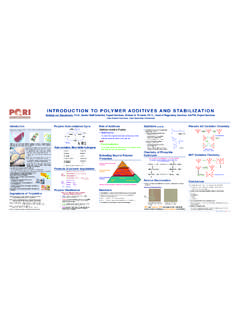
1 The Analytical Evaluation Threshold (AET). Daniel L. Norwood, PhD and Lee M. Nagao, PhD. IPAC-RS. The Analytical Evaluation Threshold (AET) is defined as the Threshold at or above which a chemist should begin to identify a particular leachable and/or extractable and report it for potential toxicological assessment. The AET is a relative value based on The Safety Concern Threshold (SCT). The drug product configuration Analytical techniques/methods used The AET is developed during extractables studies and is applied to both extractables and leachables . We present examples of how one may calculate AETs for a Metered Dose Inhaler, Dry Powder Inhaler and Inhalation Solution, and discuss considerations resulting from application of the AET in these cases.
2 Table 1 summarizes the general approach to calculating both the estimated and final AET. Note: An Estimated AET of 20. micrograms/gram is recommended for non- contact critical components in MDIs, DPIs and nasal sprays. Table 1. General Process for Determination of Estimated and Final AET. STEP 1. Determine estimated AET by converting SCT ( g/day) to units relative to an individual OINDP ( , g/canister, g/gram component, etc.). STEP 2. Estimate position of SCT on the particular extractables/ leachables profile. This is the Estimated AET. The position should be based on: The RF of an appropriate internal standard; or The RF of an unambiguously identified major extractable/leachable. STEP 3. Evaluate Analytical uncertainty: Create an appropriate RRF database.
3 Determine the Standard Deviation (SD) and %Relative Standard Deviation (%RSD) of RRFs in the database;. Use one (1) %RSD or a factor of 50% (of the Estimated AET), whichever is greater, to define the Analytical uncertainty. STEP 4. Establish the Final AET :The Final AET is defined as: Final AET = Estimated AET uncertainty factor . EXAMPLE AET CALCULATIONS FOR VARIOUS OINDP. 1. Metered Dose Inhaler Example calculation of an Estimated and Final AET for an MDI with 200 labeled actuations per canister, a recommended dose of 12 actuations per day, and a critical component elastomer mass per valve of 200 mg. Estimated AET for an individual organic leachable from this elastomer is: g/day . Estimated AET = 200 labeled actuations/canister.
4 12 actuations/day . Estimated AET g/canister Converting to an Estimated AET for individual extractables in an extractables profile of this particular elastomer: Estimated AET . ( g/canister ) (1 canister/valve). g elastomer/valve Estimated AET g/g Given the Response Factor database in Table 2, the Final AET would be: Final AET = microgram/canister ( ). Final AET = microgram/canister 50% of a g/canister is g/canister which is lower than , and therefore: Final AET = microgram/canister Table 2. Example Extractables RRF Database from GC/FID. Method. 2-Fluorobiphenyl as internal standard Analyte ID RF Value RRF Value BHT Irganox 1076 p-terphenyl-D14 Bis (2-ethylhexyl) phthalate 2,6-d-tert-butylphenol Eicosane Diphenylamine Dibutyl phthalate Mean Standard Deviation %RSD In this calculation, we assume that all 200 mg of elastomer has the same chemical composition and extractables profile, and does not consider the number of individual valve components made from this elastomer.
5 When conducting Controlled Extraction Studies and establishing acceptance criteria for unspecified extractables in Routine Extractables Testing, analysts should consider the potential additive effect to the leachables profile of multiple elastomeric and/or plastic components made from the same basic material. 2. Dry Powder Inhaler Example calculation of an Estimated AET for a DPI containing 13 mg of drug product formulation in a unit dose blister with 50. mg of blister material either in direct contact with the formulation or capable of volatilizing leachables into the headspace, and a recommended dose of 2 actuations per day. For an individual organic leachable the estimated AET. would be: g/day.
6 Estimated AET = 1 dose/blister . 2 doses/day . Estimated AET g/blister Convert relative to the total mass of drug product in a blister: g/blister . Estimated AET = . g drug product/blister . Estimated AET g/g drug product Convert to Estimated AET for extractables from blister material: g/blister . Estimated AET = . g material/b lister . Estimated AET g/g blister material There is low probability that patients will be exposed to leachables from DPIs at significant levels, due to the nature of these products, , no solvent, unit dose in contact with critical components of device for short period of time. The significant critical component that may contribute organic leachables is the unit dose container, such as a foil laminate blister, where leaching may occur via direct contact or via volatilization from the laminate into the formulation.
7 3. Inhalation Solution Estimated AET for Inhalation Solution with 3 mL of drug product contained in a low density polyethylene (LDPE). container weighing 1 g, with a recommended dose of 3. containers per day. For an individual organic leachable the estimated AET is: g/day . Estimated AET = 1 dose/container . 3 doses/day . Estimated AET g/containe r g/container . Estimated AET = . 3 mL/container . Estimated AET g/mL. Converting to an Estimated AET for individual extractables in an extractables profile of this particular LDPE. g/containe r . Estimated AET = . 1 g material/c ontainer . Estimated AET g/g container material The leachables /extractables Estimated AET for inhalation solution drug products can represent a significant Analytical challenge.
8 Therefore, if it can be scientifically demonstrated that: Aqueous and/or drug product formulation extracts of inhalation solution direct formulation contact container closure system material yield no extractables at Final AET levels, or no extractables above Final AET levels with safety concern; AND. There is no evidence for migration of organic chemical entities through the unit dose container into the drug product formulation; THEN. Drug product leachables studies are not required. This recommendation implies: Comprehensive Controlled Extraction Studies using water and solvents such as methylene chloride or 2- propanol to identify potential leachables of potential safety concern. A well designed drug product without paper labels and other sources of organic chemical migration into the drug product, either from the environment or from secondary protective packaging.
9 Comprehensive and fully validated Routine Extractables Testing methods, capable of detecting any significant change in the unit dose container material extractables profile. leachables Profile 1 Week Timepoint Abundance TIC: +07. +07. +07. +07. 1e+07. 9000000. 8000000. 7000000. 6000000. 40 g/canister 5000000. 4000000. 3000000. 2000000. 1000000. 0. Time-->. leachables Profile 1 Week Timepoint Expanded Abundance TIC: 1200000. 1100000. 1000000. 900000. 800000. 700000. 600000. 500000. 400000. 300000. 200000. 100000. Time-->. leachables Profile 1 Week Timepoint Expanded Section Abundance TIC: 500000. 450000. 400000. 350000. Red Alert!!! 300000. Estimated AET. 250000. 200000. 150000. 100000. 50000.
10 0. Time-->. leachables Profile 1 Week Timepoint Expanded Section Abundance TIC: 500000. 450000. 400000. 350000. Final AET. 300000. 250000. 200000. 150000. 100000. 50000. 0. Time-->. Library Search Identification of Abundance Scan 4091 ( min): 57. 9000. 71. 8000. 7000. 85. 6000. 5000. 4000. 3000 246. 99 123. 2000. 1000 111 141 155 282. 169182 197 211 225. 0. 20 40 60 80 100 120 140 160 180 200 220 240 260 280. m/z-->. Abundance #163879: Eicosane (CAS) $$ n-Eicosane 43 57. 9000. 8000. 7000 71. 6000. 5000 85. 4000. 3000 29. 2000. 99. 1000 113 127 141 282. 155 169 183 197 211 225 239 253. 267. 0. 20 40 60 80 100 120 140 160 180 200 220 240 260 280. m/z-->.