Transcription of The BACPR Standards and Core Components for …
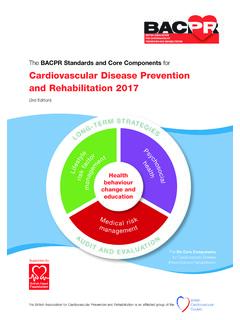
1 The BACPR Standards and Core Components for cardiovascular disease prevention and rehabilitation 2012(2nd Edition)BRITISH ASSOCIATION FOR cardiovascular prevention AND REHABILITATIONThe Seven Core Components for cardiovascular disease prevention and RehabilitationSupported byThe British Association for cardiovascular prevention and rehabilitation is an affiliated group of theAUDIT AND EVALUATIONL ifestylePsychosocialrisk factorhealthmanagementtherapiesmanagemen tCardioprotectiverisk factorMedicalHealth behaviour change and educationLONG-TERM MANAGEMENTF oreword There are an estimated million people living with heart disease in the United Kingdom
2 (UK). Cardiac rehabilitation is one of the best researched examples of long term condition management. It is a clinically and cost effective intervention that results in improved outcomes for the patient with heart disease . The second edition of the BACPR Standards and Core Components for cardiovascular disease prevention and rehabilitation sets out the seven core Standards that patients, health care professionals and commissioners should expect from a high quality cardiac rehabilitation programme. prevention , behaviour change and education are at the heart of these new Standards .
3 Approaching cardiovascular disease as a long term condition requires an integrated approach that enables the patient and their family to manage the condition with the support of a proactive and supported health care system. The development of the multidisciplinary team approach adopted by the best of cardiac rehabilitation schemes across the UK is essential to delivering this integrated publication of these Standards is an achievable and credible consensus statement from the British Association for cardiovascular prevention and rehabilitation ( BACPR ) of excellence in cardiac rehabilitation .
4 The Standards complement a suite of guidelines and reports, which include the NICE commissioning guide on cardiac rehabilitation and the Department of Health in England s commissioning pack on cardiac rehabilitation ; as well as relevant guidelines and reports that apply to Scotland, Wales and Northern Ireland. Audit and evaluation is an important inclusion in the new core Standards . The British Heart Foundation (BHF) continues to be committed to support and fund the National Audit of Cardiac rehabilitation (NACR). The most recent audit suggests that in 2009-10, only 42% of eligible patients across England, Wales and Northern Ireland took part in cardiac rehabilitation .
5 The BACPR s new Standards will help ensure that more patients take part, through the provision of excellence in cardiac rehabilitation , across the four nations of the rehabilitation is effective in improving the cost effective use of NHS resources. The NHS is currently facing a considerable financial challenge, and we are grateful to the BACPR for their timely publication of these Standards . Dr Mike Knapton, Associate Medical Director, BHFS upported byContentsSummary from the primary writing National and local factors for assuring Cardiac rehabilitation pathway of Cardiac rehabilitation as part of an integrated cardiology service Cost of cardiac Considerations and key goals for the Supporting the implementation of these Standards and core components52 The The delivery of seven core Components employing an evidence-based An integrated multidisciplinary team consisting of qualified and competent practitioners, led by a clinical Identification.
6 Referral and recruitment of eligible patient Early initial assessment of individual patient needs in each of the core Components , ongoing assessment and reassessment upon programme Early provision of a cardiac rehabilitation programme, with a defined pathway of care, which meets the core Components and is aligned with patient preference and Registration and submission of data to the National Audit for Cardiac rehabilitation (NACR) Establishment of a business case including a cardiac rehabilitation budget which meets the full service costs113 The Core Health behaviour change and Health behaviour Lifestyle risk factor Physical activity and Diet Smoking cessation and relapse Psychosocial Medical risk factor Cardioprotective Cardioprotective Implantable Long-term Patient responsibilities Service responsibilities Audit and evaluation184 Appendices 19 Appendix 1 Key websites19 Appendix 2 References20 Acknowledgements Facing page 22
7 Standards and Core Components 2012 (2nd Edition) 1 Summary from the Primary Writing GroupThis second edition of the BACPR Standards and Core Components for cardiovascular disease prevention and rehabilitation builds on the success of the original 2007 version by incorporating the latest developments in the clinical evidence base for cardiac rehabilitation . A corresponding aim is to align these new Standards with the wider agenda across the UK nations for providing quality programmes that are underpinned by appropriate service contracts or commissioning agreements and other relevant national guidance.
8 There are seven Standards together with seven core Components , which aim to ensure programmes are clinically effective, cost effective and achieve sustainable health outcomes for patients. These Standards and core Components support an integrated approach to the prevention and rehabilitation of cardiovascular disease as the foundation of every cardiac rehabilitation programme. The illustrative model of the seven core Components represents health behaviour change and education as central and integral to all of the other Components , as well as equal emphasis on the delivery of care in lifestyle risk factor management, psychosocial health, medical risk factor management and cardioprotective therapies.
9 On programme completion it is imperative for effective long-term management that each service has defined pathways for continuity of care that ultimately leads to the best possible levels of self-management and secondary prevention . Audit and evaluation is given major importance; now being included as both a standard and core rehabilitation is effective and value for money; nevertheless current service provision and uptake varies considerably across the country. The application of these Standards aims to reduce this variation in care whilst effectively increasing both service uptake and programme completion.
10 Early assessment and goal setting together with early programme commencement are emphasised in recognition of the associated benefits in improved service uptake and potential reductions in hospital readmissions. The provision of a menu of best practice approaches run by a skilled multidisciplinary team in strong partnership (integration) between primary and secondary care is essential to improve uptake and completion rates of individualised and patient-centred these Standards requires programmes to be properly funded. Delivery of the core Components involves investment in an integrated multidisciplinary team of professionally qualified staff with the necessary knowledge, skills and competences.