Transcription of The Basic Principles of Sieve Analysis - …
1 Page 1 of 7 The Basic Principles of Sieve Analysis Introduction Many natural and manufactured materials occur in a disperse form, which means that they consist of differently shaped and sized particles. The particle size distribution, the number of particles of different sizes, is responsible for important physical and chemical properties such as: mechanical bulk behavior surface reaction taste miscibility filtration properties conductivity This list could be continued at great length. The examples clearly show how important it is to have a knowledge of the particle distribution, particularly within the context of quality assurance in the production of bulk goods. If the particle distribution changes during the manufacturing process then the quality of the finished product will also change. Only a continuous monitoring of the particle size distribution can guarantee a constant product quality.
2 Particle size determination methods There are different methods for determining the particle distribution. The choice of a particular method depends primarily on the dispersion status, on the degree of fineness of the sample. Fig. 1: Particle size determination methods Page 2 of 7 The oldest and best-known method is particle size determination by Sieve Analysis . The particle size distribution is defined via the mass or volume. Sieve Analysis is used to divide the particulate material into size fractions and then to determine the weight of these fractions. In this way a relatively broad particle size spectrum can be analyzed quickly and reliably. What happens in a Sieve Analysis ? During sieving the sample is subjected to horizontal or vertical movement in accordance with the chosen method. This causes a relative movement between the particles and the Sieve ; depending on their size the individual particles either pass through the Sieve mesh or are retained on the Sieve surface.
3 The likelihood of a particle passing through the Sieve mesh is determined by the ratio of the particle size to the Sieve openings, the orientation of the particle and the number of encounters between the particle and the mesh openings. As explained later, the likelihood of passage and therefore the associated quality of the sieved sample also depends on the Sieve movement parameters and the sieving time. The different sieving methods Depending on the material and the demands placed on the sieving result, various sieving methods are used for determining particle size and distribution. A Basic differentiation is made between the following methods: 1. Manual and mechanical sieving Today, manual sieving is only used where no electricity supply is available, for rapid on-site random checking for oversize and undersize. It is only used for orientation purposes. In contrast, Sieve analyses in the laboratory and for quality assurance are carried out with Sieve shakers.
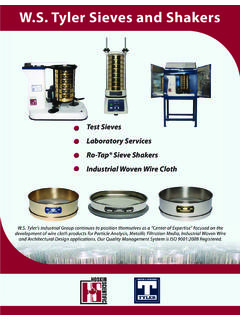
4 Modern Sieve shakers are characterized by the fact that their mechanical parameters, such as sieving time and amplitude or speed, are carried out with exact reproducibility. In the laboratory a differentiation is made between horizontal Sieve shakers and throw-action Sieve shakers. : Retsch Sieve Shakers AS 200 and AS 300 control Page 3 of 7 :In throw-action sieving the sample is subjected to a 3-dimensional movement. Throw-action sieving Throw-action Sieve shakers are also known as vibratory Sieve shakers. An electromagnetic drive sets a spring-mass system in motion and transfers the oscillations to the Sieve stack. The sample is subjected to a 3-dimensional movement and is distributed uniformly across the whole area of the Sieve . The amplitude can normally be set continuously in the range from 0-2 mm or 0-3 mm. Modern instruments, like the AS 200 control and AS 300 control from Retsch, additionally enable the required amplitude to be entered digitally.
5 During the sieving process, a built-in measuring system and control unit performs a continuous comparison between the set and actual amplitude values. This provides the optimal preconditions for reproducible sieving parameters. Digital accuracy for the sieving time and the interval function is a matter of course. Horizontal sieving In a horizontal Sieve shaker ( Retsch AS 400 control) the sieves move in horizontal circles in one plane. Horizontal Sieve shakers are preferably used for needle-shaped, flat, long or fibrous samples, as their horizontal orientation means that only a few disorientated particles enter the mesh and the Sieve is not blocked so quickly. The AS 400 control permits the use of test sieves with a diameter up to 400 mm. The large sieving area makes it possible to Sieve large amounts of sample, for example as encountered in the particle size Analysis of construction materials and aggregates.
6 In addition, in the fine particle size range and for obtaining single fractions, ultrasonic and air-jet sieving are used for special applications. 2. Single Sieve and Sieve set sieving The use of a single Sieve , frequently also known as Sieve cut, is only used to determine the percentage of undersize and oversize particles. Particle size distribution in the normal sense is not carried out. In a single sieving process, only a single Sieve with a defined mesh is subjected to the sieving movement together with a collector pan. It is normally used only for orientation purposes. Sieve set sieving is the process in which a set of several sieves is used together with a collector pan. The tests sieves are arranged in a stack with the largest mesh openings at the top of the stack. The sample is placed on the top Sieve . Fig. 4: In horizontal sieving the sample moves in horizontal circles. Page 4 of 7 3.
7 Dry and wet sieving Most sieving processes are carried out on dry materials. However, there are many applications in which wet sieving cannot be avoided, when the material to be tested is already present as suspension or when a very fine sample that tends to agglomerate has to be sieved. As in dry sieving, a Sieve stack is assembled on a Sieve shaker. The sieving process is additionally supported by water from a spray nozzle located above the uppermost Sieve . The sample is placed on the uppermost Sieve in the form of a suspension. Rinsing is carried out until the sieving liquid leaving the Sieve stack outlet is no longer turbid with solid particles. In wet sieving, the sieving liquid must not alter the physical or chemical properties of the sample. How can an optimal Sieve Analysis be carried out? Various preconditions must be fulfilled for a reproducible and meaningful Sieve Analysis and the settings must also be properly adapted to suit the particular problem.
8 The most important criteria are briefly described below. Representative part-sample The most important requirement for a reproducible Sieve Analysis is to obtain a representative partial sample from the whole of the bulk material to be tested. Representative means that the properties of the part-sample, in this case the particle distribution, must be identical to the properties of the whole bulk material to be sampled. If this requirement is not fulfilled, then the results of the Sieve Analysis can only be applied to the particular part-sample. The amount of sample depends primarily on the maximum particle size, the number of sieves in the Sieve stack and their openings. The sieves must not be overloaded. For a Sieve with a diameter of 200 mm and 2 mm mesh the amount of sample should not exceed a volume of 200 ml ( 300 g sand).
9 For a mesh of mm, the limit is 80 ml, for a mm Sieve 40 ml. Further information can be found in DIN 66 165. Calibrated and certified test sieves Standardized sieves in accordance with ISO 3310 or ASTM E11 are normally used for a Sieve Analysis . These standards describe the technical requirements for the sieves and methods for checking them. The choice of test Sieve (diameter and mesh) depends mainly on the amount of sample and its particle size distribution. The number of sieves and the steps between the nominal mesh openings should be selected so that as much as possible of the whole range of sizes contained in the sample is separated into fractions. Information about this can also be found in the main and secondary series of ISO 3310 and ISO 565. Although the majority of the sieves used have a diameter of 200 mm or 203 mm/8 , sieves with a diameter of 100 to 400 mm are also used.
10 At the customer s request the manufacturer can provide an acceptance report or a test Sieve calibration certificate. The latter is particularly important if the test Sieve is to be calibrated within the context of test agent monitoring. Optimal sieving time and amplitude or speed The settings for the sieving time and the optimal amplitude or speed depend on the material to be sieved. National and international standards, internal regulations and standards normally provide detailed information about product-specific Sieve analyses and their associated sieving parameters. The instruction manual for the Sieve shaker should also provide guidelines for this. Page 5 of 7 If this Basic information does not exist then the sieving time and amplitude or speed must be determined experimentally. This is done by first selecting a relatively short sieving time ( 5 min) and carrying out sieving at various amplitudes or speeds to determine at which values the largest amount of sample passes through the sieves (optimal sieving quality).