Transcription of The Basic Steps to Ethically Closing a Law Practice
1 1 The Basic Steps to Ethically Closing a Law Practice (Rev. Jan. 2017) By Mary F. Andreoni, Education Counsel, ARDC There are many different reasons why a law Practice closes, some are planned, , retirement, merging firms, or entering public office, and others can be unplanned, disability or death. The ethical duties of the lawyer in each of these situations, however, are similar - to protect the clients interests. There are no specific rules covering what lawyers must do in winding down a law Practice . This publication focuses on the Basic ethical obligations when Closing a law Practice .
2 The forms and suggested procedures provided here are meant to assist lawyers in accomplishing a smooth and efficient transition that meets a lawyer s ethical obligations. Lawyers with questions are encouraged to call the ARDC Ethics Inquiry Hotline at either the ARDC Chicago office: 312/565-2600 or 800/826-8625 or Springfield office: 217/52-6838 or 800/252-8048. SET TARGET DATES Closing a law Practice requires preparation, organization and time. Once the decision to close a Practice has been made, set a target date for when the Practice will close and target dates for completing the many tasks in Closing the Practice , particularly when to notify clients.
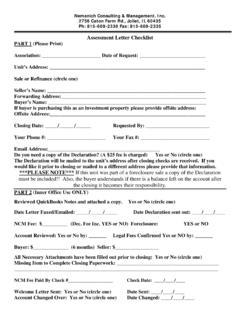
3 Planning is essential and you should probably allow at least six months to one year to complete the many tasks necessary to close a law Practice . Appendix: LAW OFFICE Closing CHECKLIST PREPARE AN INVENTORY OF CLIENT FILES AND RECORDS Client Files The first task is to inventory of all client matters. First, determine which matters are active and which are closed. For open client matters, the inventory should include the following information: name and last known address of the client; telephone numbers both for work and home of the client; nature of the client s legal matter; the current status of the representation and what remains to be done for completion of the representation; any time limitations and/or deadlines; 2 title and case number of any proceeding, if applicable; whether any funds or property is being held in trust.
4 And the location of the file and whether the file contains any original documents, such as a deed, contract or will. For closed client matters, the inventory should include the following information: name and last known address of the client; telephone numbers both for work and home of the client; nature of the client s legal matter; date when the representation was concluded; title and case number of any proceeding, if applicable; whether any funds or property that were held in trust have been disbursed; and the location of the file, destruction date and whether the file contains any original documents, such as a deed, contract or will.
5 Office Records For key Practice management records, the inventory should include the following information: Business And Trust Accounts: o Institution names and locations o Account numbers o Signatory name(s) Safety Deposit Box And/Or Storage Facilities: o Location o Access information Computer And Voice Mail: o Access codes/passwords Important Business Documents o Leases o Maintenance contracts o Business credit cards o Client ledgers o Other books and records relating to business and trust accounts Computer Data and/or Hardcopy Backups of: o Conflicts o Calendaring backup o Time billing records o Accounts receivable/payable o Active client file inventory o Closed file storage location and inventory 3 NOTIFY CLIENTS Write to clients with active files, advising them that you are unable to continue representing them and that they need to retain new counsel.
6 Your letter should inform them about time limitations and time frames important to their cases. The letter should explain how and where they can pick up copies of their files and should give a time deadline for doing this and should be sent certified mail, return receipt requested, so that a record is created of who was contacted and who received the notice. Appendix: letter ADVISING THAT LAWYER IS Closing HIS/HER OFFICE Open Client Matters If the legal matter is still open, the letter should advise the client of the following: the anticipated termination of representation and the closure of the law office time frame; the need to retain new counsel and, if desired, will refer them to three qualified attorneys and to the local bar association's lawyer referral service; the status of their matter and any time limitations and time frames important to their cases.
7 An accounting of all trust property being held by the lawyer and the lawyer s disbursement of same; the current status of fees earned and amounts owed and request for payment on all open invoices; Directions from the client regarding their authority to transfer their case to another attorney consent to withdraw and submit a motion for an order to withdraw as attorney of record picking up their original file materials, evidence paying outstanding bills disbursement of trust monies, etc. explain how and where they can pick up copies of their files and should give a time deadline for doing this, , asking them to pick up their files within 30 days (beyond which they will be destroyed, unless otherwise required by your engagement agreement or applicable law).
8 Closed Client Matters If the legal matter is closed, the letter should advise the client of the following: the closure of the law office time frame; 4 the law firm s file destruction policy; and explain how and where they can pick up copies of their files and should give a time deadline for doing this. Sale of a Law Practice Notice If the Practice is Closing due to a sale, ILRPC (c) requires additional notices to clients, as follows: The seller gives written notice to each of the seller s clients regarding: (1) the proposed sale; (2) the client s right to retain other counsel or to take possession of the file; and (3) the fact that the client s consent to the transfer of the client s files will be presumed if the client does not take any action or does not otherwise object within ninety (90) days of receipt of the notice.
9 If a client cannot be given notice, the representation of that client may be transferred to the purchaser only upon entry of an order so authorizing by a court having jurisdiction. ILRPC (c). The seller may disclose to the court in camera information relating to the representation only to the extent necessary to obtain an order authorizing the transfer of a file. ILRPC , cmt. [8]. If the purchaser has identified a conflict of interest that the client cannot waive and that prohibits the purchaser from undertaking the client's matter, the notice shall advise that the client should retain substitute counsel to assume the representation and arrange to have substitute counsel contact the seller.
10 ILRPC , cmt. [11]. Receivership Notice If a Practice is Closing due to the lawyer's death, disability or disappearance and if no partner, associate, executor or other responsible party capable of conducting the lawyer's affairs is known to exist, Supreme Court Rule 776 provides for the appointment of a receiver to inventory the law firm files and fulfill the duties necessary to close the Practice . The receiver does not necessarily take over the deceased lawyer's Practice , but instead owes fiduciary duties to the court for the proper disposition of the Practice .