Transcription of The Behaviour Change Wheel - Fight Bac!
1 Dr Lou AtkinsSenior Teaching Fellow and Australasian Hub Lead, UCL Centre for Behaviour ChangeThe Behaviour Change Wheel : a tool to promote consumer food safetyCFSE Conference January 2017, Washington DCUCL Centre for Behaviour ChangeWho we are Core team of researchers, trainers & practitioners in Behaviour Change A cross-disciplinary community of academic experts at UCL & beyond Global network of over 4,000 contactsOur aimsTo harness the breadth and depth of academic expertise in Behaviour Change to Increase the quantity and quality of Behaviour Change research Translate that expertise to policy-makers, practitioners, industry, NGOs and researchers to address key challenges facing @UCLB ehaveChangeWhat we doTraining International Summer Schools Bespoke and open short courses and workshopsTeaching MSc Behaviour Change (launching Sept 2017)
2 Methods and theories of Behaviour Change Behaviour Change interventions applied to real world issuesConsultancy Behaviour Change expertise provided to public, private and charity sector organisationsEvents Digital Health Conferences (22 & 23 Feb 2017) Public talks and seminarsKeycollaboratorsin thisworkPr Susan MichieUCL HealthPsychology ResearchgroupPr Robert WestWe know we can t build bridges or perform open heart surgeryWe recognise these tasks require expert knowledge and skillswe all behave and see others behave ..and have our own theories about how to Change Behaviour ..and they can be wrong!Yet when it comes to changing is a science of Behaviour Change but it s not always interventions designed according to The ISLAGIATT principle of intervention Seemed Like AGood Idea At The TimeMartin Eccles, Emeritus Professor of Clinical Effectiveness , Newcastle UniversityBehavioural problemInterventionUnderstanding the Behaviour (s) we are trying to changeThis tools to apply the science of Behaviour Change to promote consumer food safetyKey words: Comprehensive, Systematic, TransparentCleanWhich behaviours ?
3 Four core practices: washingCleaning utensilsCleaning surfacesRinse fruit and vegFood placement in cart and fridgeUsing cutting boardsCooked and raw food placementUsing a thermometerCooking eggs until firmReheating saucesEnsuring no coldspotsTimely refrigerationTimely disposalMarinatingDefrostingWhich behaviours ? Consider: likely impactif undertaken likelihood that such a Behaviour will be implemented ease, cost preference, acceptability spilloverto other behaviours and people every Behaviour is within a network of behaviours within each person and each person is within a network of other peopleSpecify the target Behaviour Specify whoneeds to do what, wheredo they need to do it, when, how often and for how long? Being more specific about which Behaviour (s) we are trying to Change allows us to be more focussed when it comes to understanding these longWhere/when?
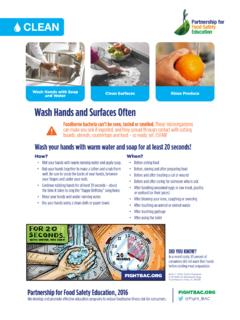
4 Cleaning handsWashing hands with warm water and soap Anyone handling food20 seconds minimumBefore and after handling food; after using the bathroom, changing diapers and handling petsUnderstand the Behaviour in context To Change Behaviour we need to understand it Whyare behaviours as they are? What needs to Change for the desired Behaviour /s to occur?The COM-B model Behaviour as an interaction between three necessary conditionsPsychological or physical ability to enact the behaviourMichieet al(2011) Implementation ScienceReflective and automatic mechanisms that activate or inhibit behaviourPhysical and social environment that enables the behaviourCollecting data using the COM-B modelObservationInterviews/focus groups -for in-depth qualitative dataQuestionnaires -for larger samplesStructured discussion -if resource poorUsing COM-B to understand what needs to Change for people to use separate cutting boards Psychological Do they know to use separate cutting boards for raw meat?
5 Physical Possibly not relevant. Physical Do they have more than one cutting board? Social Possibly not relevant. Reflective Do they think it s important to do (do they think there are benefits/harms of doing it)? Automatic Do they need to develop a routine or habit of using separate cutting boards? Intervening: Consider the full range of options Need a framework that So don t miss options that might be So can have a systematic method for intervention to a model of Behaviour So that can draw on behavioural scienceDo we have such a framework? Systematic literature review identified 19 frameworks of Behaviour Change interventions related to health, environment, culture Change , social marketing etc. None met all these three criteria So .. Developed a synthesis of the 19 frameworks The Behaviour Change WheelMichieet al(2011)]Implementation ScienceBehaviour at the hub.
6 COM-BUse rules to reduce the opportunity to engage in the behaviourIncrease knowledge or understandingUse communication to induce positive or negative feelings to stimulate actionCreate an expectation of rewardCreate an expectation of punishment or costImpart skillsIncrease means or reduce barriers to increase capability (beyond education or training) or opportunity (beyond environmental restructuring) Provide an example for people to aspire to or emulateChange the physical or social contextIntervention functions(the purpose(s) an intervention serves)Making or changing lawsDesigning and/or controlling the physical or social environmentCreating documents that recommend or mandate practice. This includes all changes to service provision Using the tax system to reduce or increase the financial cost Establishing rules or principles of Behaviour or practiceDelivering a service Using print, electronic, telephonic or broadcast mediaPolicy categories ( the channels through which an intervention is delivered)
7 Policy categoriesCommunication/ marketingGuidelinesFiscal measuresRegulationLegislationEnvironment al/ Social planningService provisionEducationPersuasionIncentivisat ionCoercionTrainingRestrictionEnvironmen tal restructuringModellingEnablementInterven tion functionsEducationPersuasionIncentivisat ionCoercionTrainingRestrictionEnvironmen tal restructuringModellingEnablementPhysical capabilityPsychological capabilityPhysical opportunitySocial opportunityAutomatic motivationReflective motivation Intervention functions based on understanding the Behaviour using COM-B Policy categories based on selected intervention functionsMatrices allow a systematic method for APEASE criteria: Making context-based decisions on intervention contentAffordabilityCan it be delivered within an acceptable budget?
8 PracticabilityCan it be delivered as designed and to scale?Effectiveness/cost-effectivenessHo w well does it work and is it worth the cost?AcceptabilityIs it judged appropriate to relevant stakeholders (policy makers, practitioners, the public) and engaging for potential users? Side-effects/safetyDoes it have unwanted side-effects or unintended consequences? EquityWill it reduce or increase disparities in health/wellbeing/standard of living? We can design a broad intervention strategy What purpose (function) our intervention should serve, to educate, persuade, enable etc. How the intervention will be delivered, communication/marketing, guidelines buthow exactly are we effecting Change within this intervention strategy? Behaviour Change Techniques (BCTs) Active ingredients within the intervention designed to Change Behaviour They are: irreducible components of an intervention observable/measurable replicable Can be used alone or in combination with other BCTs Goal setting Self-monitoring Effects of internet behavioral counselingon weight loss in adults at risk for Type 2 diabetes feedbackon self-monitoringrecord, reinforcement, recommendations for Change , answers to questions, and general support (Tate et al.)
9 JAMA 2003) Variable terminologyTitle of journal articleDescription of behavioural counseling The impact of behavioral counselingon stage of Change fat intake, physical activity, and cigarette smoking in adults at increased risk of coronary heart disease educatingpatients about the benefits of lifestyle Change , encouraging them, and suggesting what changes could be made (Steptoe et al. AJPH2001)Descriptions of behavioural counselling in two interventions Pharmacological ingredients/dose/frequency administration clearly stated for each medication in British National Formulary (BNF)BiomedicalBehavioural support Different for biomedical content for varenicline/Champix(JAMA, 2006):Mechanisms of action:Activity at a subtype of the nicotinic receptor where its binding produces agonistic activity, while simultaneously preventing binding to a4b2 content (Cochrane, 2005): -Review smoking history & motivation to quit-Help identify high risk situations-Generate problem-solving strategies-Non-specific support & encouragementMechanisms of action:None a Until recently, we lacked a shared language!
10 What is the solution? Behaviour Change Technique Taxonomies28 Michie, Richardson et al. (2013)BCT Taxonomy v1 93 BCTs Labels, definitions and examplesWhich BCTs are appropriate for my intervention? Behaviour Change Wheel Guide sets out which frequently identified BCTs link to each intervention functionsFunction:EducationBCT:Informati on about health consequencesSpecifying intervention contentFunction:ModellingBCT:Demonstrati on of the behaviourFunction:PersuasionBCT:Salience of consequencesFunction:EducationBCT:Instru ction on performing the behaviourFunction: PersuasionBCT: Salience of consequencesFunction: ModellingBCT: Demonstration of the behaviourWhy specify content? Aid replication Identify trends in use Identify underused, potentially effective functions and techniquesThe Behaviour Change Wheel : A Guide to Designing Interventions(Michie, Atkins & West, 2014) the problem in behavioural target the target what needs to of deliveryStage 3: Identify content and implementation optionsStage 2: Identify intervention optionsStage 1.