Transcription of The C Programming Language Ritchie & Kernighan
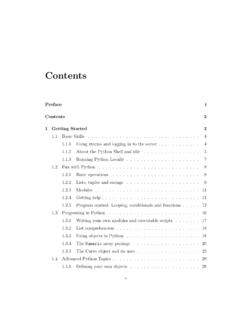
1 1. 2. 6. Preface to the first edition .. 8. Chapter 1 - A Tutorial Introduction .. 9. Getting 9. Variables and Arithmetic Expressions .. 11. The for 16. Symbolic 17. Character Input and Output .. 18. File 18. Character Counting .. 20. Line 21. Word 22. Arrays .. 23. Functions .. 25. Arguments - Call by 28. Character Arrays .. 29. External Variables and Scope .. 31. Chapter 2 - Types, Operators and Expressions .. 35. Variable Names .. 35. Data Types and Sizes .. 35. Constants .. 36. 39. Arithmetic 40. Relational and Logical 40.
2 Type 41. Increment and Decrement 44. Bitwise Operators .. 46. Assignment Operators and 47. Conditional 49. Precedence and Order of 49. Chapter 3 - Control Flow .. 52. Statements and Blocks .. 52. If-Else .. 52. Else-If .. 53. 54. Loops - While and For .. 56. Loops - 58. Break and 59. Goto and 60. Chapter 4 - Functions and Program 62. Basics of Functions .. 62. Functions Returning Non-integers .. 65. External Variables .. 67. Scope Rules .. 72. Header 73. Static Variables .. 75. Register Variables .. 75. Block 76.
3 Initialization .. 76. 78. The C Preprocessor .. 79. 3. File 79. Macro Substitution .. 80. Conditional Inclusion .. 82. Chapter 5 - Pointers and Arrays .. 83. Pointers and 83. Pointers and Function Arguments .. 84. Pointers and Arrays .. 87. Address Arithmetic .. 90. Character Pointers and 93. Pointer Arrays; Pointers to Pointers .. 96. Multi-dimensional Arrays .. 99. Initialization of Pointer 101. Pointers vs. Multi-dimensional 101. Command-line Arguments .. 102. Pointers to 106. Complicated Declarations .. 108. Chapter 6 - 114.
4 Basics of Structures .. 114. Structures and Functions .. 116. Arrays of Structures .. 118. Pointers to Structures .. 122. Self-referential Structures .. 124. Table Lookup .. 127. 129. Unions .. 131. 132. Chapter 7 - Input and 135. Standard Input and Output .. 135. Formatted Output - printf .. 137. Variable-length Argument 138. Formatted Input - 140. File Access .. 142. Error Handling - Stderr and Exit .. 145. Line Input and Output .. 146. Miscellaneous Functions .. 147. String 147. Character Class Testing and Conversion.
5 148. Ungetc .. 148. Command Execution .. 148. Storage 148. Mathematical Functions .. 149. Random Number generation .. 149. Chapter 8 - The UNIX System 151. File Descriptors .. 151. Low Level I/O - Read and 152. Open, Creat, Close, Unlink .. 153. Random Access - Lseek .. 155. Example - An implementation of Fopen and 156. Example - Listing Directories .. 159. Example - A Storage Allocator .. 163. Appendix A - Reference Manual .. 168. Introduction .. 168. 4. Lexical 168. Tokens .. 168. 168. 168. 169. Constants .. 169.
6 String Literals .. 171. Syntax 171. Meaning of Identifiers .. 171. Storage Class .. 171. Basic Types .. 172. Derived 173. Type 173. Objects and Lvalues .. 173. Conversions .. 173. Integral 174. Integral 174. Integer and 174. Floating Types .. 174. Arithmetic 174. Pointers and Integers .. 175. Void .. 176. Pointers to 176. 176. Pointer Conversion .. 177. Primary 177. Postfix Expressions .. 177. Unary Operators .. 179. Casts .. 181. Multiplicative 181. Additive Operators .. 182. Shift Operators .. 182. Relational 183.
7 Equality 183. Bitwise AND 183. Bitwise Exclusive OR Operator .. 184. Bitwise Inclusive OR Operator .. 184. Logical AND 184. Logical OR Operator .. 184. Conditional 184. Assignment 185. Comma Operator .. 185. Constant Expressions .. 186. 186. Storage Class Specifiers .. 187. Type 188. Structure and Union Declarations .. 188. 191. 192. Meaning of Declarators .. 193. 196. Type 198. 5. 199. Type Equivalence .. 199. Statements .. 199. Labeled 200. Expression Statement .. 200. Compound Statement .. 200. Selection 201. Iteration 201.
8 Jump statements .. 202. External Declarations .. 203. Function 203. External Declarations .. 204. Scope and Linkage .. 205. Lexical Scope .. 205. 206. 206. Trigraph Sequences .. 207. Line Splicing .. 207. Macro Definition and Expansion .. 207. File 209. Conditional Compilation .. 210. Line Control .. 211. Error 211. Pragmas .. 212. Null 212. Predefined names .. 212. 212. Appendix B - Standard 220. Input and Output: < > .. 220. File Operations .. 220. Formatted 222. Formatted Input .. 223. Character Input and Output 225.
9 Direct Input and Output Functions .. 225. File Positioning Functions .. 226. Error Functions .. 226. Character Class Tests: < > .. 226. String Functions: < >.. 227. Mathematical Functions: < >.. 228. Utility Functions: < > .. 229. Diagnostics: < >.. 231. Variable Argument Lists: < > .. 231. Non-local Jumps: < >.. 232. Signals: < > .. 232. Date and Time Functions: < >.. 233. Implementation-defined Limits: < > and < >.. 234. Appendix C - Summary of Changes .. 236. 6. Preface The computing world has undergone a revolution since the publication of The C.
10 Programming Language in 1978. Big computers are much bigger, and personal computers have capabilities that rival mainframes of a decade ago. During this time, C has changed too, although only modestly, and it has spread far beyond its origins as the Language of the UNIX. operating system. The growing popularity of C, the changes in the Language over the years, and the creation of compilers by groups not involved in its design, combined to demonstrate a need for a more precise and more contemporary definition of the Language than the first edition of this book provided.