Transcription of The Choice is Clear - OSPHOS
1 The Choice is ClearNAVICULAR SYNDROME is a multifaceted disease and the treatment options are not always Clear . When radiographic signs indicative of bony changes associated with navicular syndrome are present, OSPHOS is a Clear ReactionForceFlexingForceLong Pastern BoneExtensor TendonCoronary BandSensitive LaminaeHorny LaminaePedal (Coffin) BoneHoof WallSoleFrogNavicular BursaDigial CushionNavicular Bone Short Pastern BoneFlexor TendonsDeep Digital Flexor TendonP1P2P3 Long Pastern BoneExtensor TendonCoronary BandSensitive LaminaeHorny LaminaePedal (Coffin) BoneHoof WallSoleFrogNavicular BursaDigital CushionNavicular Bone Short Pastern BoneFlexor TendonsP1P2P3 Long Pastern BoneExtensor TendonCoronary BandSensitive LaminaeHorny LaminaePedal (Coffin) BoneHoof WallSoleFrogNavicular BursaDigital CushionNavicular Bone Short Pastern BoneFlexor TendonsDIAGNOSIS: No single test can be used to diagnose navicular syndrome.
2 In addition to physical exam and lameness evaluation, a combination of hoof pressure tests, nerve blocks, motion analysis, radiographs and imaging modalities (ultrasound, nuclear scintigraphy, computed tomography, and magnetic resonance imaging) may be be needed. Diagnosis is made after a consideration of the horse s history, use, conformation, and test results. Radiography is the most universally used, and widely accessible, diagnostic test for supporting a clinical diagnosis of navicular NAVICULAR SYNDROME is defined as chronic forelimb lameness associated with pain arising from the navicular bone and closely related structures including the collateral suspensory ligaments of the navicular bone, distal sesamoidean impar ligament, navicular bursa, and the deep digital flexor pain associated with navicular syndrome has been reported as causing one-third of all chronic forelimb lameness in The syndrome affects horses of many breeds and activity groups, typically 4 to 15 years of ,3 The term navicular syndrome encompasses disease to any tissue in the heel including pathologic changes to bone, cartilage, ligaments and tendons.
3 Often there are multiple tissues involved in the disease process leading to a progressive, degenerative state. The exact cause of navicular syndrome is unknown; however biomechanical influences are thought to be involved causing damage to the navicular bone which leads to increased bone remodeling and destruction. This abnormal bone remodeling can change the integrity of the navicular bone causing pain and leading to further damage. NAVICULAR SYNDROME is described as an intermittent, often bilateral, forelimb lameness most easily recognized by: Lameness observed turning or trotting the horse in circles Elicitation of pain over the middle third of the frog with hoof testers Improvement of the lameness after palmar digital nerve blocks Most horses with navicular syndrome exhibit mild to moderate lameness and 2-3 out of 5 on the AAEP lameness scale that is worse on hard surfaces1 AAEP LAMENESS SCALE (0-5)0: Lameness not perceptible under any : Lameness is difficult to observe and is not consistently apparent, regardless of circumstances ( under saddle, circling, inclines, hard surface, etc.)
4 2: Lameness is difficult to observe at a walk or when trotting in a straight line but consistently apparent under certain circumstances ( weight-carrying, circling, inclines, hard surface, etc.).3: Lameness is consistently observable at a trot under all : Lameness is obvious at a : Lameness produces minimal weight bearing in motion and/or at rest or a complete inability to navicular bone is a complex structure which contains foraminae for vessels and nerves on the proximal and distal borders. Bisphosphonate administration Corrective shoeing and proper hoof trimming Regenerative medicine ( irap, stem cells) Veterinary-prescribed rest and exercise protocols tailored to the individual horse Veterinary-prescribed pain management Nutraceuticals Shockwave therapyNON-SURGICAL TREATMENT OPTIONS FOR NAVICULAR SYNDROME:BONE REMODELING and BISPHOSPHONATESThe normal bone remodeling pathway requires that bone resorption (digestion of bone) and new bone formation take place at the same site and in a coordinated fashion.
5 Usually, the amount of bone formed during bone remodeling equals the amount destroyed. Any disruption in this balance results in disease to the bone, including bone main effect of a bisphosphonate is to decrease bone resorption. Bisphosphonates act to inhibit bone resorption by decreasing the number and the activity of osteoclasts. During bone stress or disease, bone metabolism is accelerated and osteoclasts are stimulated to begin the remodeling cycle. Osteoblasts follow behind the bone-eating cells, but at a much slower pace. Accelerated bone resorption may exceed the bone rebuilding process during these times of chronic bone disease or stress, including navicular Drugs such as bisphosphonates (including OSPHOS ) regulate bone metabolism through inhibition of bone resorption and bring the balance of osteoclast and osteoblast activity back to normal by reducing the activity of the only way to evaluate different bisphosphonate drugs is via evaluation of published safety and efficacy in the target species.
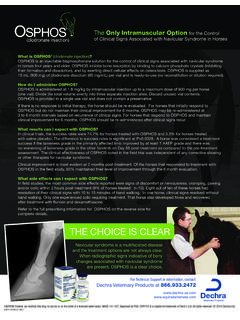
6 Normally, the amount of bone formed during bone remodeling equals the amount destroyed. Any disruption in this balance results in disease to the bone, including bone Osteoclast resorbing boneBone matrix Osteoblasts receive the signal to migrate to the site of resorptionOsteoblasts move in to begin bone reformationOsteoblasts complete the bone remodeling processWhat is OSPHOS (clodronate injection)? OSPHOS is an FDA approved injectable bisphosphonate solution for the control of clinical signs associated with navicular syndrome in horses four years and older. OSPHOS inhibits bone resorption by binding to calcium phosphate crystals (inhibiting their formation and dissolution), and by exerting direct cellular effects on osteoclasts. OSPHOS is supplied as 15 mL (900 mg) of clodronate disodium (60 mg/mL) per vial and is ready-to-use (no reconstitution or dilution required).How do I administer OSPHOS ?
7 OSPHOS is administered at mg/kg by intramuscular injection up to a maximum dose of 900 mg per horse (one vial). Divide the total volume evenly into three separate injection sites. Discard unused vial contents. OSPHOS is provided in a single use vial and does not contain a there is no response to initial therapy, the horse should be re-evaluated. For horses that initially respond to OSPHOS but do not maintain their clinical improvement for 6 months, OSPHOS may be re-administered at 3 to 6 month intervals based on recurrence of clinical signs. For horses that respond to OSPHOS and maintain clinical improvement for 6 months, OSPHOS should be re-administered after clinical signs results can I expect with OSPHOS ?In clinical trials, the success rates were for horses treated with OSPHOS and for horses treated with saline placebo. The difference in success rates is significant (p-value= ). A horse was considered a treatment success if the lameness grade in the primarily affected limb improved by at least 1 AAEP grade and there was no worsening of lameness grade in the other forelimb on Day 56 post-treatment as compared to the pre-treatment assessment.
8 Of the 86 horses treated with OSPHOS , 8 horses had an improvement of 3 lameness grades, 45 horses improved by 2 lameness grades and 16 horses improved by one lameness grade (raw data).5 The clinical effectiveness of OSPHOS noted in the field trial was independent of any corrective shoeing or other therapies for navicular syndrome. Clinical improvement is most evident at 2 months post-treatment. Of the horses that responded to treatment with OSPHOS in the field study, 65% maintained their level of improvement through the 6 month evaluation. What side effects can I expect with OSPHOS ?In field studies, the most common side effects reported were signs of discomfort or nervousness, cramping, pawing and/or colic within 2 hours post-treatment (9% of horses treated: n=10). Eight out of ten of these horses had resolution of their clinical signs with 10 to 15 minutes of hand walking. In one horse, clinical signs resolved without hand walking.
9 Only one experienced colic requiring treatment. That horse also developed hives and recovered after treatment with flunixin and dexamethasone. 1. Adam s and Stashak s lameness in horses-6th [edited by] Gary M. Baxter. Wiley-Blackwell, West Sussex, UK 2011; pp 475-593. 2. Colles, CM. Navicular Disease and Its Treatment. In Practice 1982; 4:29-36. 3. Dyson, SJ. Navicular disease and other soft tissue causes of palmar foot pain. In Diagnosis and Management of Lameness in the Horse. Ross MW, Dyson SJ, eds. Saunders, St. Louis, MO 2003; 286-298. 4. Fleisch, H. Biological effects. Bisphosphonates in bone disease: from the laboratory to the patient. [ ], 34-51. 2000. San Diego, Academic Data on fileCAUTION: Federal law restricts this drug to use by or on the order of a licensed veterinarian. NADA 141-427, Approved by FDA. OSPHOS is a registered trademark of Dechra Ltd. All rights reserved. Dechra Veterinary Products US and the Dechra D logo are registered trademarks of Dechra Pharmaceuticals PLC.
10 2015 Dechra Ltd. 04TB-OSP6001-0115 For Technical Support or information, contact: Dechra Veterinary Products at CLINICAL SIGNOSPHOS (n=111)Uncomfortable, Nervous, Colic, and/or Pawing (10)Lip (6) (5)Head (3)Injection site (2)Colic requiring treatment* (1) (1)Control (n=35)0% (0)0% (0)0% (0)0% (0) (1)0% (0)0% (0)(clodronate injection)BisphosphonateCAUTION: Federal law (USA) restricts this drug to use by or on the order of a licensed intramuscular use in horses : Clodronate disodium is a non-amino, chloro-containing bisphosphonate. Chemically, clodronate disodium is (dichloromethylene) diphosphonic acid disodium salt and is manufactured from the tetrahydrate structural formula of clodronate disodium is:Molecular Formula: CH2CL2O6 Weight: substance clodronate disodium tetrahydrate mg/mL corresponds to clodronate disodium mg/mL. Each mL contains 60 mg clodronate disodium, sodium hydroxide (to adjust pH) and water for : For the control of clinical signs associated with navicular syndrome in AND ADMINISTRATION: Administer mg/kg by intramuscular injection up to a maximum dose of 900 mg per horse.