Transcription of The Concise ProQOL Manual
1 2010 The Concise ProQOL Manual Beth Hudnall Stamm, PhD and 2 THE Concise Manual FOR THE PROFESSIONAL QUALITY OF LIFE SCALE THE ProQOL 3 The Concise ProQOL Manual , 2nd Edition Reference Stamm, (2010). The Concise ProQOL Manual , 2nd Ed. Pocatello, ID: Copyright Beth Hudnall Stamm. All rights reserved. 12345679890. Published The , Box 4362. Pocatello, ID 83205-4362. Cover design by Beth Hudnall Stamm Images copyright 2008 Henry E. Stamm, IV. Printed in Trebuchert MS font for the headers and 11 point Calibri font for the body. ISSN to be applied for Reference Stamm, (2010). The Concise ProQOL Manual . Pocatello, ID: Acknowledgements I here provide acknowledgements for their faithful contributions to the development of the ProQOL go to Joseph M.
2 Rudolph, Edward M. Varra, Kelly Davis, Debra Larsen, Craig Higson Smith, Amy C. Hudnall, Henry E. Stamm, and to all those from around the world who contributed their raw data to the databank. I am forever indebted to Charles F. Figley who originated the scale, and in 1996, 4 handed the scale off to me saying I put a semicolon there; you take it and put a period at the end of the sentence. No one could have wished for a better mentor, colleague, and friend. This material may be freely copied as long as (a) author is credited, (b) no changes are made, & (c). it is not sold except for in agreement specifically with the author.
3 TABLE OF CONTENTS The ProQOL .. 3 Section 1: compassion Satisfaction and compassion Fatigue .. 8 Figure 1: Diagram of Professional Quality of Life .. 8 Background .. 8 Figure 2: Theoretical path analysis .. 10 Section 2: Scale Definitions .. 12 compassion Satisfaction .. 12 compassion Fatigue .. 12 Section 3: Scale Properties .. 13 Scale Distribution .. 13 Table 1: ProQOL Moments .. 13 Reliability .. 13 Validity 13 Section 4: Administration of the ProQOL .. 14 Individual Administration .. 14 Group Administration .. 15 Research Administration .. 15 Section 5: ProQOL scoring .. 15 Calculating the Scores on The ProQOL .. 15 Scale Definitions and Scores.
4 17 Cut Scores .. 18 Table 2: Cut Scores for the ProQOL .. 18 Section 6: Interpreting the ProQOL .. 18 The ProQOL Is Not Diagnostic .. 18 5 The Importance of Knowing More than Just the ProQOL Scores .. 19 Scores Across Demographic Categories .. 19 Table 3: Gender .. 19 Table 4: Age Group .. 20 Table 4: Race .. 20 Table 5: Income Group .. 20 Table 6: Years at Current Employer .. 20 Table 7: Years in Field .. 21 Interpreting Individual Scales .. 21 compassion Satisfaction .. 21 compassion Fatigue .. 21 Interpreting Scale Scores in Combination .. 22 High compassion Satisfaction, Moderate to Low Burnout and Secondary Traumatic Stress.
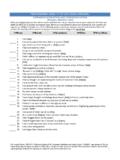
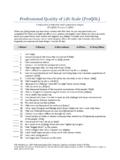
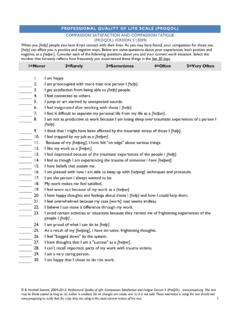
5 22 High Burnout, Moderate to Low compassion Satisfaction and Secondary Traumatic Stress .. 22 High Secondary Traumatic Stress with Low Burnout and Low compassion Satisfaction .. 22 High Secondary Traumatic Stress and High compassion Satisfaction with Low Burnout .. 23 High Secondary Traumatic Stress and High Burnout with Low compassion Satisfaction .. 23 Interpreting the ProQOL at a Group Level .. 23 Section 7: Using the ProQOL for Decision Making .. 24 Changing the Person Event Interaction .. 24 Monitoring Change Across Time .. 25 Section 8: The ProQOL Test and Handout .. 26 Professional Quality of Life Scale ( ProQOL ).
6 Error! Bookmark not defined. ProQOL Self Scoring Worksheet .. Error! Bookmark not defined. Scoring .. Error! Bookmark not defined. 6 Your Scores on The ProQOL : Professional Quality Of Life Scale .. Error! Bookmark not defined. SECTION 9: Converting from the ProQOL IV to the ProQOL 5 .. 31 Table for Determining ProQOL t Score from Raw Scores .. 31 SECTION 10: Bibliography .. 35 SECTION 11: Frequently Asked Questions .. 73 About the Author .. 77 7 SECTION 1: compassion SATISFACTION AND compassion FATIGUE Professional quality of life is the quality one feels n relation to their work as a helper. Both the positive and negative aspects of doing one's job influence ones professional quality of life.
7 People who work in helping professions may respond to individual, community, national, and even international crises. Helpers can be found in the health care professionals, social service workers, teachers, attorneys, police officers, firefighters, clergy, airline and other transportation staff, disaster site clean up crews, and others who offer assistance at the time of the event or later. Professional quality of life incorporates two aspects, the positive ( compassion Satisfaction) and the negative ( compassion Fatigue). compassion fatigue breaks into two parts. The first part concerns things such like exhaustion, frustration, anger and depression typical of burnout.
8 Secondary Traumatic Stress is a negative feeling driven by fear and work related trauma. Some trauma at work can be direct (primary) trauma. In other cases, work related trauma be a combination of both primary and secondary trauma. FIGURE 1: DIAGRAM OF PROFESSIONAL QUALITY OF LIFE Professional Quality of Life compassion compassion Satisfaction Fatigue Secondary Burnout Trauma BACKGROUND Professional quality of life for those providing care has been a topic of growing interest over the past twenty years. Research has that shown those who help people that have been exposed to traumatic stressors are at risk for developing negative symptoms associated with burnout, depression, and posttraumatic stress disorder.
9 In this body of literature, typically known as secondary traumatization or vicarious traumatization, the positive feelings about people's ability to help are known as compassion Satisfaction (CS). The negative, secondary outcomes have variously been identified as burnout, countertransference, compassion Fatigue (CF) and Secondary Traumatic Stress (STS), and Vicarious Traumatization (VT). While the incidence of developing problems associated with the negative aspects of providing care seems to be low, they are serious and can affect an individual, their family and close others, the care they provide, and their organizations.
10 The positive aspects of helping can be viewed as altruism; feeling good that you can do something to help. The negative effects of providing care are aggravated by the severity of the traumatic material to which the helper is exposed, such as direct contact with victims, particularly when the exposure is of a grotesque and graphic nature. The outcomes may include burnout, depression, increased use of substances, and symptoms of posttraumatic stress disorder. 8 In 1995, three books introduced the concepts of the negative effects on caregivers who provide care to those who have been 2 3 The terminology was at that time, and continues to be, a taxonomical conundrum.