Transcription of The Geometry of Perspective Projection
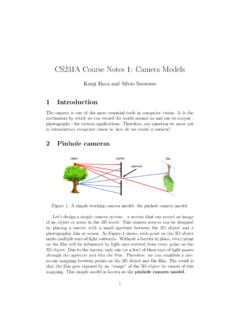
1 The Geometry of Perspective Projection Pinhole camera and Perspective Projection - This is the simplest imaging device which, however, captures accurately the geome- try of Perspective Projection . - Rays of light enters the camera through an infinitesimally small aperture. - The intersection of the light rays with the image plane form the image of the object. - Such a mapping from three dimensions onto two dimensions is called Perspective Projection . -2- A simplified geometric arrangement - In general, the world and camera coordinate systems are not aligned. - To simplify the derivation of the Perspective Projection equations, we will make the following assumptions: (1) the center of Projection coincides with the origin of the world. (2) the camera axis (optical axis) is aligned with the world's z-axis. -3- (3) avoid image inversion by assuming that the image plane is in front of the cen- ter of Projection .
2 Some terminology - The model consists of a plane ( image plane) and a 3D point O (center of Projection ). - The distance f between the image plane and the center of Projection O is the focal length ( , the distance between the lens and the CCD array). - The line through O and perpendicular to the image plane is the optical axis. - The intersection of the optical axis with the image place is called principal point or image center. (note: the principal point is not always the "actual" center of the image ). -4- The equations of Perspective Projection (notation: (x, y, z) (X, Y , Z), r R, (x , y , z ) (x, y, z), r r). - Using the following similar triangles: f r (1) from OA B and OAB: =. Z R. x y r (2) from A B C and ABC: = =. X Y R. Xf Yf Perspective proj. eqs: x= y= z= f Z Z. - Using matrix notation: xh f 0 0 0 X . yh 0 f 0 0 Y.
3 = . zh 0 0 f 0 Z . w 0 0 1 0 1 . - Verify the correctness of the above matrix (homogenize using w = Z): xh fX yh fY zh x= = y= = z= = f w Z w Z w -5- Properties of Perspective Projection Many-to-one mapping - The Projection of a point is not unique (any point on the line OP has the same Projection ). Scaling/Foreshor tening - The distance to an object is inversely proportional to its image size. -6- - When a line (or surface) is parallel to the image plane, the effect of Perspective Projection is scaling. - When an line (or surface) is not parallel to the image plane, we use the term foreshortening to describe the projective distortion ( , the dimension parallel to the optical axis is compressed relative to the frontal dimension). Effect of focal length - As f gets smaller, more points project onto the image plane (wide-angle cam- era).
4 - As f gets larger, the field of view becomes smaller (more telescopic). Lines, distances, angles - Lines in 3D project to lines in 2D. - Distances and angles are not preserved. - Parallel lines do not in general project to parallel lines (unless they are parallel to the image plane). -7- Vanishing point * parallel lines in space project perspectively onto lines that on extension inter- sect at a single point in the image plane called vanishing point or point at infinity. * (alternative definition) the vanishing point of a line depends on the orientation of the line and not on the position of the line. * the vanishing point of any given line in space is located at the point in the image where a parallel line through the center of Projection intersects the image plane. Vanishing line * the vanishing points of all the lines that lie on the same plane form the vanish- ing line.
5 * also defined by the intersection of a parallel plane through the center of projec- tion with the image plane. -8- Orthographic Projection - It is the Projection of a 3D object onto a plane by a set of parallel rays orthogonal to the image plane. - It is the limit of Perspective Projection as f > ( , f /Z > 1). orthographic proj. eqs: x = X, y=Y (drop Z). - Using matrix notation: xh 1 0 0 0 X . yh 0 1 0 0 Y . = . zh 0 0 0 0 Z . w 0 0 0 1 1 . - Verify the correctness of the above matrix (homogenize using w=1): xh yh x= =X y= =Y. w w Properties of orthographic Projection - Parallel lines project to parallel lines. - Size does not change with distance from the camera . -9- Weak Perspective Projection - Perspective Projection is a non-linear transformation. - We can approximate Perspective by scaled orthographic Projection ( , linear trans- formation) if: (1) the object lies close to the optical axis.
6 (2) the object's dimensions are small compared to its average distance Z from the camera ( , z < Z/20). Xf Xf Yf Yf weak Perspective proj. eqs: x= y= (drop Z). Z Z Z Z. f - The term is a scale factor now ( , every point is scaled by the same factor). Z. - Using matrix notation: xh f 0 0 0 X . yh 0 f 0 0 Y . = . zh 0 0 0 0 Z . w 0 0 0 Z 1 . - Verify the correctness of the above matrix (homogenize using w = Z): xh fX yh fY. x= = y= =. w Z w Z.