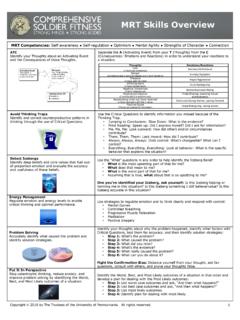
Transcription of THE ICEBERG MODEL EXPLAINED - …
1 1 THE ICEBERG MODEL EXPLAINED Our behaviour arises as a result of the interaction of two things: some characteristic we possess as a person, and some characteristic of the situation we face. If we wish to understand why we do what we do, and to exercise more choices about our behaviour, then we not only need to have a realistic understanding of the world around us, but we must also develop a high degree of self knowledge. There are many personal characteristics that influence what we do: skills, knowledge, social role, self image, traits and motives. These various characteristics exist at different levels of consciousness. You can think of these characteristics as being levels of an ICEBERG , as illustrated below. The most conscious ones are those above water on the visible tip of the ICEBERG , while the characteristics that are less conscious or unconscious are below water, on the submerged part of the ICEBERG .
2 The characteristics of which you are most conscious are your knowledge and skills, depicted as the tip of the ICEBERG . Skills represent what you can do and knowledge is what you know, including your experience of things and situations. 2 THE ICEBERG MODEL OF COMPETENCIES Social role is how you see yourself in society it affects what you think you should do in a particular role, and the things that you consider to be important. Our social role is a powerful driver of behaviour. It is formed and conditioned by our assumptions about the expectations of others; in particular by what we assume important people expect of us. This naturally leads to some more questions: Who is important? What expectations do I assume they have of me? We associate certain right things to do or think with roles we have: manager, parent, volunteer, etc. Our perceptions about these roles and the expectations of others condition not only choices we make about our behaviour, but also how we feel about those choices.
3 We may know that it is important, as a parent, to be at home to look after our children in the early evening, but this may be in conflict with our perception that a successful worker should be entertaining clients in the evening. SKILLSKNOWLEDGEEXPERIENCEI cannotI don t know howIt s not importantor appropriate to meIt s not meI don t enjoy itI canI know howIt s important to meIt is meI enjoy itSOCIAL ROLE, VALUES(How I see myself in society)SELF IMAGE(What I value in myself)TRAITS(My non conscious patterns of behaviour)MOTIVES(What excites me)Competency: any characteristic of a person that differentiates levels of performance in a given job, role, organisation or doesn t come easily to meIt comes easily to me 3 Sometimes we do not allow ourselves to consider the question: Who is important? We do things that conflict with a truthful answer to that question. For example, you may value balancing a career and family, or you may value achieving as much success as you can, or you may value both.
4 Self image is our sense of self of who we are which contains elements of positive, negative and unconditional regard. Many elements of self image are formed in childhood when we absorbed messages from our parents, teachers and formative influences. As such, we are scarcely conscious of its role in driving our behaviour. It is possible to access facets of self image through structured reflection (most of us would be able to describe what we thought were desirable and undesirable characteristics of ourselves without too much difficulty) but understanding how these became part of our self image may be more difficult. There are as many definitions of self image as there are approaches to development. At the core of most are three distinct elements of the way that we think of ourselves: A sense of the positive self, which is driven by what we think is respected by our parents, teachers or the environment in which we find ourselves.
5 As such it is influenced by how we interpret the social role of our current job or a job we aspire to. As noted above, we tend to ask what important people will expect of me in this role. It is also influenced by the injunctions of good and bad that we received from our parents. Sometimes we believe strongly in this interpretation of ourselves, and sometimes we have a feeling of its falseness. Sometimes we seek to protect this image through our defences. A sense of the negative self that we wish to hide from the world. If they knew how evil / bad / horrible / hating / incompetent / weak / worthless / needy I am they would all hate / reject / avoid me. This sense of self image is also false. Like the positive self image it is driven in part by judgements based on the values of our parents and / or the outside world. 4 The third sense of self could be called the unconditional self; the part of ourselves that we are at ease with, despite or regardless of external values in the past or current world.
6 This could be seen as the attribute of our self image in which we have made our own decisions about what we value, and it tends to be a more compassionate set of values and interpretations. With this part of myself I am OK , respectful not smug, at ease with myself rather than rejecting or hiding. This is not meant to be an exhaustive definition but one that shows how self image fits in relation to traits and social motives, how traits may be influenced or created by the values of our parents and therefore our sense of positive and negative self, and how the imposition of positive and negative may also be conditioned by society and our work through the definition of social role. Traits refer to relatively enduring physical, cognitive, and other characteristics that are habitual driver behaviours . They underpin many of the successful and less successful aspects of our lives. The ability to see patterns across the seemingly unrelated is an example of a cognitive trait called pattern recognition.
7 Self control is an example of a psychosocial trait. They can be recognised in patterns of behaviour. Traits are our attempts to behave in ways that will both gain us the recognition we need from others and satisfy the basic motivations that drive us (see below). Raised to awareness, we can exercise choice and our driver behaviours can help us towards successful living and working. However, when we are under stress, the driver behaviour may hijack us. Such hijacks undermine our ability to respond appropriately and can result in our being more stressed and potentially not fixing the problem. Because traits are formed through powerful influences deep in our intrinsic make up and the formative years of childhood, they often drive habits that are deeply ingrained but inappropriate for the complexities and subtleties of adult life. 5 Social motives are the least conscious characteristics. They are actually non conscious in that we are likely to be completely unaware of their existence in shaping who we are.
8 The reason they are so important is that they influence almost everything we do. Yet, because we rarely get feedback on what motivates us, we may not know or understand that characteristic in ourselves. At the detailed level, a motive is a concern. It is a concern that we have for something. And it s not a temporary concern; it s a recurrent concern that has as its object some goal or (if it is less tangible) a goal state based on a natural incentive. The goal or goal state is intrinsically satisfying. So a motive is a recurrent concern for a goal state, and that concern drives our thoughts and behaviour. Motives tend to determine the arenas in which we choose to engage. And, since motives orient our behaviour, we can start to understand what drives us by paying attention to what gives us a buzz , by looking carefully at our trait patterns, and then linking these to our leadership styles and other characteristics.
9 Even more importantly for leaders, we need to consider the potential for arousing different motives in others. What patterns of behaviour do I see in others, and how might they arise? Where is the trigger? Is it very deep seated in motives or higher up the ICEBERG in social role, for example? In summary, the deeper characteristics the submerged ones determine how well we are matched with our roles or jobs. But we have a choice about behaviour and if I understand my motives I can manage them in a way that is appropriate for my role in leading others. We can use other layers of the ICEBERG to help us develop the behaviours we need to lead others.