Transcription of THE INTERNET STROKE CENTER
1 THE INTERNET STROKE CENTERPRESENTATIONS AND DISCUSSIONS ON STROKE MANAGEMENTE mergency STROKE Evaluation & DiagnosisAbout this PresentationThe content of these pages is from an educational CD-ROM, " acute Ischemic STROKE : New Concepts of Care." Presentation on the INTERNET STROKE CENTER web site is made possible by an unrestricted educational grant from Genentech. All images and text are copyright 1998-1999, Genentech, Inc. and may not be reproduced in any form without written OF CONTENTS Evaluation by EMS Personnel 2 AHA STROKE Council Recommended Assessment of a Person with a Suspected STROKE by EMS Personnel 2 Clinical Presentations 3 Clinical Presentations of acute STROKE 3 Differential Diagnosis of STROKE 4 Conditions that Mimic STROKE in the Emergency Department 5 Left and Right Hemisphere STROKE : Common Patterns 6 Brain Stem / Cerebellum / Posterior Hemisphere STROKE .
2 Common Patterns 7 Tests for Emergent Evaluation 8 Tests for the Emergent Evaluation of the Patient with acute Ischemic STROKE 8 Acknowledgements 1 Evaluation by EMS PersonnelAHA STROKE Council Recommended Assessment of a Person with a Suspected STROKE by EMS PersonnelAssure adequate airwayMonitor vital signsConduct general assessment Evidence of trauma to head or neck CardConduct neurological examination Level of consciousness Presence of seizure activity Glasgow Coma Scale/NIHSS Pupils: size, equality, reactivity Individual limb movementsSource:Adapted from Adams HP, et al. Circulation. 1994;90 2 Clinical PresentationsClinical Presentations of acute StrokeAlteration in Consciousness Stupor or Coma Confusion or agitation/memory loss Seizures DeliriumHeadache Intense or unusually severe Associated with decreased level of consciousness/neurological de#cit Unusual/severe neck or facial painAphasia (incoherent speech or difficulty understanding speech)Facial weakness or asymmetry Paralysis of facial muscles ( , when patients speaks or smiles) May be on same side (ipsilateral) or opposite side contralateral to limb paralysisIncoordination, weakness, paralysis, or sensory loss of one or more limbs (usually one half of the body and in particular the hand)Ataxia (poor balance, clumsiness, or difficulty walking)
3 Visual loss Monocular or binocular May be partial loss of the #eld Intensive vertigo, double vision, unilateral hearing loss, nausea, vomiting, photophobia, or phonophobiaSource:American Heart Association. Basic Life Support for Healthcare Providers and Advanced Cardiac Life 3 Differential Diagnosis of StrokeIschemic strokeHemorrhagic strokeCraniocerebral / cervical traumaMeningitis/encephalitisIntracrania l mass Tumor Subdural hematomaSeizure with persistent neurological signsMigraine with persistent neurological signsMetabolic Hyperglycemia (nonketotic hyperosmolar coma) Hypoglycemia Post-cardiac arrest ischemia Drug/narcotic overdoseSource:American Heart Association. Basic Life Support for Healthcare Providers and Advanced Cardiac Life 4 Conditions that Mimic STROKE in the Emergency DepartmentOf 411 patients with an initial diagnosis of STROKE , 78 (19%) were eventually found to have other conditions, the majority consisting of: Postictal states Systemic infections Tumors Toxic-metabolic disturbancesVariables increasing the odds of a STROKE "mimic" in patients with initial diagnosis of STROKE : Decreased level of consciousness Normal eye movements Variables decreasing the odds of a STROKE "mimic" in patients with initial diagnosis of STROKE : Abnormal visual #elds Diastolic BP > 90 mmHg Atrial #brillation of ECG History of anginaSource:Libman RB, et al, Arch Neurol.
4 1995;52 5 Left and Right Hemisphere STROKE : Common Patterns Left (Dominant) Hemisphere STROKE : Common Pattern Aphasia Right hemiparesis Right-sided sensory loss Right visual #eld defect Poor right conjugate gaze Dysarthria Difficulty reading, writing, or calculating Right (Non-dominant) Hemisphere STROKE : Common Pattern Neglect of left visual #eld Extinction of left-sided stimuli Left hemiparesis Left-sided sensory loss Left visual #eld defect Poor left conjugate gaze Dysarthria Spatial disorientationSource:Adams HP, et al. Circulation. 1994;90 6 Brain Stem / Cerebellum / Posterior Hemisphere STROKE : Common Patterns Motor or sensory loss in all four limbs Crossed signs Limb or gait ataxia Dysarthria Dysconjugate gaze Nystagmus Amnesia Bilateral visual #eld defects Small Subcortical Hemisphere or Brain Stem (Pure Motor) STROKE : Common Pattern Weakness of face and limbs on one side of the body without abnormalities of higher brain function, sensation, or vision Small Subcortical Hemisphere or Brain Stem (Pure Sensory) STROKE : Common Pattern Decreased sensation of face and limbs on one side of the body without abnormalities of higher brain function, motor function, or visionSource:Adams HP, et al.
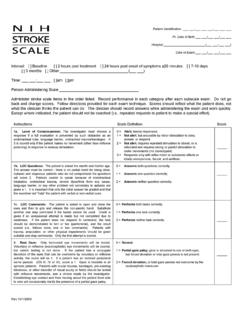
5 Circulation. 1994;90 7 Tests for Emergent EvaluationTests for the Emergent Evaluation of the Patient with acute Ischemic STROKE CT of the brain without contrast Electrocardiogram Chest x-ray Hematologic studies (complete blood count, platelet count, prothrombin time, partial thromboplastin time) Serum electrolytes Blood glucose Renal and hepatic chemical analyses National Institutes of Health Scale (NIHSS) scoreSource:Adams HP, et al. Circulation. 1994;90 8 AcknowledgementsThe INTERNET STROKE CENTER web presentation of acute Ischemic STROKE : New Concepts of Care is made possible by an unrestricted educational grant from Genentech, Inc. The content is Genentech, Inc. and may not be reproduced without note that the INTERNET STROKE CENTER does not distribute copies of this CD. Requests should be made directly to would like to thank the following people for their invaluable contribution:Thomas Brott, , Department of Neurology Mayo ClinicJacksonville, FLMichael P.
6 Marks, of Neuroradiology, Stanford STROKE CenterStanford UniversityStanford, CASuresh C. Patel, , Division of NeuroradiologyHenry Ford HospitalDetroit, MI Howard A. Rowley, Professor of Radiology & NeurologyClinical Director, Biomagnetic Imaging Lab University of California San Francisco, CABarbara C. Tilley, PhDDivision Health Biostatistics & Research EpidemiologyHenry Ford Health Sciences CENTER Detroit, 9