Transcription of THE JU RAL - CrossFit
1 1 of 7 THEJOURNALC opyright 2011 CrossFit , Inc. All Rights Reserved. CrossFit is a registered trademark of CrossFit , Inc. Subscription info at to Basics: Drill for SkillBy Dave ReJanuary 2011 Practical shooting grand master Dave Re describes the drills seen in the video Handgun Basics Part 2 of Handgun Basics is a whirlwind tour through a number of techniques and drills I employ with students in teaching them basic handgun skills. Editing five or so hours of teaching down to the 11 minutes of footage seen in the video inevitably leaves some questions. The goal of this companion piece is to fill in some of those holes and help make clear the purpose and intent of several of the drills shown in the Re PhotographyHandgun Basics.
2 (continued)2 of 7 Copyright 2011 CrossFit , Inc. All Rights Reserved. CrossFit is a registered trademark of CrossFit , Inc. Subscription info at to goal behind the Handgun Basics videos was to demon-strate starting skills for handling and shooting a handgun safely and with reasonable proficiency. To that end, we didn t cover presentation of the gun from a holster, or other skills that are required for self-defense, tactical or competition shooting . 0:56 Stance TestWhat you see going on here is a method to confirm and check a shooter s firing stance without having to fire live ammo.
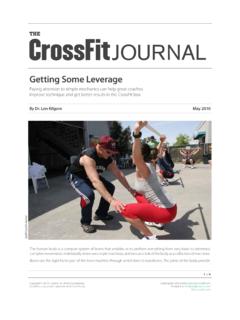
3 This allows the shooter to feel what s going on in the stance without the distraction of having to drive the gun at the same time, and it allows the instructor to cue the shooter and be understood. Have the shooter set up in his or her stance and simply push straight back on the shooter s hands. Start light and increase pressure gradually, backing off occasionally to be sure the shooter is not leaning into the pressure you re putting on him or her. Like so many other things in athletics, each shooter s optimal stance (and grip, for that matter) will vary slightly from another s due to body type, size, relative strength, etc.
4 In my experience, this process allows the shooter to find the stance that s going to work best for him or her and will be more effective than having the instructor try to put each student into the same position visually. Allowing the shooter to feel the position under some tension and feel the difference between various tweaks to the stance as they happen helps him or her intuitively understand why those tweaks are being made. Notice the improvement Travis finds in his stance following a few changes and tweaks when we retest at 2:11 in the video. It s immediately apparent that the new position is better for managing the rearward push of recoil from the :00 Tight Core?
5 First, when the core is tight, the shoulders are effectively coupled directly to the hips, and any force exerted against the shoulders will also tend to be exerted on the hips. Some recoil energy inevitably makes it through the elbows and up the arms to the shoulders. With tight abdominals, that energy is also transmitted to the hips, resulting in the shooter being pushed over backward. Relaxing the abs allows the shooter to further buffer the recoil energy and prevents that energy from being transmitted down the , tension in the core tends to lead to tension elsewhere in the body.
6 Tension is a killer for trigger control, ease and fluidity of movement, and possibly most importantly mental focus. It s very difficult to be tense when your core is relaxed. Try it and see. That said, relaxed doesn t mean the body is flopping over and loose. If you simply focus on being relaxed in your core, your body will know how much tension to maintain. Just let it do its job for :55 Weak Hand Grip Angle and Its Effect on Recoil ManagementUsed properly, the weak or off hand is possibly the largest tool the shooter has for recoil management on a handgun.
7 What we re doing is putting the weak hand (the left hand for right-handed shooters) into a position where the wrist extensor muscles are in the strongest part of their range of motion. Those extensor muscles will then be the primary muscles acting against the tendency of the muzzle to rise, and they will provide most of the effort required to bring the gun back down onto the target following a shot. If we put them in a position to be strong, they ll do that job exceedingly well. In fact, it s almost magical how well they Wallace PhotographyTesting a shooter s stance helps him find the optimal position for Basics.
8 (continued)3 of 7 Copyright 2011 CrossFit , Inc. All Rights Reserved. CrossFit is a registered trademark of CrossFit , Inc. Subscription info at to might notice the similarities to the outside 90 concept Tony Blauer talks about in The Bear Hug Drill Revisited. I t s the exact same concept applied to a different s such a thing as too much cant forward on the wrist. Once you hit bone lock (the furthest point forward you can cant the wrist), the effect on your grip strength is the same as if you lock your arm out at the elbow: it s diminished quite a bit, and that makes it very hard to hang onto the gun.
9 The best place for almost everyone ends up being canted as far forward as possible, but maybe 5-10 percent short of hitting bone s more discussion on grip pressure, the shooter s overall grip strength and their effects on recoil management :34 What s a Group ?Non-shooters watching the video may not be aware of the term group. In simplest terms, a group is just a collection of shots on a target, usually fired at roughly the same time in the same conditions. The goal in shooting a group is to cluster the shots as closely together as possible, demonstrating control over the gun and fundamental marksmanship skills.
10 As such, shooting a group can be a good test of where a shooter is at in those basics. In the video, I ask Travis and Crystal to shoot 10 shots at the target as close together as possible. We did this several times through the day, each time checking to see the difference each technique refinement made to their group :00 Trigger Jerk and Milking the Grip In any modality of shooting , it s desirable to have a smooth press on the trigger in order to achieve the most consistent, accurate results. A sharp, jerky trigger pull results in pulling the gun off target.