Transcription of The key to essential English
1 The key to essential EnglishInformation for English Test (KET)2 After the examExam dayAbout the examPreparingWhat is Cambridge English : Key? Cambridge English : Key, also known as Key English Test (KET), is a test at A2 level of the Common European Framework of Reference for Languages (CEFR). The test has exactly the same types of tasks and questions as Cambridge English : Key for Schools. Both tests use English in everyday situations. The only difference is that Cambridge English : Key is for people who have left school and may be working. You can do Cambridge English : Key as a paper-based or computer-based the examHere s a summary of what s in the exam:Paper detailsWhat s in the paper?
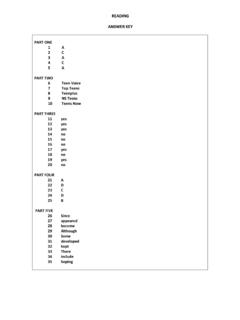
2 What do I need to be able to do?Reading and Writing1 hour 10 minutesThe Reading and Writing paper has nine parts and the tasks include: matching sentences to notices multiple-choice questions on a text multiple-choice responses to something someone says a multiple-matching question a spelling task an open-cloze task (a text with gaps you need to fill in the gaps) an information -transfer task a guided writing of the things you need to be able to do are: understand real-world notices read and choose the correct word read and choose the correct answer put a conversation in the correct order spell words correctly choose the correct words to complete a text complete an email/letter with missing words complete a form with important information write a short note, email or to use this guideYou can print this document if you wish, but it is better to read it on screen.
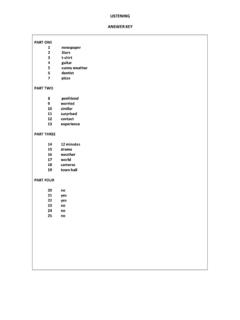
3 Click the links in the document to access other useful online resources such as videos and practice tests, and to find the information you need. 23 After the examExam dayAbout the examPreparingPaper detailsWhat s in the paper?What do I need to be able to do?ListeningAbout 30 minutesThe Listening paper has five parts and the tasks include: answering multiple-choice questions on short listening texts matching a list of nouns to people while listening answering multiple-choice questions on a conversation filling in missing words on a form while listening to one or two people need to be able to: listen for important information in short and long conversations and monologues listen and write down important information and spell words correctly.
4 SpeakingAbout 8 10 minutesThe Speaking test has two parts. In the first part the interlocutor asks the candidate getting to know you type questions; in the second part candidates talk to each other to get/give some information . You need to be able to: answer questions about yourself read a card and ask your partner some questions to get missing information read a card and answer your partner s don t need to pass all three papers to pass the whole exam. For example, if you do very well in Reading and Writing and Listening, but you don t do so well in Speaking, it is still possible to pass the Reading and Writing paper tests two skills so the weighting for this paper is a complete sample a computer-based practice test.
5 (Please note you will need to use the Firefox or Chrome browser to view these sample tests.)xxWatch a video of a Speaking the examExam dayAbout the examPreparingBefore the exam preparationIt is good to do practice tests and try to improve your grammar and vocabulary, but remember that the most important thing is that you can communicate clearly. So, for example, in the Speaking test, the examiner will be interested in how you ask your partner questions and how you give information to your partner as well as the grammar and vocabulary you use. To help you get ready for Cambridge English : Key, our website has a lot of free exam material available, including: tips and FAQs for each exam paper sample papers and a computer-based practice test links to further books for can also buy official preparation materials, including coursebooks and practice tests, to help you you answer these questions?
6 1. What do I have to do in each part of the test?2. How important are practice tests?3. What kinds of things should I read?4. How can I improve my writing skills?5. How can I learn to use more vocabulary and grammar? 6. How can I improve my listening skills?7. What is the best way to improve my speaking skills?Find the answers on the next pageHow much do you know about preparing for Cambridge English : Key?5 After the examExam dayAbout the examPreparingANSWERSP reparing for Cambridge English : Key 1. What do I have to do in each part of the test? You can download a sample paper and find more information about each part of the test on the Cambridge English Language Assessment website.
7 If you are taking a computer-based exam, you can try a computer-based practice test here. 2. How important are practice tests?It is very useful to do some practice tests, so you will know exactly what is in the test. It is also important to practise doing a timed test. When you have finished, look at the answers and think carefully about the ones that are wrong and why they are wrong. After you have done the Writing part, look at the sample answers. You could also do a practice Speaking test with a friend. Remember, doing practice tests is only part of the work you need to do to get ready for the exam.
8 Think about what you are good at and not so good at when you use English . Try to improve your English , not just for the exam but for life after the exam! 6 After the examExam dayAbout the examPreparing3. What kinds of things should I read?The Reading paper contains different kinds of texts so try to look at texts that you can find around you or on the internet, not just in your coursebook. Some things that would be useful to look at include: signs, notices and advertisements short newspaper and magazine articles notes, text messages and emails from friends posters and leaflets (you may be able to find leaflets in English in the library or in a tourist information office) graded readers (books that are written for people learning English ).
9 The Reading paper tests reading in different ways, so prepare yourself for this. For example: try to read a text quickly to get the main idea (this is called skimming ) read a text to find out certain information , for example, reading a TV guide to find out if there is a type of programme on today (this is called scanning ) try to read some texts carefully so that you understand will need to read in all of these different ways in the Reading test so if you can practise like this it will really help you. Another useful thing you can do when you are reading is try to guess the meaning of a word that you don t know in a the examExam dayAbout the examPreparing4.
10 How can I improve my writing skills? Some useful ways of preparing for the Writing parts are: Write short messages or emails to friends and encourage them to write back to you. Try to learn how to do things in your writing like giving information , inviting, suggesting, thanking and apologising. Practise writing a message (Part 9 of the test) that is 25 35 words long so that you have a good idea of what that many words looks like. When practising answering exam questions, try not to use the words that are in the question; use your own words instead. Look at model answers in coursebooks to see what answers are like at A2 level.