Transcription of The learners…
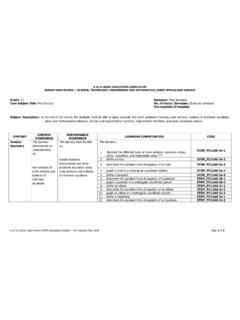
1 K to 12 BASIC EDUCATION CURRICULUM SENIOR HIGH SCHOOL CORE SUBJECT K to 12 Senior High School Core Subject Disaster Readiness and Risk Reduction May 2016 Page 1 of 8 Grade: 11/12 Subject Title: Disaster Readiness and Risk Reduction No. of Hours/Semester: 80 hours/semester Prerequisite: Grades 3-10 Science Subject Description: This course focuses on the application of scientific knowledge and the solution of practical problems in a physical environment. It is designed to bridge the gap between theoretical science and daily living. CONTENT CONTENT STANDARD PERFORMANCE STANDARD LEARNING COMPETENCIES CODE Basic concept of disaster and disaster risk The learners demonstrate understanding of 1.
2 Concept of disaster 2. Concept of disaster risk 3. Nature of disasters 4. Effects of disasters The learners relate the concept of disaster with daily life. The 1. Explain the meaning of disaster; 2. Differentiate the risk factors underlying disasters; 3. Describe the effects of disasters on one s life; 4. Explain how and when an event becomes a disaster; 5. Identify areas/locations exposed to hazards that may lead to disasters; and 6. Analyze disaster from the different perspectives (physical, psychological, socio-cultural, economic, political, and biological). DRR11/12-Ia-b-1 DRR11/12-Ia-b-2 DRR11/12-Ia-b-3 DRR11/12-Ia-b-4 DRR11/12-Ia-b-5 DRR11/12-Ia-b-6 K to 12 BASIC EDUCATION CURRICULUM SENIOR HIGH SCHOOL CORE SUBJECT K to 12 Senior High School Core Subject Disaster Readiness and Risk Reduction May 2016 Page 2 of 8 CONTENT CONTENT STANDARD PERFORMANCE STANDARD LEARNING COMPETENCIES CODE Exposure and Vulnerability The learners demonstrate understanding Various elements that may be exposed to hazards: 1.
3 Physical 2. Social 3. Economic 4. Environmental Vulnerability of each exposed element. The learners conduct hazard hunts of exposed elements and propose corresponding corrective actions for one s preparedness. The 1. Enumerate elements exposed to hazards; 2. Explain the meaning of vulnerability; 3. Explain why certain sectors of society are more vulnerable to disaster than others; 4. Analyze why certain structures are more vulnerable to specific hazards than others; DRR11/12-Ic-7 DRR11/12-Ic-8 DRR11/12-Ic-9 DRR11/12-Ic-10 5. Determine the elements that are exposed to a particular hazard; 6.
4 Recognize vulnerabilities of different elements exposed to specific hazards; and 7. Differentiate among hazards, exposure, and vulnerabilities and give examples from actual situations. DRR11/12-Id-11 DRR11/12-Id-12 DRR11/12-Id-13 Basic concept of hazard The learners demonstrate understanding of 1. Concept of hazard 2. Types of hazards 3. The impact of various hazards The learners relate various types of hazard with a specific area for one s preparedness. The 1. Define hazards; 2. Give examples of the types of hazards; and 3. Explain the impact of various hazards on different exposed elements.
5 DRR11/12-Ie-14 DRR11/12-Ie-15 DRR11/12-Ie-16 K to 12 BASIC EDUCATION CURRICULUM SENIOR HIGH SCHOOL CORE SUBJECT K to 12 Senior High School Core Subject Disaster Readiness and Risk Reduction May 2016 Page 3 of 8 CONTENT CONTENT STANDARD PERFORMANCE STANDARD LEARNING COMPETENCIES CODE Earthquake Hazards The learners demonstrate understanding Potential earthquake hazards: 1. Ground shaking 2. Ground rupture 3. Liquefaction 4. Earthquake-induced ground subsidence 5. Tsunami 6. Earthquake-induced landslide The learners develop a family emergency preparedness plan to guide them on what to do before, during, and after an earthquake.
6 The 1. Identify various potential earthquake hazards; 2. Recognize the natural signs of an impending tsunami; 3. Analyze the effects of the different earthquake hazards; DRR11/12-If-g-17 DRR11/12-If-g-18 DRR11/12-If-g-19 4. Interpret different earthquake hazard maps; and 5. Apply precautionary and safety measures before, during, and after an earthquake. DRR11/12-If-g-20 DRR11/12-If-g-21 Volcano Hazards The learners demonstrate understanding Signs of impending volcanic eruptions Potential volcano-related hazards: 1. Lahar 2. Ash fall 3. Pyroclastic flow 4. Ballistic projectile 5.
7 Volcanic gasses 6. Lava flow The learners develop a family emergency preparedness plan to guide them on what to do before, during, and after a volcanic eruption. The 1. Explain various volcano-related hazards; 2. Differentiate among different volcano hazards; 3. Recognize signs of an impending volcanic eruption; DRR11/12-Ih-i-22 DRR11/12-Ih-i-23 DRR11/12-Ih-i-24 4. Interpret different volcano hazard maps; and 5. Apply appropriate measures/interventions before, during, and after a volcanic eruption. DRR11/12-Ih-i-25 DRR11/12-Ih-i-26 K to 12 BASIC EDUCATION CURRICULUM SENIOR HIGH SCHOOL CORE SUBJECT K to 12 Senior High School Core Subject Disaster Readiness and Risk Reduction May 2016 Page 4 of 8 CONTENT CONTENT STANDARD PERFORMANCE STANDARD LEARNING COMPETENCIES CODE Other related geological hazards The learners demonstrate understanding Related geological hazards 1.
8 Rainfall-induced landslide 2. Sinkhole The learners develop a family emergency preparedness plan to guide them on what to do before, during, and after the occurrence of events that cause geological hazards. The 1. Discuss the different geological hazards; 2. Analyze the causes of geological hazards; 3. Recognize signs of impending geological hazards; DRR11/12-IIa-b-27 DRR11/12-IIa-b-28 DRR11/12-IIa-b-29 4. Interpret geological maps; and 5. Apply mitigation strategies to prevent loss of lives and properties. DRR11/12-IIa-b-30 DRR11/12-IIa-b-31 Hydrometeorological hazards The learners demonstrate understanding Potential hydrometeorological hazards: 1.
9 Typhoon 2. Thunderstorm 3. Flashflood 4. Flood 5. Stormsurge 6. El ni o 7. La ni a The learners develop a family emergency preparedness plan to guide them on what to do before, during, and after the occurrence of events that cause hydrometeorological hazards. The learners develop proficiency in executing emergency response plans through safety drills. The 1. Distinguish and differentiate among and between different hydrometeorological hazards; 2. Recognize signs of impending hydrometeorological hazards; DRR11/12-IIc-d-32 DRR11/12-IIc-d-33 3. Apply appropriate measures/interventions before, during, and after hydrometeorological hazards; 4.
10 Interpret different hydrometeorological hazard maps; and 5. Use available tools for monitoring hydro-meteorological hazards. DRR11/12-IIc-d-34 DRR11/12-IIc-d-35 DRR11/12-IIc-d-36 K to 12 BASIC EDUCATION CURRICULUM SENIOR HIGH SCHOOL CORE SUBJECT K to 12 Senior High School Core Subject Disaster Readiness and Risk Reduction May 2016 Page 5 of 8 CONTENT CONTENT STANDARD PERFORMANCE STANDARD LEARNING COMPETENCIES CODE Fire hazard The learners demonstrate understanding Fire hazards and related concepts: 1. Fire triangle 2. Causes of fires 3. Phases of a fire emergency The learners develop a family emergency preparedness plan to guide them on what to do before, during, and after a fire incident.