Transcription of The Lower Extremity Functional Scale (LEFS)
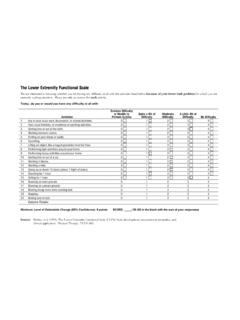
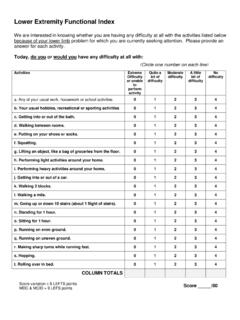
1 Patient Identification The Lower Extremity Functional Scale (LEFS) DATE: _____Patient instructions: Today do you or would you have any difficulty at all with these activities? Key0 = Unable to perform1 = Quite a bit of difficulty2 = Moderate difficulty3 = A little bit of difficulty4 = NO DifficultyActivities (20): 01234(1) any of your usual work housework or school activities (2) your usual hobbies recreational or sporting activities. (3) getting into or out of the bath (4) walking between rooms (5) putting on your shoes or socks (6) squatting (7) lifting an object like a bag of groceries from the floor (8) performing light activities around your home (9) performing heavy activities around your home (10) getting into or out of a car (11) walking 2 blocks (about 1/6th mile or about 250 meters) (12) walking 1 mile ( km) (13) going up or down 10 steps (about 1 flight of stairs) (14) standing for 1 hour (15) sitting for 1 hour (16) running on even ground (17)
2 Running on uneven ground (18) making sharp turns while running fast (19) hopping (20) rolling over in bedSub -Total Percentage of Maximal Function100 XTotal Score80 Min Detectable Change (MDC) = 9 Scale pointsMin Clinically Important Difference (MCID) = 9 Scale pointsOverview: The Lower Extremity Functional Scale (LEFS) can be used to evaluate the Functional impairment of a patient with a disorder of one or both Lower extremities. It can be used to monitor the patient over time and to evaluate the effectiveness of an intervention.
3 The authors are from McMaster University in Hamilton Ontario.