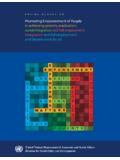
Transcription of The Millennium Development Goals Report - …
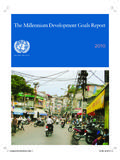
1 The Millennium Development Goals ReportU N I T E D N A T I O N S2007 This Report is based on a master set of data that has been compiled by an Inter-Agency and Expert Group on MDG Indicators led by the Department of Economic and Social Affairs of the united nations Secretariat, in response to the wishes of the General Assembly for periodic assessment of progress towards the MDGs. The Group comprises representatives of the international organizations whose activities include the preparation of one or more of the series of statistical indicators that were identified as appropriate for monitoring progress towards the MDGs, as reflected in the list below. A number of national statisticians and outside expert advisers also contributed.
2 I N T E R N AT I O N A L L A B O U R O R G A N I Z AT I O N F O O D A N D AG R I C U LT U R E O R G A N I Z AT I O N O F T H E U N I T E D N AT I O N SU N I T E D N AT I O N S E DU CAT I O N A L , S C I E N T I F I C A N D C U LT U R A L O R G A N I Z AT I O NWO R L D H E A LT H O R G A N I Z AT I O NT H E WO R L D B A N KI N T E R N AT I O N A L M O N E TA RY F U N D I N T E R N AT I O N A L T E L E C O M M U N I CAT I O N U N I O N E C O N O M I C C O M M I S S I O N F O R A F R I CAE C O N O M I C C O M M I S S I O N F O R E U RO P EE C O N O M I C C O M M I S S I O N F O R L AT I N A M E R I CA A N D T H E CA R I B B E A NE C O N O M I C A N D S O C I A L C O M M I S S I O N F O R A S I A A N D T H E PAC I F I CE C O N O M I C A N D S O C I A L C O M M I S S I O N F O R W E S T E R N A S I AJ O I N T U N I T E D N AT I O N S P RO G
3 R A M M E O N H I V / A I D S U N I T E D N AT I O N S C H I L D R E N S F U N DU N I T E D N AT I O N S C O N F E R E N C E O N T R A D E A N D D E V E L O P M E N T U N I T E D N AT I O N S D E V E L O P M E N T F U N D F O R WO M E NU N I T E D N AT I O N S D E V E L O P M E N T P RO G R A M M E U N I T E D N AT I O N S E N V I RO N M E N T P RO G R A M M E U N I T E D N AT I O N S F R A M E WO R K C O N V E N T I O N O N C L I M AT E C H A N G EU N I T E D N AT I O N S H I G H C O M M I S S I O N E R F O R R E F U G E E S U N I T E D N AT I O N S H U M A N S E T T L E M E N T S P RO G R A M M EU N I T E D N AT I O N S P O P U L AT I O N F U N D I N T E R- PA R L I A M E N TA RY U N I O N O R G A N I SAT I O N F O R E C O N O M I C C O - O P E R AT I O N A N D D E V E L O P M E N TWO R L D T R A D E O R G A N I Z AT I O NThe Millennium Development Goals Report 2007U N I T E D N A T I O N SN E W Y O R K , 2007 ForewordSince their adoption by all united nations Member States in 2000, the Millennium Declaration and the Millennium Development Goals have become a universal framework for Development and a means for developing countries and their Development partners to work together in pursuit of a shared future for all.
4 We are now at the midpoint between the adoption of the MDGs and the 2015 target date. So far, our collective record is mixed. The results presented in this Report suggest that there have been some gains, and that success is still possible in most parts of the world. But they also point to how much remains to be done. There is a clear need for political leaders to take urgent and concerted action, or many millions of people will not realize the basic promises of the MDGs in their lives. The MDGs are still achievable if we act now. This will require inclusive sound governance, increased public investment economic growth, enhanced productive capacity, and the creation of decent work. Success in some countries demonstrates that rapid and large-scale progress towards the MDGs is feasible if we combine strong government leadership, good policies and practical strategies for scaling up public investments in vital areas with adequate financial and technical support from the international community.
5 To achieve the Goals , nationally-owned Development strategies and budgets must be aligned with them. This must be backed up by adequate financing within the global partnership for Development and its framework for mutual accountability. The world wants no new promises. It is imperative that all stakeholders meet, in their entirety, the commitments already made in the Millennium Declaration, the 2002 Monterrey Conference on Financing for Development , and the 2005 World Summit. In particular, the lack of any significant increase in official Development assistance since 2004 makes it impossible, even for well-governed countries, to meet the MDGs. As this Report makes clear, adequate resources need to be made available to countries in a predictable way for them to be able to effectively plan the scaling up of their investments.
6 Yet, these promises remain to be fulfilled. I commend this Report as a key resource to help show what can be achieved and how much still needs to be done. Reliable and timely information is key to formulating the necessary policies and strategies to ensure progress, monitor Development and make the MDGs Ki-moonSecretary-General, united Nations45 Progress at the MDG mid-pointThe Millennium Declaration set 2015 as the target date for achieving most of the Goals . As we approach the midway point of this 15-year period, data are now becoming available that provide an indication of progress during the first third of this 15-year period. This Report presents the most comprehensive global assessment of progress to date, based on a set of data prepared by a large number of international organizations within and outside the united nations results are, predictably, uneven.
7 The years since 2000, when world leaders endorsed the Millennium Declaration, have seen some visible and widespread gains. Encouragingly, the Report suggests that some progress is being made even in those regions where the challenges are greatest. These accomplishments testify to the unprecedented degree of commitment by developing countries and their Development partners to the Millennium Declaration and to some success in building the global partnership embodied in the results achieved in the more successful cases demonstrate that success is possible in most countries, but that the MDGs will be attained only if concerted additional action is taken immediately and sustained until 2015. All stakeholders need to fulfil, in their entirety, the commitments they made in the Millennium Declaration and subsequent following are some measures of the progress that has been achieved: The proportion of people living in extreme poverty fell from nearly a third to less than one fifth between 1990 and 2004.
8 If the trend is sustained, the MDG poverty reduction target will be met for the world as a whole and for most regions. The number of extremely poor people in sub-Saharan Africa has levelled off, and the poverty rate has declined by nearly six percentage points since 2000. Nevertheless, the region is not on track to reach the Goal of reducing poverty by half by 2015. Progress has been made in getting more children into school in the developing world. Enrolment in primary education grew from 80 per cent in 1991 to 88 per cent in 2005. Most of this progress has taken place since 1999. Women s political participation has been growing, albeit slowly. Even in countries where previously only men were allowed to stand for political election, women now have a seat in parliament.
9 Child mortality has declined globally, and it is becoming clear that the right life-saving interventions are proving effective in reducing the number of deaths due to the main child killers such as measles. Key interventions to control malaria have been expanded. The tuberculosis epidemic, finally, appears on the verge of decline, although progress is not fast enough to halve prevalence and death rates by pointing to what has been achieved, these results also highlight how much remains to be done and how much more could be accomplished if all concerned live up fully to the commitments they have already made. Currently, only one of the eight regional groups cited in this Report is on track to achieve all the Millennium Development Goals .
10 In contrast, the projected shortfalls are most severe in sub-Saharan Africa. Even regions that have made substantial progress, including parts of Asia, face challenges in areas such as health and environmental sustainability. More generally, the lack of employment opportunities for young people, gender inequalities, rapid and unplanned urbanization, deforestation, increasing water scarcity, and high HIV prevalence are pervasive obstacles. Moreover, insecurity and instability in conflict and post-conflict countries make long-term Development efforts extremely difficult. In turn, a failure to achieve the MDGs can further heighten the risk of instability and conflict. Yet in spite of a technical consensus that Development and security are mutually dependent, international efforts all too often treat them as independent from one another.