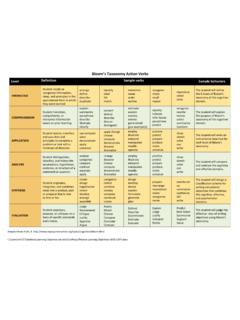
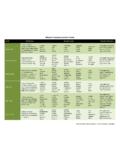
Transcription of The “New Bloom's Taxonomy,” Objectives, and …
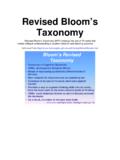
1 The New Bloom's taxonomy , Objectives, and AssessmentsPrepared by Elizabeth DaltonDecember 3, document provides a review of the latest revision of the venerable bloom 'sTaxonomy, which combines aspects of the original taxonomy published by bloom ,Engelhart, Furst, Hill, and Krathwohl in 1956 with more recent taxonomy and frameworkresearch by others such as Merrill, Ausubel, Gagn , Romizowski, etc. David Krathwohl,one of the original contributing authors to Bloom's taxonomy , was one of the two editorsof the new version, published in A taxonomy for Learning, Teaching, and Assessing in2001. Unfortunately, when this revision was begun Benjamin bloom was in advancedstages of Alzheimer's disease and unable to participate in the project. He died before therevision was document overviews the revised taxonomy in terms of types of objectives andlearning activities, and particularly assessments, and where they fall in the two-dimensional taxonomy .
2 A short review of other possible taxonomies or frameworks andcomparable tools for selection of activities or assessments is also ObjectivesWhat is meant by "levels" or "complexities" of learning objectives? Anderson, Krathwohl,et. al have updated the classic " Bloom's taxonomy " to incorporate advances in learningtheory and practice since its inception, and offer the following two-dimensionalframework to describe learning objectives:RememberUnderstandApplyAnalyz eEvaluateCreateFactRememberFactsUndersta ndFactsApply FactsConcept/PrincipleRememberConceptsUn derstandConceptsApplyConceptsProcedureRe memberProceduresUnderstandProceduresAppl yProceduresAnalyzeusing Facts,Concepts,PrinciplesandProceduresEv aluateusing Facts,Concepts,PrinciplesandProceduresCr eate usingFacts,Concepts, two-dimensional framework distinguishes between the type of knowledge beinglearned ( Fact, Concept, Principle, Procedure, Metacognitive), and the type ofcognitive process being employed (Remember, Understand, Appy, Analyze, Evaluate, orCreate).
3 The horizontal dimension of cognitive process aligns with the original bloom 'sTaxonomy categories, rewritten to active tense verb forms. (Evaluate and Create,formerly Synthesis and Evaluation, have also changed places to reflect meta-analysis theauthors performed on various empirical studies of Bloom's taxonomy in the interveningyears.) The vertical dimension of type of knowledge aligns with other frameworks the work of David Merrill or Ruth the left-most three columns, there is a strong correlation between the cognitive processand the type of knowledge content, as indicated by the shaded blocks. That is, most oftenwe expect learners to remember facts, understand concepts, and apply procedures, thoughit is also possible to create learning objectives in the other cells, Apply Concepts. Inthe rightmost three columns, generally multiple types of knowledge content are employedin each of these more complex cognitive processes.
4 Along the bottom we have also addedanother set of terms often used to characterize these objectives: knowledge, skill, ActivitiesOur intent, whether developing classroom-based instructor-led training, online training,or a blend of the two, is to include a rich environment of activities which promotelearning and help our learners feel engaged with the content. However, we also want toensure that the activities, including assessments, match with the objectives specified forthe learning. To facilitate this, we provide a framework in which to define how thevarious activities apply to learning objectives of different types, based on theAnderson/Krathwohl revision of Bloom's . The activity types which we have identifiedinclude: Informational Documents Organizational Aids Diagrammatic Activities ( flowcharts, information mapping) Discussions Collaborative Activities Authentic Practice Presentations Job Aids Demonstrations Drill/Practice ModelingThese learning activities are suitable to support different levels or complexities oflearning objectives, as defined above in the revised Bloom's taxonomy .
5 Once we haveused the two-dimensional taxonomy to classify learning objectives, we can then offerinstruction designers and course developers tools with which to select appropriatelearning activities, including assessments, to match the type of learning this in mind, we can see that we might present the following types of activities tosupport these areas of the taxonomy :RememberUnderstandApplyAnalyzeE valuateCreateFactPresentationInformation alDocumentDrill/PracticePresentationInfo rmationalDocumentPresentationConcept/Pri nciplePresentationInformationalDocumentD rill/PracticePresentationInformationalDo cumentOrganizationalAidDiagrammaticActiv ityDiscussionCollaborationPresentationOr ganizationalAidDiagrammaticActivityDiscu ssionAuthenticPracticeProcedurePresentat ionInformationalDocumentJob AidsPresentationInformationalDocumentOrg anizationalAidDiscussionCollaborationJob AidsPresentationOrganizationalAidDiscuss ionCollaborationAuthenticPracticeJob AidsModelingPresentationDiagrammaticActi vityDiscussionCollaborationAuthenticPrac ticeJob AidsModelingPresentationDiscussionCollab orationAuthenticPracticeJob StrategyThe taxonomy described above also applies directly to the
6 Realm of assessment. Thefollowing types of asessement activities have been identified:Multiple Choice (Recall,Interpretations, Summaries, predictions,Best Answer, etc.)Matching (concepts, cause & effect,etc.)SequencingMultiple True/FalseShort Answer EssayComprehension Item SetInterlineal Item SetPictoral Item SetLab: High-InferenceLab: Low-InferenceInteractive video/simulationInstrumented labVisual observation/ratingItem set FIBP rojectInstrument-aided observationAnecdotal (formative)Demonstration with rating scale/checklistExhibitionPerformanceDiff erentiation interlineal setKnowledge mappingProblem-solving item setDiscussion (formative)Essay (rated on use of principles,procedures, etc.)Review/critiqueConstructed ResponseSelf-assessment (formative)The items above are not presented in any particular order.
7 They would be matched to thetaxonomy as follows:RememberUnderstandApplyAnalyzeEv aluateCreateFactMultiple Recalldefinitions astaughtM/CM-T/FM/C -Interpretationshort-answeressaym/c - Applymemorized factsto simpleauthenticsituationsConcept/Princip lematchingrecall concept,category,principledefinitionsmat ch cause-effectm/c predict usingprinciplescomprehensionitem setchoose best(new) definitionmatchclassificationm/c - examplesand - summarieslab: high-inferencepictoral item setApply conceptsto solve anauthenticproblemm/c - bestanswerlab: highinferencedifferentiationinterlineal setknowledgemappingproblem-solvingitem setm/c: bestanswerdiscussion(formative)essay (rated onuse ofprinciples)essay (rated onuse ofprocedures)review/critiqueconstructedr esponseexhibitionportfolioRememberUnders tandApplyAnalyzeEvaluateCreateProcedurer ecall steps ofproceduresrecall sequencinginterlineal itemsetlab: low-inferenceinteractivevideo/simulation instrumented labvisualobservation/ratingitem set FIBprojectpictoral item setinstrument-aidedobservationanecdotal( formative)demonstrationwith ratingscale/checklistexhibitionperforman c