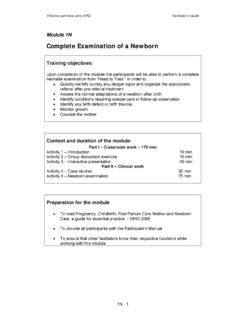
Transcription of The Newborn Physical Examination
1 - a faculty development program with support from US Dept. Health & Human Services, Health Resources and Services Administration, Bureau of Health Professions create 6/24/2015; last modified date 11/23/2015 Page 1 of 12
2 The Newborn Physical Examination assessment of a Newborn with Joan Richardson Joan Richardson's assessment of a Newborn What follows is a demonstration of the Physical Examination of a Newborn baby as well as the determination of the gestational age of the baby using the Dubowitz Examination . Dubowitz Examination From Dubowitz et al, Clinical assessment of gestational age in the Newborn infant. Journal of Pediatrics 77-1, 1970, with permission Skin Color When examining a Newborn baby, start by closely observing the baby.
3 Observe the color. Is the baby pink or cyanotic? The best place to observe is the lips or tongue. If those are nice and pink then baby does not have cyanosis. The most unreliable places to observe for cyanosis are the fingers and toes because babies frequently have poor blood circulation to the extremities and this results in acrocyanosis.(See video below of baby with cyanotic feet) Also observe the baby for any obvious congenital malformations or any obvious congenital anomalies. Be sure to count the number of fingers and toes.
4 Cyanotic Feet The most unreliable places to observe for cyanosis are the fingers and toes because babies frequently have poor blood circulation to the extremities and this results in a condition called acrocyanosis. Definitions you need to know: Cyanotic a bluish or purplish discoloration (as of skin) due to deficient oxygenation of the blood - a faculty development program with support from US Dept.
5 Health & Human Services, Health Resources and Services Administration, Bureau of Health Professions create 6/24/2015; last modified date 11/23/2015 Page 2 of 12
6 Acrocyanosis Blueness or pallor of extremities, normal sign of vasomotor instability characterized by color change limited to the peripheral circulation. Occurs in healthy newborns and will eventually resolve. congenital 1. Existing at or dating from birth 2. Acquired during development in the uterus and not through heredity Respiration Watch the baby breathe. Is the baby breathing easily or is she having problems. Time the respiratory rate.
7 Normal babies breathe about 40 to 60 times a minute. Does the baby have intercostal, subcostal or sternal retraction? Is the baby demonstrating an expiratory grunting respiration, stridor or gasping. Definitions you need to know: grunting forced expiration against a partially closed glottis stridor a harsh vibrating sound heard during respiration in cases of obstruction of the air passages. gasping slow and laborious breaths Movement Look at the baby's movement. Is the baby moving all extremities equally and symmetrically?
8 And does the baby appear to have good muscle tone? If the baby is asleep, does the baby easily arouse, wake up, and cry when disturbed? Generally, babies will start crying when disturbed, so start the Examination by looking at those areas that are more easily examined if the baby remains quiet. Start be examining the heart, lungs and abdomen. Save the Examination of the head and neck until last because that tends to irritate the baby and cause them to cry more Cardiovascular - PMI Start with the Examination of the heart. Palpate the PMI that is the point of maximal impulse.
9 The PMI should be at about the 3rd of4th intercostal space at about the midclavicular line. If the PMI is shifted dramatically either to the right or to the left, you must be concerned about a pneumothorax. If the PMI is shifted remarkable to the right, then you have to consider the possibility of dextrocardia. - a faculty development program with support from US Dept. Health & Human Services, Health Resources and Services Administration, Bureau of Health Professions create 6/24/2015.
10 Last modified date 11/23/2015 Page 3 of 12 Cardiovascular - Pulses Palpate the pulses.