Transcription of The quadratic formula
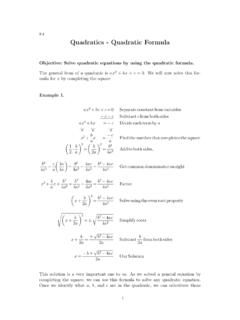
1 The quadratic formulaYou may recall the quadratic formula for roots of quadraticpolynomialsax2+bx+c. It says that the solutions to thispolynomial are b b2 example, when we take the polynomialf(x) =x2 3x 4, weobtain3 9 + 162which gives 4 and quick terminologyIWe say that 4 and 1 arerootsof the polynomialx2 3x 4orsolutionsto the polynomial equationx2 3x 4 = mayfactor x2 3x 4 as (x 4)(x+ 1).IIf we denotex2 3x 4 asf(x), we havef(4) = 0 andf( 1) = quadratic formulaYou may recall the quadratic formula for roots of quadraticpolynomialsax2+bx+c.
2 It says that the solutions to thispolynomial are b b2 example, when we take the polynomialf(x) =x2 3x 4, weobtain3 9 + 162which gives 4 and quick terminologyIWe say that 4 and 1 arerootsof the polynomialx2 3x 4orsolutionsto the polynomial equationx2 3x 4 = mayfactor x2 3x 4 as (x 4)(x+ 1).IIf we denotex2 3x 4 asf(x), we havef(4) = 0 andf( 1) = quadratic formulaYou may recall the quadratic formula for roots of quadraticpolynomialsax2+bx+c. It says that the solutions to thispolynomial are b b2 example, when we take the polynomialf(x) =x2 3x 4, weobtain3 9 + 162which gives 4 and quick terminologyIWe say that 4 and 1 arerootsof the polynomialx2 3x 4orsolutionsto the polynomial equationx2 3x 4 = mayfactor x2 3x 4 as (x 4)(x+ 1).
3 IIf we denotex2 3x 4 asf(x), we havef(4) = 0 andf( 1) = quadratic formulaYou may recall the quadratic formula for roots of quadraticpolynomialsax2+bx+c. It says that the solutions to thispolynomial are b b2 example, when we take the polynomialf(x) =x2 3x 4, weobtain3 9 + 162which gives 4 and quick terminologyIWe say that 4 and 1 arerootsof the polynomialx2 3x 4orsolutionsto the polynomial equationx2 3x 4 = mayfactor x2 3x 4 as (x 4)(x+ 1).IIf we denotex2 3x 4 asf(x), we havef(4) = 0 andf( 1) = quadratic formulaYou may recall the quadratic formula for roots of quadraticpolynomialsax2+bx+c.
4 It says that the solutions to thispolynomial are b b2 example, when we take the polynomialf(x) =x2 3x 4, weobtain3 9 + 162which gives 4 and quick terminologyIWe say that 4 and 1 arerootsof the polynomialx2 3x 4orsolutionsto the polynomial equationx2 3x 4 = mayfactor x2 3x 4 as (x 4)(x+ 1).IIf we denotex2 3x 4 asf(x), we havef(4) = 0 andf( 1) = that in the example both roots are integers, but other timesit may give numbers are not integers or even rational numbers,such as withx2 5, which gives 5, which is a real number thatis not times it may even give complex numbers that are not real,such as withx2+ 1, which gives that in the example both roots are integers, but other timesit may give numbers are not integers or even rational numbers,such as withx2 5, which gives 5.
5 Which is a real number thatis not times it may even give complex numbers that are not real,such as withx2+ 1, which gives degree polynomialsIf you look at a cubic polynomiala3x3+a2x2+a1x+a0or aquartica4x4+a3x3+a2x2+a1x+a0(where theaiare allintegers) there are similar (but more complicated) degree 5, there are no such formulas. This is called theinsolubility of the quinticand it is a famous result proved by Abeland Galois in the early 19th , we will be interested in something a bit more simple tobegin with.
6 Rational numbersolutions to polynomials with is, we will consider polynomials of the formf(x) =anxn+an 1xn 1+ +a0and look forrational numbers b/csuch thatf(b/c) = degree polynomialsIf you look at a cubic polynomiala3x3+a2x2+a1x+a0or aquartica4x4+a3x3+a2x2+a1x+a0(where theaiare allintegers) there are similar (but more complicated) degree 5, there are no such formulas. This is called theinsolubility of the quinticand it is a famous result proved by Abeland Galois in the early 19th , we will be interested in something a bit more simple tobegin with.
7 Rational numbersolutions to polynomials with is, we will consider polynomials of the formf(x) =anxn+an 1xn 1+ +a0and look forrational numbers b/csuch thatf(b/c) = degree polynomialsIf you look at a cubic polynomiala3x3+a2x2+a1x+a0or aquartica4x4+a3x3+a2x2+a1x+a0(where theaiare allintegers) there are similar (but more complicated) degree 5, there are no such formulas. This is called theinsolubility of the quinticand it is a famous result proved by Abeland Galois in the early 19th , we will be interested in something a bit more simple tobegin with.
8 Rational numbersolutions to polynomials with is, we will consider polynomials of the formf(x) =anxn+an 1xn 1+ +a0and look forrational numbers b/csuch thatf(b/c) = degree polynomialsIf you look at a cubic polynomiala3x3+a2x2+a1x+a0or aquartica4x4+a3x3+a2x2+a1x+a0(where theaiare allintegers) there are similar (but more complicated) degree 5, there are no such formulas. This is called theinsolubility of the quinticand it is a famous result proved by Abeland Galois in the early 19th , we will be interested in something a bit more simple tobegin with.
9 Rational numbersolutions to polynomials with is, we will consider polynomials of the formf(x) =anxn+an 1xn 1+ +a0and look forrational numbers b/csuch thatf(b/c) = degree polynomialsIf you look at a cubic polynomiala3x3+a2x2+a1x+a0or aquartica4x4+a3x3+a2x2+a1x+a0(where theaiare allintegers) there are similar (but more complicated) degree 5, there are no such formulas. This is called theinsolubility of the quinticand it is a famous result proved by Abeland Galois in the early 19th , we will be interested in something a bit more simple tobegin with.
10 Rational numbersolutions to polynomials with is, we will consider polynomials of the formf(x) =anxn+an 1xn 1+ +a0and look forrational numbers b/csuch thatf(b/c) = solutions to polynomialsNote that if we havef(x) =anxn+an 1xn 1+ +a0andf(b/c) = 0,(whereb/cis in lowest terms, no commonfactors) then we havea0=bc(an(bc)n 1+..x1)sobmust , after multiplying through by (c/b)nwe obtainan=cb(a0(cb)n 1+ +an 1)socmust there are finitely many rationalb/csuch thatbdividesanandcdividesa0, this reduces finding all the rational solutions tof(x) = 0 to a simple search solutions to polynomialsNote that if we havef(x) =anxn+an 1xn 1+ +a0andf(b/c) = 0,(whereb/cis in lowest terms, no commonfactors) then we havea0=bc(an(bc)n 1+.)