Transcription of The rules of netball – summary
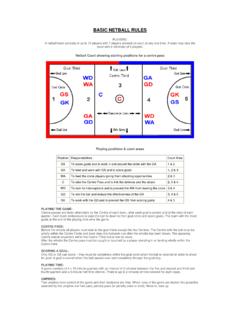
1 The rules of netball summary The following summary does not replace the Official Rule book. *Westlakes time rules may vary **new rules since 2007 rule book published. Summarised by Kylie-Ann Lysaght - BPFBNC Measurements Side line 100ft ( ) Goal line 50ft ( ) Centre circle 3ft ( ) diameter Goal circle 16ft ( ) radius Transverse line divide court into 3 equal thirds Lines are 50mm (2 inches) thick, preferably white Goal post (10ft) high at midpoint of each goal line Post is 65-100mm in diameter, preferably white Metal ring internal diameter 380mm (15 inches)
2 15mm steel rod Ring projects 150mm horizontally from top of post Net, preferably white, open at both ends The ring and net are part of the goal post Padding (preferably white) and not more than 50mm thick from base up full length of post. The ball shall be 690-710mm in circumference Weigh 400-450g Made of leather, rubber or similar Umpires check court, goalposts and ball prior to game. Check uniforms, jewellery and fingernails prior to play. Umpires toss for goal end, winner controls northern half. Each umpire controls the same end for the entire game. They control their entire sideline and goal line. They may appeal to the other umpire for decisions.
3 Players Suitable footwear, no spikes. Registered playing uniforms including positions to be worn at all times. Position initials to be worn above the waist on front and back and shall be 150mm high. No jewellery, except wedding ring or medical bracelet (which shall be taped). No adornment that may endanger player safety may be worn. Fingernails shall be short and smooth. The game Four quarters of 15 minutes. Intervals are 3min / 5-10min / 3 min. Teams change ends each quarter. An interval may be extended by umpires to deal with an emergency. Time for stoppages must be played in that quarter or half of the game.*Westlakes no injury time until finals.
4 Umpire s whistle starts and stops the game, restarts and ends each quarter. A penalty pass or shop awarded but not taken at the end of a quarter may be taken after the whistle. **If a winner is required: 2 minutes interval at end of game, 2 x 7 min halves with 1 min interval, teams changing ends at half time. Centre pass is team entitled to next centre pass. Team substitutions and changes may be made at both intervals. Normal injury rules apply (first stoppage 2 min, each subsequent stoppage 30 sec in entire extra time). If scores even at end of extra time play continues until there is a 2 point advantage. Match Officials Umpires 2 (and 1 reserve) whistle to start/stop game, signal infringement to be penalised, signal goal scored, signal timekeepers for stoppages and to restart play.
5 Keep outside the court except for toss up. Only make decisions in their half and sideline, unless appealed by other umpire. Start play at beginning of quarter if play is to go in their direction. Restart play after a goal is scored in their half. The umpire responsible for controlling the centre pass is responsible for penalising infringements by that centre in the centre circle. The umpire responsible for a sideline will penalise infringements relating to the throw in player/opponent. Umpires will conduct toss ups in their own goal circle, if outside the goal circle, the nearer umpire shall do it. The umpire will refrain from blowing the whistle to penalise an infringement if the non-offending team would be placed at a disadvantage, they will instead call advantage.
6 If the whistle is blown, the umpire must award the penalty, unless a goal is scored by the non-offending team. Umpires do not criticise or coach any team. Umpires state the infringement, the penalty and use hand signals to clarify signals. Scorers if umpires disagree on centre pass, they shall appeal to the scorer. There shall be 2 scorers, scorer 1 is the official scorer. Scorers record the names of the players, record goals scored, record any suspensions. Timekeepers 2 timekeepers commence timing from the umpires whistle. Signal umpire at end of each quarter, notify umpires when there are 30 seconds and 10 seconds remaining prior to start of game, the end of an interval or a stoppage.
7 Subsequent injury stoppages require 10 seconds notice. Timekeepers hold time when instructed by the umpire and restart on the umpires whistle. Team Officials Coach Manager Captain conducts toss and notifies umpire goal ends and first centre pass. Captains may approach the umpire during an interval for clarification of any rule. Up to 3 others including one Primary Carer **Team officials and bench players may coach during play provided they sit or stand at their team bench. Coaching is allowed at intervals and during stoppages. The team 7 positions. Must be 5 players to take the court. Up to 12 players constitute a team.
8 There is no limit to the number of substitutions made during a game. Late arrivals No player arriving after play has started may replace a player who has filled their position. The late arrival may be used as a substitute as per the rules . If there is a vacant position, the late arrival may take the court (in the vacant position) after a goal has been scored, at a stoppage for injury/illness or after an interval, and must notify the umpire before taking the court. PENALTY Free pass to opposing team where ball was when play was stopped. The player shall leave the court until after the next goal or interval. Late arrivals should be checked for jewellery/fingernails prior to taking the court.
9 Substitutions and team changes Substitution a player leaves the court and is replaced. Team change when players on the court change positions. Both teams can make substitutions or team changes at intervals, when play is stopped for injury (as long as the injured player takes part in the substitution or team change. Stoppages **Coaching is permitted by any team official who may approach the sideline. Bench players may approach the sideline for coaching. During a stoppage any team official may approach the side line for the purpose of rehydration. Play may be stopped for injury or illness after a call from an on court player, (**)in extreme circumstances by an umpire if the umpire considers the injured player is unable to call time and is in need of treatment.)
10 The decision to stop play is made by the umpire, who will blow the whistle and signal the timekeepers. During a stoppage, both teams may make substitutions and team changes if desired, as long as the injured player is involved in a team change or substitution. The first stoppage for each team in each quarter shall be 2 minutes, each subsequent stoppage for each team is 30 seconds. Injuries after the allowable stoppage time must be treated off the court. Game continues from the spot where the ball was when play was stopped, or a throw in if ball was off court, a toss up (any 2 players in that area) if umpire is unable to call possession or ball was on ground when play was stopped, a penalty pass or shot if obstruction or contact caused the stoppage.