Transcription of THE SUBJUNCTIVE MOOD: SUMMARY OF FORMS …
1 THE SUBJUNCTIVE MOOD: SUMMARY OF FORMS AND CLAUSE TYPESR. A. LaFleur(rev. May 23, 2011)I. CONCEPT OF THE SUBJUNCTIVE mood (Definition)You will recall from Wheelock Ch. 1 that mood (from Lat. modus) is the manner ofexpressing a verbal action or state of being. In Ch. 1 we encountered verbs in two of the three Latinmoods, the indicative and the imperative. As you know, an imperative (from imper re, to command)emphatically commands someone to undertake an action that is not yet going on, while indicatives(from indic re, to point out) "indicate" real actions, , actions that have in fact occurred (or havedefinitely not occurred) in the past, that are occurring (or are definitely not occurring) in the present,or that fairly definitely will (or will not) occur in the contrast to the indicative, the mood of actuality and factuality, the SUBJUNCTIVE is in general(though not always)
2 The mood of potential, tentative, hypothetical, ideal, or even unreal action. Anexample in English is, If the other student were here, he would be taking notes ; in this conditionalsentence, which imagines actions that are contrary to the actual facts, English employs the auxiliaries were and would to indicate that the action described is only ideal. Among the other auxiliariesused in English to describe potential or hypothetical actions are may, might, should, would, may have, would have, employs the SUBJUNCTIVE much more frequently than English, in a wide variety of clausetypes, and it uses special SUBJUNCTIVE verb FORMS rather than auxiliaries.
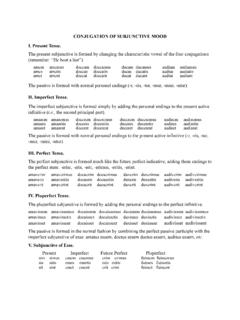
3 There are two tasks involvedin mastering the SUBJUNCTIVE : first, learning the new FORMS , which is a relatively simple matter;second, learning to recognize and translate the various SUBJUNCTIVE clause types, which is also quiteeasily done, if your approach is SUBJUNCTIVE TENSES (Formation/Recognition)There are only four tenses in the SUBJUNCTIVE mood . The present SUBJUNCTIVE is introducedin Ch. 28 and has rules for formation that vary slightly for each of the four conjugations; rules forforming the imperfect (Ch. 29), perfect, and pluperfect (Ch. 30) are the same for all SUBJUNCTIVE : resembles present indicative, but with the vowel changessignalled in the mnemonic WE FEAR A LIAR and the personal endings -m, -s, -t, etc.
4 ; sometimestranslated with the auxiliary may. 1 IMPERFECT SUBJUNCTIVE : = 2nd principal part (present active infinitive), with the final-e lengthened, plus personal endings -m, -s, -t, etc.; sometimes translated with might. PERFECT SUBJUNCTIVE : ACTIVE = the perfect active stem (from 3rd principal part) +-erim, -er s, etc. (resembles future perfect indicative except -erim not -er and - - long in -er s, -er mus, -er tis; sometimes translated with may have. PASSIVE = perfect passive participle (4thprincipal part) + sim, s s, etc. ( , SUBJUNCTIVE equivalent of sum); sometimes translated with mayhave been.)
5 PLUPERFECT SUBJUNCTIVE : ACTIVE = perfect active infinitive (from 3rd principal part)+ -m, -s, -t, etc.; sometimes translated with might have. PASSIVE = perfect passive participle (4thprincipal part) + essem, ess s, etc. ( , SUBJUNCTIVE equivalent of eram); sometimes translated with might have been. SYNOPSISThe following synopsis provides a useful overview of the entire Latin verb system, includingall four SUBJUNCTIVE mood tenses:Indicative citd cetd c batd xitd xeritd citurd c turd c b turductusductusductus est erit eratSubjunctive cat----d ceretd xerit ----d c tur----d cer turductus ----ductus sit esset2 III.
6 SUBJUNCTIVE CLAUSE TYPESIn Wheelock you are introduced to a series of SUBJUNCTIVE clause types: jussive and purposeclauses (Ch. 28), result clauses (29), indirect questions (30), cum clauses (31), proviso clauses (32),conditions (33, with three distinct SUBJUNCTIVE types), jussive noun clauses (36), relative clauses ofcharacteristic (38), and fear clauses (40). You should systematically learn three details for each: (1)its definition, (2) how to recognize it in a Latin sentence, and (3) how to translate it into JUSSIVE SUBJUNCTIVES (Wheelock Ch. 28)Definition: an independent (main) clause expressing a command or exhortation (the only useof the SUBJUNCTIVE in a main clause formally introduced in Wheelock).
7 , Let us study this lessoncarefully. Recognition: easily recognized, since the sentence's main verb (and often its only verb) issubjunctive; negatives are introduced by n .Translation: let (sometimes may or should) is the English auxiliary used in translation,followed by the subject noun or pronoun (in the objective case, , me, us, him, her, it, them). ,C git m nunc d h c r , et tum n n err b .Let me now think about this matter, and then I will not make a discat aut disc the student either learn or mus magn cum d lect ti ne linguam Lat us learn the Latin language with great id faci mus.
8 Let us not do PURPOSE CLAUSES (Wheelock Ch. 28)Definition: a subordinate clause explaining the purpose of the action in the main clause, ,answering the question why? , we study Latin so that we may learn more about ancientRome or we study Latin to improve our English. Recognition: introduced by ut if purpose is stated positively, by n if negative, with asubjunctive verb at the end, and answering the question why? Translation: there are often several options, including translating ut + the subjunctivetogether as an infinitive; other more formal options include using the auxiliary may for the presentsubjunctive and might for the imperfect.
9 :3 Hic d cit ut e s says this to help them. in order to help them. that he may help them. so that he may help them. in order that he may help first two translation options given above are more colloquial, the others more d xit ut e s iuv said this to help them. in order to help them. that he might help them. so that he might help them. in order that he might help RESULT CLAUSES (Wheelock Ch. 29)Definition: a subordinate clause explaining the result of the action in the main clause, ,answering the question what is (was) the outcome?
10 , It is raining so hard that the streets areflooding and Vicky studied Latin so diligently that she knew it like a Roman. Recognition: introduced by ut and concludes with a SUBJUNCTIVE verb; if negative, containssome negative word (n n, n m , numquam, etc.); and answers the question what is (was) theoutcome? Main clause usually contains a signal word indicating degree (tam, tantus, ita, s c). Easily distinguished from a purpose clause by sense and context, by the signal word in the mainclause, and, if negative, by the presence of some negative word within the clause (vs.)