Transcription of The Ten Commandments – Principles for a …
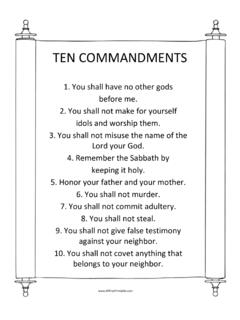
1 The Ten Commandments Principles for a Satisfying Life And God spoke all these words, saying: I am the Lord your God who brought you out of the Land of Egypt, out of the house of bondage. You shall have no other gods before me . :1-17 You shall not make for yourself and craved images, or any likeness of anything that is in heaven above, or that is in the earth beneath, or that is in the water under the earth; you shall not bow down to them nor serve themFor I, the Lord your God, am a jealous God, visiting the iniquity of the fathers on the children to the third and fourth generation of those who hate me, but showing mercy to thousands to those who love Me and keep Mycommandments.
2 You shall not take the name of the Lord your God in vain, for the Lord will not hold him guiltless who takes His name in vain. Remember the Sabbath day, to keep it holy. Six days you shall labor and do all your work, but the seventh dayis the Sabbath of the Lord your God. In it you shall do no work; you, nor your son, nor your daughter, nor your manservant, nor your cattle, nor your stranger who is with in your gates. For six days the Lord made the heavensand the earth, the seas, and all that is in them, and rested on the seventh day. Therefore the Lord blessed the Sabbath day and hallowed it.
3 Honor your father and your mother that your days may be long upon the land which the Lord your God is givingyou. You shall not murder. You shall not commit adultery. You shall not steal. You shall not bear false witness against your neighbor. You shall not covet your neighbor s house; you shall not covet your neighbor s wife, nor his manservant nor hismaidservant, nor his maidservant, nor his ox, nor his donkey, nor anything that is your neighbor s Exodus 20 These 10 Commandments fall into 2 sections: The first section is Commandments 1 through 4.
4 They teach us about our relationship to God. he second section is Commandments 5 through 10. They teach us about our relationship to Others. T The first section reveals our responsibility to God. he second section reveals our responsibility to others. T The first section teaches a reverence for God. he second section teaches a respect for others. T The first section teaches us to love God. he second section teaches us to love others. t The first section is vertical, relating to God in heaven. he second section is horizontal, relating to people on earth.
5 T doctrine while The first section deals primarily with the second section deals with ethics. These 286 words found in 17 verses make up the foundation for our Christian life. Without the Ten Commandments we are a people, a culture, and a country without a moral compass. Here we learn what God expects of us. (These Principles are not out dated, they are up to the minute. They are very functional. When applied to our life that make us a good and decent people. For the person who decides to practice them they will begin to find true satisfaction in life.)
6 Solomon said at the conclusion of trying all that the world had to offer that the whole of man, what makes life worth living, what brings satisfaction to life, is to fear God and keep His Commandments . "We have staked the whole future of American civilization, not upon the power of government, far from it. We have staked the future of all our political institutions upon the capacity of mankind for self-governmentupon the capacity of each and all of us to govern ourselves, to control ourselves, to sustain ; f God." Madison, father Constitution ourselves, according to the Ten Commandments ont James Presideof our The Ten Commandments begin with a Preamble.
7 A preamble tells you who is writing the document and the authority that is standing behind it. In verses 1 and 2 we find some of the most important words a human being can ever read or hear. It says "And God spoke all these words, saying I am the Lord your God who rought you out of the land of Egypt, out of the house of bondage." b Many people say that the greatest question of all questions is: Is there a God? I think a greater question thanthat question is if there is a God has He spoken and can I kn ow Him personally? In verses 1 and 2 we find at God has spoken and that He can be known personally.
8 The God of Reality. (I am the Lord your God) He is the God f Redemption. (Who brought you out of bondage) god question we face is we will orship the God who created us or the god(s) we create. only. We are to worship only the true living od. Nothing is to be placed in front of God. oth God and idol. That which your heart clings and entrust itself is, I say, really your God." hat are our false god s? e are told who to worship. In the second command we are going to be ld how to worship. the second command we have a statement that prohibits false worship.
9 Th He is the God of Revelation. (And God spoke) He is o What do we learn from each commandment? From the first commandment You shall have no other gods before me we learn who we are to worship. Based on the statement I am the Lord we have who is to be worshipped. Many feel that this command is first in position because it is first in priority. Deciding which to worship is very important. Everyone worships a god. Thew The idea here is that we, as the people of God, are not to bring before God s face any other gods. You see God has many enemies but He will have no rivals.
10 God expects from His people that they will be totally devoted to Him and Him G In helping us understand what is it to have a god or What is God let me give you Martin Luther's answer. Martin Luther said, "a god is that which we look for all good and in which we find refuge in every time of need. To have a god is nothing else than to trust and believe him with our whole heart. As I have often said, the trust and faith of the heart alone makes b W From the second command You shall make no graven images we learn how to worship God. In the first command wto In the first command we have a statement that prohibits false gods.