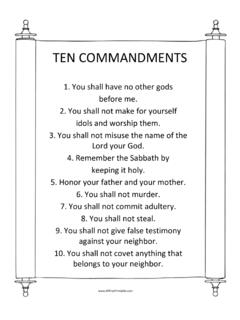
Transcription of The Ten Commandments - Trinity Reformed Baptist …
1 The Ten Commandments Trinity Baptist Church Discipleship Training (July, 2005) Introduction: There are two things essential in the life of the believer knowledge and obedience. No one can possess the hope of eternal salvation without obedience (1 John 2:3-4). As Thomas Watson said, Obedience carries in it the life-blood of religion (The Ten Commandments , page 1). No one can practice Biblical obedience without knowledge. One can possess knowledge without putting it into practice but practice demands a standard. In order to rightly obey God we must be rightly informed of His standard or rule of obedience. God has prescribed for us laws for regulating our actions. These laws are summarized in the Ten Commandments and obedience is demanded of all men (Romans 2:14-15). Some argue that the Law has been fully abrogated by the coming of Christ into the world.
2 They claim that to demand obedience to the Law from Christians is to bring them under that heavy yoke of bondage that no man has ever been able to bear. Doesn t the Bible state that we are not under the Law but under grace? To bring the Christian under obedience to the Law is in opposition to the liberty that all Christians enjoy in Christ it is nothing but legalism. In answer to these objections, we must simply hear the words of our Lord: Think not that I am come to destroy the law, or the prophets: I am not come to destroy, but to fulfil. 18 For verily I say unto you, Till heaven and earth pass, one jot or one tittle shall in no wise pass from the law, till all be fulfilled (Matt. 5:17-18). The Christian is not under the Law as a covenant of works but the Law will forever remain God s standard of obedience. Samuel Bolton aptly phrased it: When we read that the law is still in force, it is to be understood of the law as a rule, not as a covenant.
3 Again, when we say that the law is abrogated, and that we are freed from the Law, it is to be understood of the law as a covenant, not as a rule (The True Bounds of Christian Freedom, page 28). The purpose of this study is to examine each of the Ten Commandments that they might instruct us in the way of obedience. Although there will be some degree of defense for the perpetuity of the Ten Commandments , particularly with regard to the Sabbath, the scope of this study will largely presuppose that the Ten Commandments are reflective of God s holy character and will thus continue to stand unchanged into eternity. Bibliography: Barcellos, Richard C. In Defense of the Decalogue, Enumclaw: Winepress Publishing, 2001. Berkhof, Louis. Systematic Theology, Grand Rapids: Eerdmans, 1996. Bolton, Samuel. The True Bounds of Christian Freedom, Edinburgh, The Banner of Truth Trust, 2001.
4 Calvin, John. Sermons on the Ten Commandments , translated and edited by Benjamin W. Farley. Grand Rapids, Baker Book House, 1980. Calvin, John. Institutes of the Christian Religion, translated by Henry Beveridge. Grand Rapids, Wm. B. Eerdmans Publishing Co., 1983. Dabney, Robert Discussions of Robert L. Dabney. Edinburgh: The Banner of Truth Trust, 1967. Hodge, Charles. Systematic Theology, Grand Rapids: Eerdmans, 1986. 2 Plumer, William S. Law of God. Harrisonburg: Sprinkle Publications, 1996. Pink, Arthur W. The Ten Commandments , Grand Rapids: Baker Book House Co., 1994. Ray, Bruce Celebrating the Sabbath. Phillipsburg: P&R Publishing, 2000 Ryken, Philip Graham. Written in Stone. Wheaton: Crossway Books, 2003. Watson, Thomas. The Ten Commandments , Edinburgh, The Banner of Truth Trust, 1995. Shedd, William G.
5 T. Dogmatic Theology. Third Edition, Edited by Alan Phillipsburg: Presbyterian and Reformed Publishing Company, 2003. The Identity of the Ten Commandments : The Ten Commandments in our generation have suffered under an unfortunate loss of identity, particularly with the advance of New Covenant Theology. Many are claiming today that the Fourth Commandment should not be considered a part of God s Moral Law. Some New Covenant theologians appear to argue for the content of the Moral Law in this fashion: Since sins against nine of the Ten Commandments were published by God prior to the promulgation of the Decalogue via Moses, and since those same nine Commandments are represented in the New Testament, then these nine Commandments represent the Moral Law (Barcellos, Richard C. In Defense of the Decalogue, Page 77). The fact that the seventh day was set apart and hallowed by God at creation demands the acknowledgement of its existence before the publishing of the Ten Commandments .
6 Israel was observing the Sabbath before the giving of the Law in Exodus 20. In Chapter 16 some gathered manna on the Sabbath against the command of God. God condemned their breech of the Law. Exodus 16:28-29 And the LORD said unto Moses, How long refuse ye to keep my Commandments and my laws? 29 See, for that the LORD hath given you the sabbath, therefore he giveth you on the sixth day the bread of two days; abide ye every man in his place, let no man go out of his place on the seventh day. Would it not seem strange that God gave ten laws etched in stone but only nine would have a perpetual observance? The Ten Commandments are ten none have been abrogated. The Purpose of the Ten Commandments 1. The Law has never be a means of sinners being reconciled before God. Salvation in both the Old and New Testaments has always been by grace alone through faith.
7 Law has never been opposed to grace. Romans 4:3-5 "For what saith the scripture? Abraham believed God, and it was counted unto him for righteousness. 4 Now to him that worketh is the reward not reckoned of grace, but of debt. 5 But to him that worketh not, but believeth on him that justifieth the ungodly, his faith is counted for righteousness." 2. The Law shows sinners their need of a Savior Galatians 3:23-24 "But before faith came, we were kept under the law, shut up unto the faith which should afterwards be revealed. 24 Wherefore the law was our schoolmaster to bring us unto Christ, that we might be justified by faith." A. The Law makes demands for absolute obedience. The Law teaches us how to live but does not offer the power for obedience. No man can meet its demands. B. The Bible teaches that the Law actually provokes us to sin.
8 3 Romans 7:8-9 But sin, taking occasion by the commandment, wrought in me all manner of concupiscence. For without the law sin was dead. For I was alive without the law once: but when the commandment came, sin revived, and I died. 1. In other words, the Law increases sin. The Law does this in two ways. a. One, the Law reveals our guilt before God. Before a man comes face to face with the Law he doesn t see himself as a guilty sinner. b. Two, men by nature rebel against the Law In this way by the Law transgressions are actually increased. 2. Bunyan illustrated this truth in Pilgrims Progress as Christian goes to the Interpreter s house: Then the Interpreter took Christian by the hand, and led him into a very large parlour that was full of dust, because never swept; the which, after he had reviewed a little while, the Interpreter called for a man to sweep.
9 Now, when he began to sweep, the dust began so abundantly to fly about, that Christian had almost therewith been choked. Then said the Interpreter to a damsel that stood by, Bring hither the water, and sprinkle the room; the which when she had done, it was swept and cleaned with pleasure. Christian: Then said Christian, What means this? Interpreter: The interpreter answered, This parlour is the heart of a man that was never sanctified by the sweet grace of the gospel: the dust is his original sin and inward corruptions, that have defiled the whole man. He that began to sweep at first is the law; but she that brought water, and did sprinkle it, is the gospel. Now, whereas thou sawest that , so soon as the first began to sweep, the dust did so fly about, that the room by him could not be cleansed, but that thou was almost choked therewith: this is to shew thee, that the law, instead of cleansing the heart, by its working, from sin, doeth revive, put strength into, and increase it in the soul, even as it doth discover and forbid it; for it doth not give power to subdue.
10 C. The Law convicts men of their sin and their helplessness in keeping the Law and drive him to Christ. 3. The Law teaches the redeemed how to live for the glory of God Galatians 3:25-28 "But after that faith is come, we are no longer under a schoolmaster. 26 For ye are all the children of God by faith in Christ Jesus. 27 For as many of you as have been baptized into Christ have put on Christ." A. The Law reflects the righteous character of God B. The Law is in no way opposed to the Gospel. The same Law that shows us our sin and guilt before a holy God is the Law that then teaches us how we might live righteously before God after we are saved. C. The redeemed have been redeemed from the Law as a taskmaster, a standard that none can meet. Now the Law has become a joy. The saved man who loves God loves to honor Him.