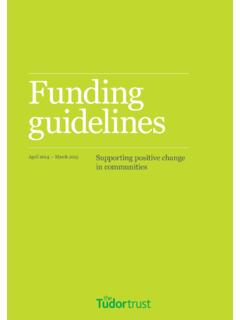
Transcription of The Tudor Trust Guidelines 2018
1 funding guidelinesSupporting positive change in communitiesApril 2018 March 2019 Tudor makes grants to smaller community-led groups that support people at the margins of s o c ie t s trustees are closely involved at every stage of the grant-making process and look forward to reading your good funding relationship is based on openness and Trust . Tudor s trustees are keen to hear from our applicants what it is that they really need and to understand how we can best support you have any questions or need more advice once you ve read these Guidelines please call the Information Team on 020 7727 8522. If you are Deaf, or have other communication difficulties, you can email us on This email address is only for use by people who would find it difficult to contact us by document has interactive elements to aid navigation. Roll over the contents list on the right to quickly link to each section, and navigate pages using the arrows on the bottom Trust funding Guidelines 2018 Tudor Trust is an independent grant-making charitable Trust .
2 We fund a wide range of organisations working to support positive change in people s lives and in their communities around the UK. We don t have specific funding programmes designed to advance any particular agenda as we think that the groups we support are best placed to identify challenges and develop means that we support work which tries to meet the many different needs of people at the margins of society in a wide variety of ways. We are interested in how organisations tackle these needs, and their root causes. We are keen to work with organisations that have a real understanding of the challenges facing the communities they support, and a clear sense of the difference they seek to make through their work. Introduction to TudorWe are interested in how organisations work, as well as in what they do: the key characteristics and qualities we look for are outlined on pages 8 and 9 of these Guidelines .
3 There are some types of organisation and work that we will not consider for funding . See page 10 for we receive more applications than we can fund we have a straightforward two-stage application process designed to reduce the time and effort organisations spend on their first approach to us. The application process is described on page 12. We Trust the groups we fund and aim to build open and straightforward relationships with them. Tudor Trust funding Guidelines 2018 Tudor Trust wants to support smaller groups, embedded in their communities, which work directly with people who are on the edges of mainstream society in ways which encourage inclusion, integration and are particularly interested in supporting work that develops and promotes the social connections and relationships which make such an important contribution to the well-being and quality of life of individuals, and which strengthens is clear from the experience of the groups we support that austerity policies have put communities and the organisations working within them under huge pressure.
4 Many organisations have seen their funding reduce as need and demand has increased. Our sense is that things are not going to get better any time soon so we are keen to support organisations that can demonstrate their ability to adapt to this new reality while also imagining new ways of doing kind of organisations do we support? Tudor s trustees are also particularly interested in supporting smaller, under-resourced organisations: in our experience smaller organisations are particularly well-placed to deliver positive change because they know their communities and can be highly responsive to need, providing an individualised and holistic response to the people they support. The best smaller-scale organisations also encourage participation and inclusion and contribute to the resilience of communities by offering opportunities for connection and engagement. We are therefore much more likely to fund groups with an annual income of less than 1 million.
5 In practice the majority of the organisations we support are much smaller than this: last year 77% of our grants went to groups with an annual income of less than 500,000. If you are from an organisation with an income of more than 1 million and want to discuss whether it is worth making an application please call the Information Team on 020 7727 8522 for Trust funding Guidelines 2018 kind of funder is Tudor ?We want to respond flexibly to your ideas and energy and to provide support in a way which is helpful and enabling. Our funding Guidelines are broad because we want to support the work that you really want to do. We aim to give you the opportunity and practical tools to do the work that you know is needed. Our ability to be flexible can mean that we are in a good position to support organisations which are in transition, whether they are entering a period of growth and development or are responding creatively to challenging an independent grant maker, an important part of our role is to support work which is untried and that has uncertain outcomes.
6 However, we are not interested in innovation for innovation s sake: we also recognise the need for sound, practical work that seeks to bring stability and wellbeing into difficult places and Trust the groups we fund and aim to build open and straightforward relationships with them. We try to offer high levels of support and engagement when this is helpful and appropriate. Our two-stage application process gives us more time to work creatively with applicants who reach the second stage. Through careful listening and constructive dialogue we hope to give you the opportunity to think about your options and develop a proposal that focuses on the real needs of your organisation and the people you are working with. We don t have specific funding programmes designed to advance any particular agenda as we think that the groups we support are best placed to identify challenges and develop solutions. Tudor Trust funding Guidelines 2018 sort of grants can we make?
7 Because we try to respond to the needs identified by organisations themselves, many of our grants take the form of core funding : funding which goes towards the core costs of running an organisation, including salaries, overheads and day-to-day running costs. Sometimes we may decide to offer unrestricted funding , through a grant which can be used as an organisation s trustees wish to further its charitable can also provide project grants, capital grants for buildings or equipment and grants to help strengthen your organisation. There is no maximum or minimum grant, though in practice it is unusual for us to make a grant of less than 10, some situations we may look at making a short-term loan if this is the most helpful solution and you can demonstrate how you can pay it back: if you are interested in loan funding please ring the Information Team on 020 7727 8522 for advice before making an we make grants that run for one, two or three years.
8 We understand that tackling deep-rooted problems takes time so we regularly fund over a longer period, usually by making a further grant following on from the original one. However, our interest in supporting work in the longer term has to be balanced against our need to encourage new groups and new thinking. This means that our funding can t continue aims to be a helpful and flexible funder and we want to respond imaginatively to your organisation s specific concerns and priorities. Although our primary focus is grant making we also engage with the groups we fund in other ways, offering advice and development support where this is needed. We re particularly keen to work with organisations where this kind of enhanced engagement will be of real benefit and make a significant contribution to what they want to Trust funding Guidelines 2018 can we fund? We can only fund work which is charitable but you don t have to be a registered charity to apply to us.
9 We can consider your application if: you are seeking support for work that has a charitable purposeand the application comes from an organisation which has both a constitution and a bank account. We can make grants to groups operating under a range of legal structures including registered charities, unincorporated associations, community interest companies and industrial and provident societies. We don t make grants to individuals. When we assess applications we are looking for a mix of characteristics and qualities in your organisation, your work and what you aim to deliver. One of the crucial things we look for in the applications we receive is a strong focus on support for the most marginalised on those individuals and communities who have limited access to resources and opportunities. We don t work to a single definition of marginalisation: we rely on our applicants to share their understanding of marginalisation with us and we also assess this in relation to the full range of applications we receive.
10 We want to support smaller groups, embedded in their communities, which work directly with people who are on the edges of mainstream society in ways which encourage inclusion, integration and independence. Tudor Trust funding Guidelines 2018 are we looking for?In this section we give an overview of what we are looking for when we consider an application. Tudor wants to support organisations which: Address marginalisation Display positive organisational characteristics Make a differenceWe don t expect every application to demonstrate all of these characteristics and qualities but we are looking for a combination of them when we review a first-stage proposal. We are likely to be more interested in applications which combine qualities from all three of these areas, though there will be occasional exceptions to diagram opposite may help you to visualise our approach. We explain more about what we are looking for under each heading on the next page.