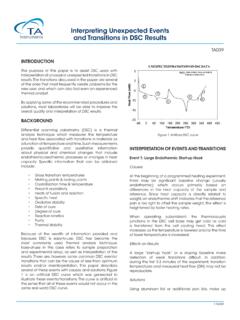
Transcription of THE VORTEX DROP STRUCTURE IMPLEMENTATION …
1 THE VORTEX DROP STRUCTURE IMPLEMENTATIONFOR ODOR AND CORROSOIN CONTROLW illiam P. Moeller, Jr., , Eugene Natarius, council Environmental Services3565 Kennebec DriveEagan, Minnesota 55122-1036 ABSTRACTH ydrogen sulfide gas emissions cause extensive corrosion and odor problems in wastewaterconveyance and treatment systems. A significant source of these emissions is from drop struc-tures such as interceptor drop maintenance holes, forcemain discharges, joint structures, and wetwell drops in sewer pumping stations. The VORTEX Drop STRUCTURE (VDS), invented by EugeneNatarius, is an effective energy dissipater and aerator, which considerably improves the dropstructure. It dissipates the flow energy and aerates the wastewater, preventing emission of odor-ous gases, oxidizing the hydrogen sulfides, and protecting the drop STRUCTURE from corrosion andabrasive council Environmental Services, a regional public agency serving the Minneapolis/St.
2 Paul area, successfully implements the VDS. Four installed VDS have been working on maininterceptors with no odor complains from the public. The cost of chemical feed for odor controlhas been significantly reduced, and the structures are virtually maintenance-free. Additional VDSinstallations are in progress at a pumping station wet well, and on a forcemain to measure VDS effectiveness was performed at two installations. The analysis of mul-tiple wastewater samples taken simultaneously upstream and downstream of the VORTEX DropStructures shows a significant decrease of dissolved hydrogen sulfides and a sharp rise in thedissolved oxygen concentrations downstream of the structures. The results of air qualitymonitoring around VDS installations indicate a strong effectiveness.
3 Odor complaints fromadjacent homeowners have virtually drop STRUCTURE , gas emission, VORTEX drop STRUCTURE , odor control, corrosion control, wastewateraeration, abrasive wear control, solution, sewer drops create turbulent flow, which releases Hydrogen sulfide (H2S) gas. Thisemission from the drop structures can lead to rapid, extensive damage to concrete and metalsewer piping and mechanical equipment, and is a main source for odor are beneficial aspects of vertical drops in situations where sewage is still fresh andcontains a relatively low amount of dissolved sulfides. Intensive flow turbulence and re-aerationat these drops boost the level of dissolved oxygen in such sewers. The O2 boost prevents exhaus-tion of the dissolved oxygen for a considerable length of in most practical cases, sewage contains a significant amount of potentially volatile dis-solved molecular H2S.
4 This H2S gas is released in drop structures and causes corrosion and odorproblems. Substantial physical evidence and test data show that most hydrogen sulfide emissionoccurs at the drops, rather than in the pipes. This is further confirmed by public odor complaintsmost often coming from areas neighboring the sewage to its elevation, flow upstream of the drop possesses great potential energy. This energy mustbe dissipated to solve the problem. A known method is to create a wall-hugging spiral flow in thevertical drop STRUCTURE to dissipate the energy by friction [1]. This VORTEX flow is formed by acircular, or volute-shaped chamber situated concentrically on top of the vertical this method to a typical drop of interceptor sewage flow is complicated by two , the upstream flow velocities are usually not enough to create a stable tangential flow on thevertical wall of a standard maintenance hole (MH).
5 Second, quite often the MH is used forlateral connections at elevations lower than the main influent method can be improved considerably if the influent flow is accelerated and directed into ashaft of a predetermined diameter installed in the drop STRUCTURE ( VORTEX Shaft) See ( pending).The VORTEX form with a VORTEX channel of decreasing radius creates accelerating spinning accelerating flow is directed through a special top cut into a VORTEX shaft, with a muchsmaller diameter, installed inside of a sewer drop STRUCTURE . The flow continues spiraling down-ward in a combined field of gravity and centrifugal forces. Due to the sharp reduction in diameterand significant increase of centrifugal forces, the flow maintains intimate contact with the vortexshaft wall creating a stable air core without loosing its integrity.
6 In the VORTEX shaft, the flowdrags air down creating a slightly negative air pressure above the VORTEX . This effect prevents gasfrom escaping up above the VORTEX form. The air is entrained and mixed with the flow. The mostintensive processes of vigorous mixing and aeration occur in the submerged part of the vortexshaft. The flow exits the VORTEX shaft at the bottom into an energy-dissipating pool. Theremaining flow energy is dissipated through mixing and internal friction. A tranquil flow satu-rated with air exits the energy dissipating pool to the effluent VORTEX flow acceleration combined with its direction into a much smaller diameter innershaft provides effective energy dissipation with intensive airflow mixing and aeration before theemission occurs.
7 This method yields the following benefits: Elimination of odorous gas emission Protection of the STRUCTURE and pipes from intensive corrosion Aeration of wastewater flow Effective energy dissipation eliminating abrasive wear of the STRUCTURE Creation of conditions for boosting dissolved oxygen and oxidation of dissolved sulfides Reliable function independent of flow fluctuations Elimination of the need for air treatment Significant improvement of existing drop STRUCTURE rehabilitation DROP IMPROVEMENTSThe metropolitan council Environmental Services (MCES) has used the new VORTEX method tocontrol odor and improve collection system flow drop structures situated on main MCES is a regional public agency that provides wastewater collection treatment to a seven-county metropolitan area surrounding Minneapolis and St.
8 Paul, first VORTEX drop STRUCTURE constructed by MCES is located in Minneapolis on HumboldtAvenue South. The STRUCTURE has a 15-foot flow drop and is located at a MH downstream of thedischarge point of a 27,000-foot long forcemain (FM). This FM has an average flow (ADF) million gallons daily (MGD). For years, the drop STRUCTURE was the main cause of aneighborhood odor problem. The sewer odor was a constant nuisance in this otherwise elegantarea of century-old homes and with the odor problem, the upstream 30-inch concrete pipe was deteriorated by H2 Scorrosion. It had been repaired twice; first in 1989 by sliplining a length of about 300 feet, andagain in 1996 with cured-in-place pipe. In July 1997, a chemical injection system containingchemical pumps and a 5000-gallon chemical underground storage tank was installed on the FMat a flow metering station approximately two miles upstream of the discharge point.
9 Between 60and 80 gallons of Bioxide solution were injected daily to oxidize dissolved hydrogen sulfideand control odor at the drop. Expenses for chemicals averaged up to $5,700 a drop STRUCTURE was improved by installing a VORTEX form and shaft into the existing MH ( ,a). Improvements included the following: Removal and replacement of the existing STRUCTURE , using a standard 48-inch concrete MHon a new base. Constructing a box-like concrete entrance flume and connecting it to the VORTEX shaft top(Fig. 2, b). Bolting a corrosion-protected metal base plate to the MH bottom and covering it with 2-inch thick concrete reinforcement. Installing the 24-inch outside diameter shaft on the metal base with free flow exit be-tween vertical channels.
10 The shaft is fusion-welded, high-density polyethylene (HDPE). Sealing the space between the VORTEX shaft and the new drop STRUCTURE is connected to a 54-inch brick interceptor by 7 feet of 30-inch reinforcedconcrete 35-day gas monitoring in main and lateral sewers around the new VORTEX drop struc-ture has shown very low concentrations of H2S. The monitors were installed into MHs upstreamand downstream of the VORTEX drop, into the drop STRUCTURE above the VORTEX , and in two locallines connected to the drop STRUCTURE . The H2S monitoring program consisted of two phases. Oneincluded chemical injection and the other did average upstream and downstream H2S gas concentrations in the phase without chemicalswere even slightly less than the corresponding data with the chemical injection: ppm ppm vs.