Transcription of Thiodan EC - HerbiGuide
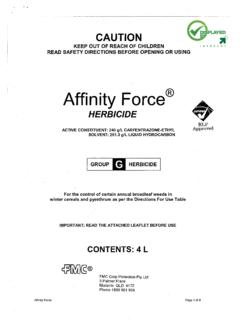
1 Thiodan EC DANGEROUS POISON KEEP OUT OF REACH OF CHILDREN READ SAFETY DIRECTIONS BEFORE OPENING OR USING Thiodan EC INSECTICIDE Active Constituent: 350 g/L endosulfan Solvent: 640 g/L LIQUID HYDROCARBONS GROUP 2A INSECTICIDE For the control of various insect pests on cotton, oilseeds, vegetables and other crops as specified in the DIRECTIONS FOR USE table RESTRICTED CHEMICAL PRODUCT ONLY TO BE SUPPLIED TO OR USED BY AN AUTHORISED PERSON. A CONDITION OF REGISTRATION OF THIS PRODUCT IS THAT IT WILL ONLY BE SUPPLIED TO AN AUTHORISED PERSON. TO DO OTHERWISE IS AN OFFENCE UNDER THE AGVET CODE. GENERAL INSTRUCTIONS Insecticide Resistance Warning For insecticide resistance management, Thiodan EC Insecticide is a Group 2A insecticide.
2 Some naturally occurring insect biotypes resistant to Thiodan and other Group 2A insecticides may exist through normal genetic variability in any insect population. The resistant individuals can eventually dominate the insect population if Thiodan or other Group 2A insecticides are used repeatedly. The effectiveness of Thiodan on resistant individuals could be significantly reduced. Since occurrence of resistant individuals is difficult to detect prior to use, Bayer CropScience accepts no liability for any losses that may result from the failure of Thiodan to control resistant insects. The user should seek advice, and monitor the performance, and if the results are not in accordance with expectations, contact the manufacturer immediately.
3 Apparent resistance however, should not be confused with poor application, coverage or timing techniques. Thiodan may be subject to specific resistance management strategies. For further information contact your local supplier, Bayer CropScience representative or local agricultural department agronomist. Mixing Add the required quantity of Thiodan EC Insecticide directly to water in spray tank, with agitators in motion. Compatibility Thiodan EC is compatible with some formulations of most commonly used insecticides and fungicides, including copper oxychloride, wettable sulphur, zineb, ziram, Ovasyn Options and organic phosphate materials. Thiodan EC is also compatible with the plant growth regulator Reign . Thiodan EC should not be mixed with dinocap or alkaline sprays such as Bordeaux mixture or lime sulphur.
4 Changes in climatic conditions and formulations of the preparations with which it may be mixed may cause variation in plant tolerance to admixtures. Application Thiodan EC Insecticide is a contact spray. Thorough, even coverage is essential. Refer to detailed application instructions below. Special Instructions for tree and vine crops Dilute Spraying Use a sprayer designed to apply high spray volumes, up to the point of run-off and matched to the crop being sprayed. Set up and operate the sprayer to achieve even coverage throughout the crop canopy. Apply sufficient water to cover the crop to the point of run-off. Avoid excessive run-off. The required spray volume may be determined by applying different test volumes, using different settings on the sprayer, or from industry guidelines or expert advice.
5 Add the amount of product specified in the Direction for Use table for each 100 L of water. Spray to the point of run-off. The required dilute spray volume will change and the sprayer set up and operation may also need to be changed, as the crop grows. Thiodan EC Concentrate Spraying Use a sprayer designed and set up for concentrate spraying (that is a sprayer which applies spray volumes less than those required to reach the point of run-off) and matched to the crop being sprayed. Set up and operate the sprayer to achieve even coverage throughout the crop canopy using your chosen spray volume. Determine an appropriate dilute spray volume (See Dilute Spraying above) for the crop canopy. This is needed to calculate the concentrate mixing rate.
6 The mixing rate for concentrate spraying can then be calculated in the following way: EXAMPLE ONLY 1. Dilute spray volume as determined above: For example 1500 L/ha 2. Your chosen concentrate spray volume: For example 500 L/ha 3. The concentration factor in this example is 3 X ( 1500 L 500 L = 3) 4. If the dilute label rate is 190 mL/100 L, then the concentrate rate becomes 3 x 190, that is 570 mL/100 L of concentrate spray. The chosen spray volume, amount of product per 100 L of water, and the sprayer set up and operation may need to be changed as the crop grows. Do not use a concentrate rate greater than 5 times the dilute spraying rate. For further information on concentrate spraying, users are advised to consult relevant industry guidelines, undertake appropriate competency training and follow industry best practice.
7 HIGH VOLUME LARGE-DROPLET-PLACEMENT TECHNIQUE SPECIFICATIONS FOR EC FORMULATIONS Meteorology Mandatory Immediately before beginning a spray application, the operator (or a person acting on his or her behalf) must measure and record wind speed, wind direction, ambient air temperature and relative humidity (wet-bulb temperature depression) at the application site. Do not apply endosulfan when surface temperature inversion conditions exist at the application site. Advisory endosulfan should not be applied during unstable atmospheric conditions characterised by high temperatures, strong convective activity and variable horizontal wind velocities. endosulfan should be applied when the local mean wind speed is between 4 and 20 km/hr as measured 2 metres above the ground.
8 Spraying should not take place when the wet-bulb depression (a measure of evaporation potential) is greater than 10oC. Aerial Equipment and Application Apply using water as a carrier. Thiodan EC Insecticide should not be applied by aircraft in Tasmania without the specific approval of the registrar of Chemical Products. Mandatory Do not apply endosulfan EC formulations unless a volume of carrier water greater than 30 L/ha is used. Use higher volumes of water (40 to 50 L/ha) when ambient air temperatures at the application site exceed 30oC. Do not apply endosulfan with booms where the distance between the two outermost nozzles is greater in length than 65% of the wingspan. Do not apply endosulfan EC formulations unless the droplet volume median diameter (VMD) of the spray is greater than 250 m.
9 The nozzle system and airspeed combinations specified in the following table can be used to satisfy this requirement. Note: For the following table, means Ok to use NOTE WELL: All nozzles must be directed backward and aimed parallel with the airstream. Thiodan EC Nozzle Type Airspeed 90-115 knots Airspeed 116-135 knots CP Standard30 deflector Boom Pressure greater than 30psi required DO NOT USE CP Straight Stream 30 deflector DO NOT USE CP Straight Stream 5 deflector DO NOT USE CP Straight Stream 0 deflector Boom Pressure greater than 30 psi required Flat Fan Min. Specification: Fan angle 65 or less Orifice size 10 or greater Advisory Aircraft used for endosulfan EC application should be pattern tested to ensure that even coverage and low coefficients of variation are achieved at optimum flight lane separations.
10 The spray system should not be operated if the wheel height is greater than 3 metres above the crop height. Booms should be fixed at a vertical displacement of 25 to 30 cm below the trailing edge of the aircraft wing. Ground-Based Equipment and Application Standard low volume boom or high volume equipment may be used. Mandatory Do not apply endosulfan EC formulations unless a volume of carrier water greater than 50 L/ha is used. For band spraying applications, use at least 50 L/ha of carrier water for the actual area sprayed in the bands. Use only flat fan nozzles with all ground-based boom sprayer equipment. All nozzles must be operated such that a medium spray quality is produced as indicated by manufacturers according to the BCPC and ASAE nozzle classification system.