Transcription of Third Party Administrator Claim Audit Report - …
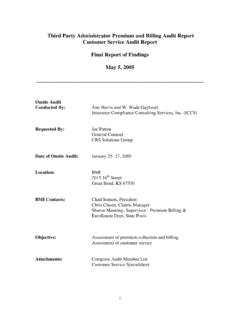
1 Third Party Administrator Claim Audit Report Final Report of Findings May 12, 2005 _____ Onsite Audit Conducted By: Friede Dub and Betsy Gisler Insurance Compliance Consulting Services, Inc. (ICCS) Requested By: Joe Patton General Counsel CRS Solutions Group Date of Onsite Audit : January 25 -2 7, 2005 Location: Benefit Management Inc. Great Bend, Kansas BMI Contacts: Chad Somers, Vice President Chris Clasen, Manager, Pool Unit Objective: The overall purpose of the Audit is to ensure compliance with the Administrative Service Agreement and to measure the Administrator s performance.
2 Attachments: Audit Detail Spreadsheet 1 I. General Information The Washington State Health Insurance Pool (WSHIP) provides health benefits to approximately 2,800 enrollees. Benefit Management Inc. (BMI) is the new contracted Third Party Administrator (TPA) that provided the Claim administration for the period audited. BMI has 65 full-time employees; 12 of those employees are involved in the WSHIP program. For the onsite Audit , BMI provided hard copies of the actual claims and explanation of benefits. System access was also provided that allowed inquiry to system notes, accumulators, and eligibility information. BMI did not provide any documentation for pending items with the exception of some pre-certification information that had been received from Health Integrated via fax. Chris Clasen, Manager answered questions and provided additional documentation during the onsite Audit as well as follow-up documentation post onsite review.
3 II. Scope of Audit In preparation for the Audit a total of 200 claims were selected from a Claim data dump produced by BMI. Based on the sample size and selection pool, this Audit carries a 95% confidence level at 4% sample precision. The data included all claims processed by BMI from April 1, 2004 through September 30, 2004. The claims were randomly selected by Claim type (professional and facility) and payment category ($0 and up) to ensure an adequate Audit sample. The majority of the claims selected for this Audit were run-in claims that had been originally received by the prior TPA. The Washington State Health Insurance Pool offers three health insurance plans to its enrollees. Plan 1 is a major medical plan with deductible options ranging from 2$500-$1,500, Plan 2 is available to enrollees that are covered by Medicare Part A and Part B and does not have a deductible; Plan 3 is a PPO plan with deductible options of $500 or $1,000 and a variable coinsurance for par vs.
4 Non-par provider claims. WSHIP pays benefits secondary to all other coverage except Medicaid. Medical case management, pre-certifications and concurrent reviews are handled by Health Integrated. The Preferred Provider Organization is First Choice Health Network. Claims are submitted to First Choice Health Network, which forwards the claims with repricing sheets to the TPA for processing. Member ID cards list the First Choice Health address for this purpose. Claim checks are issued to the members and providers daily. III. Audit Findings Member Eligibility Member eligibility was verified by accessing the TPA Claim system. This included effective and termination dates as well as plan types selected for each member. WSHIP policies do not provide benefits for pre-existing conditions during the first six months of coverage. Upon request, BMI produced some additional information for enrollees that were subject to this provision, such as system documentation that indicated premium discounts because of continuous prior coverage.
5 BMI policies and procedures indicate that annual requests are made to update other coverage, and that inquiries are made if the standard billing forms include an indicator that other coverage may be in force. 3 Claim Adjudication BMI informed the auditors that currently all claims are received by mail or fax as they are not yet prepared to accept any data via Electronic Data Interface (EDI). According to BMI policies and procedures, the mail is date-stamped upon receipt and delivered to the pre-registration department. Pre-registration staff assigns an internal control number to each Claim which is stamped on the Claim and then the Claim is entered into the claims system within two working days of actual receipt. Claims are batched by date of receipt for processing. The claims examiners process the Claim batches according to date of receipt. Benefit codes are assigned by the Claim examiners and they enter all applicable information for adjudication.
6 At the end of each business day, a check list is created and matched against all processed claims. Checks are issued on a daily basis. All claims and related documentation are digitally archived in alpha order (last name) and by check date. Claim pending procedures are in place for accidents, subrogation, and pre-existing conditions. Letters for additional information in those cases are addressed to the member with a copy to the provider. If no response is received within seven days, another letter is issued. If no response is made within 14 days from the initial request, the Claim will be denied. All claims will be pended if the member has not paid the premium for the month in which the Claim has been incurred. The Claim examiner will review the Claim weekly to determine if premium has been received or if a termination date was entered into the claims system by the billing department. The BMI claims system does not provide a tracking record on pending claims.
7 According to BMI the pending dates are stored in the database; however, they were not 4visible or accessible during the onsite Audit while reviewing the various claims on the system. The system only shows the last date the Claim was handled by an examiner or supervisor prior to payment. It is our understanding that that date is used to calculate the turnaround time as well. Ingenix data base is utilized to determine UCR for non-par claims. Other coverage inquiries are made annually by BMI for all members. There are no procedures in place to obtain itemized bills for any claims. BMI does not maintain a refund/overpayment log. They indicated that those claims are maintained in a file and reviewed periodically. BMI indicated that it has not identified any claims involving potential subrogation or Third Party liability, therefore, no log was available for review. BMI informed the auditors that the back-log claims that were received from the prior Administrator were all pended for duplicate checking using pending code WR.
8 Since the pending documentation was not available at the onsite Audit , the pending codes and dates were checked post Audit from data dump that was previously provided to the auditors by BMI. BMI reports that its internal pend code of WR (for claims received from ACS) is removed by the examiner allowing the adjudication process to be completed. Once the pend code is removed, BMI loses the ability to see the pend code in its system. BMI reports that part of the 11,000+ claims in back log that it received from ACS had previously been processed by ACS, even though BMI requested to receive separately the unprocessed claims. In September of 2004, BMI investigated the accuracy of claims 5with incurred dates prior to April 1, 2004 that BMI had processed in order to attempt to find the overpayments. Procedures for duplicate Claim checking were provided which indicate that the claims examiner must manually check for potential duplicates.
9 BMI reports that its duplicate check against ACS information was a manual process for examiners against a text file that ACS had originally provided. BMI subsequently received an Access database with ACS claims history which allowed BMI to cross reference its database of claims processed with a date of service prior to April 1, 2004 in order to ascertain which claims BMI had been paid in duplicate. While many duplicate claims were found that were recovered by BMI prior to the Audit , several of the claims audited were actually corrected billings of previously adjudicated claims. These were processed by BMI for full payment resulting in overpayments as well. While many of the refunds/credits could be identified during the Audit process, it is suggested that BMI complete a full Audit of all claims received during the run-in period to ensure accurate accounting of all overpayments, refunds, and outstanding refunds.
10 Deficiencies noted1. Duplicate Claim checking. As noted above, many duplicate payments were discovered in the Audit process that were previously processed by ACS, unknown to and subsequently overpaid by BMI. BMI was able to substantiate that many of these overpayments were discovered as part of the recovery process described above and were successfully recovered by BMI prior to the Audit . All of these prior-ACS claims are 6noted on the attached spreadsheet; however, they are not counted as deficiencies in this Report . The claims noted below are duplicates that BMI did not substantiate as having been yet recovered, or that were missed during the recovery efforts described above. Claim 20040122731 - $5, Corrected billing; not originally checked for duplicate; $5, was paid by ACS, thus $5, overpayment. BMI notes that the total charge on this Claim was $6, and that during the search for duplicates, this overpayment was not discovered.