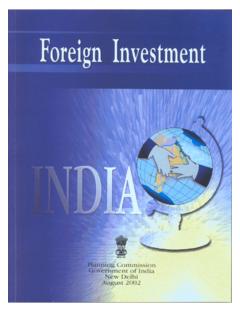
Transcription of This Five Year Plan document focuses on inclusive …
1 eleventh five year Plan Planning Commission Government of IndiaPublished five year Plan 2007-12 This five year Plan document focuses on inclusive growth. The document is divided into three volumes. Volume I: inclusive Growth details the vision, policies, and strategies of the key sectors and gives the macroeconomic framework and financing of the Plan; Volume II: Social Sector provides plans for Education, Sports, Art and Culture, Health and Family Welfare, Nutrition and Social Safety Net, Drinking Water and Sanitation, and Women and Child Rights; and Volume III: Agriculture, Rural Development, Industry, Services, and Physical Infrastructure includes chapters on the respective 0009780195696509 ISBN 0-19-569650-6 Volume IInclusIVe growthEleventh five year Plan2007-12 Volume IPlanning Commission Government of IndiaEleventh five year Plan(2007 2012) inclusive GrowthVolume IPlanning CommissionGovernment of India1 YMCA Library Building, Jai Singh Road, New Delhi 110 001 Oxford University Press is a department of the University of Oxford.
2 It furthers theUniversity s objective of excellence in research, scholarship, and educationby publishing worldwide inOxford New YorkAuckland Cape Town Dar es Salaam Hong Kong Karachi Kuala LumpurMadrid Melbourne Mexico City Nairobi New Delhi Shanghai Taipei TorontoWith offices inArgentina Austria Brazil Chile Czech Republic France Greece GuatemalaHungary Italy Japan Poland Portugal Singapore South Korea SwitzerlandThailand Turkey Ukraine VietnamOxford is a registered trademark of Oxford University Pressin the UK and in certain other countriesPublished in IndiaBy Oxford University Press, New Delhi Planning Commission (Government of India) 2008 The moral rights of the authors have been assertedFirst published 2008 All rights reserved. No part of this publication may be reproduced or transmitted, in any form or by any means,electronic or mechanical, including photocopying, recording or by any information storage and retrieval system,without permission in writing from Planning Commission, Government of IndiaISBN-13: 978-0-19-569650-9 ISBN-10: 0-19-569650-6 Typeset in Minion in 11/13by Eleven Arts, Keshav Puram, Delhi 110 035 Printed by Tara Art Printers Pvt.
3 Ltd., NoidaPublished by Oxford University PressYMCA Library Building, Jai Singh Road, New Delhi 110 001On behalf of Planning Commission, Government of India, Yojna Bhawan,Sansad Marg, New Delhi 110 0011 ForewordIndia s commitment to planned economic developmentis a reflection of our society s determination to improvethe economic conditions of our people and an affirmationof the role of the government in bringing about thisoutcome through a variety of social, economic, andinstitutional means. The eleventh five year Plan, whichwas approved by the National Development Council on19 December 2007 reaffirms this commitment. Itprovides a comprehensive strategy for inclusivedevelopment, building on the growing strength of theeconomy, while also addressing weaknesses that strength of the economy is evident from theremarkable transition to a high growth path, which hasbeen achieved in recent years. The Tenth Plan period(2002 03 to 2006 07) began modestly, but then saw theeconomy accelerating steadily to achieve an averagegrowth rate of , for the Plan period as a whole, whichis the highest ever achieved in any Plan period.
4 In thelast four years the growth rate has averaged makingIndia one of the fastest growing economies in the transition to high growth is an impressiveachievement, but we must not forget that growth is notthe only measure of development. Our ultimate objectiveis to achieve broad based improvement in the livingstandards of all our people. Rapid growth is essential forthis outcome because it provides the basis for expandingincomes and employment and also provides the resourcesneeded to finance programmes for social uplift. However,it is not by itself sufficient. We also need to ensure thatgrowth is widely spread so that its benefits, in terms of Prime Ministerincome and employment, are adequately shared by thepoor and weaker sections of our society, especially theScheduled Castes (SCs) and the Scheduled Tribes (STs),Other Backward Classes (OBCs) and minorities. For thisto happen, the growth must be inclusive in the broadestsense. It must occur not just in our major cities but alsoin our villages and small towns.
5 It must be spread acrossall states and not just limited to some. It must generatesufficient volumes of high quality employment to providethe means for uplift of large numbers of our populationfrom the low income low quality occupations in whichtoo many of them have been traditionally eleventh Plan addresses itself to the challenge ofmaking growth both faster and more inclusive . The rapidgrowth achieved in the past several years demonstratesthat we have learnt how to bring about growth, but wehave yet to achieve comparable success in , whether we look at it narrowly in terms of thepopulation below consumption based poverty line ormore broadly in terms of population without access toessential services, is definitely declining but the pace ofdecline is slower than it should be. Our people have a rightto expect that the evidently increased economic capabilitiesof our economy are translated into accelerating progressin these dimensions also. The eleventh Plan aims atachieving a radical transformation in this aspect of ourdevelopment.
6 It sets a target for 9% growth in the fiveyear period 2007 08 to 2011 12 with acceleration duringthe period to reach 10% by the end of the Plan. It alsoidentifies 26 other measurable indices of performancerelating to poverty, education, health, women and children,infrastructure, and environment and sets monitorabletargets in each of in a market economy which is becomingincreasingly integrated with the world is bound to bedifferent from what it used to be in earlier years. Muchof what used to be done by governments, includingespecially the establishment of production unitsproducing manufactured goods and commercial services,is now being done by the private sector. India is blessedin having a long tradition of private entrepreneurshipand the private sector has responded magnificently tothe new opportunities opened up by economic , this does not mean that the role of thegovernment must shrink. On the contrary, the governmentmust play a much larger role in some areas even whileshifting out of eleventh Plan outlines the new priorities for thepublic sector.
7 These relate to reviving dynamism inagriculture and building the necessary supportiveinfrastructure in rural areas, expanding access to healthand education, especially in rural areas, undertakingprogrammes for improving living conditions for theweaker sections and for improving their access to economicopportunity. It also includes a major thrust forinfrastructure development in general, which is a criticalconstraint on our performance in agriculture is necessary if ourgrowth is to be inclusive . The eleventh Plan adopts a multi-pronged approach towards this end. It provides for a majorexpansion in the programmes for irrigation and watermanagement. The Rashtriya Krishi Vikas Yojana (RKVY)has been launched to assist the States in development andimplementation of district level agricultural plans, basedon local agro-climatic conditions. As a step towards foodsecurity, which has assumed special relevance in view ofrecent international developments, the National FoodSecurity Mission aims at increasing cereal and pulsesproduction by 20 million tons over a five year is a massive thrust in the eleventh Plan onaccess to education and health, which are critical to socialand economic empowerment of the people.
8 In education,the Plan will spend more than double of what was spentin the Tenth Plan, as a proportion of the total budgetarysupport to Central Ministries. We have made goodprogress in providing access to primary education butthere are quality issues that need to be addressed. We mustalso expand access to secondary education in the EleventhPlan. In higher education, the Plan will work towardsincreasing enrolment rates from 11 to 21 percent over aivForewordten year period. This will require a massive expansion inour university system. There will also be emphasis oncreating competitive, world class institutions of higherlearning. The National Skill Development Mission willhelp in meeting the demands for skills in our growingeconomy as well as in generating high quality in higher education and skill development, the privatesector will be encouraged to augment the government sefforts appropriately. Given the special focus on educationin the eleventh Plan, I have no hesitation in calling thisPlan a National Education Plan.
9 In health, the Plan aims at providing improved broadbased health care in rural areas through the National RuralHealth Mission. The Rashtriya Swasthya Bima Yojana willprovide the much needed insurance cover against illnessto the population below the poverty line. Our initiativesin implementing a nationwide mid-day meals scheme inschools and improving the implementation of the ICDS will also improve the health and nutrition status ofour of affordable energy is critical for ourgrowth. With international oil prices rising sharply overthe last couple of years, and coal prices more recently, ourefforts towards energy security have acquired urgency. TheEleventh Plan will work towards policies for variousenergy sectors that are consistent with the optimal useof the different sources of energy. The Plan emphasizesthe need for energy conservation, increasing energyefficiency, and development of renewable sources of pricing of energy is necessary for a number ofreasons and this requires transmission of permanentchanges in prices to consumers while at the same timeprotecting the vulnerable sections of the society throughappropriate interventions.
10 These are challenges that wewill have to overcome for achieving the targets andobjectives of the very first year of the eleventh Plan has seen aresurgence of inflation in the last quarter mainly due tothe steep rise in international prices of oil and food-grains. Though these supply side factors are largelybeyond our control, we have launched a determined effortto moderate the inflationary trend while simultaneouslyinsulating the poor to the extent possible throughtargeted food and energy subsidies. These efforts willcontinue and I am confident that we can bring inflationunder control in a manner which does not hurt the longerterm growth prospects of the economy. This poses amajor challenge for short term macroeconomic policiesin the coming important aspect of the eleventh Plan is that mostof the public sector programmes are in areas that arenormally in the domain of State Governments and whereimplementation depends upon the active involvementof local level bodies including the Panchayati RajInstitutions.