Transcription of Thread Milling Quick Reference Pocket Guide
1 Thread MILLINGA Quick Reference Pocket DiameterOverall LengthLength of CutCutter DiameterNo matter the type of holemaking, Allied is here to help you re a production facility producing thousands of parts for one customer or a job shop making a handful of parts for a thousand customers, we re here to make sure the job gets done. Our precision holemaking and finishing solutions are backed by our experienced staff of knowledgeable engineers who are standing by, ready to t hesitate to call us. Let us know what problems you re having, and we ll find the solution. Holemaking is what we do, so you can feel confident when seeking our advice to solve your application all, we are the holemaking experts. All you have to do is Milling Reference Guide | 1 ContentsGENERAL INFORMATIONWhat We Offer.
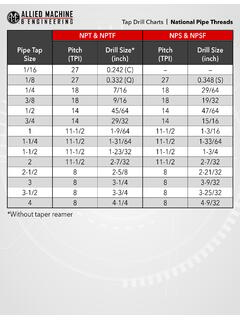
2 2 Understanding Thread Mills .. 3 Thread Terminology .. 4 - 5 Benefits of Thread Mills .. 6 - 7 PROGRAMMINGG Codes and M Codes .. 8 Climb Milling vs Conventional Milling .. 9 Internal Programming .. 10 External Programming .. 11 Programming Guide .. 12 - 13 Programming Example: Standard .. 14 - 17 Programming Example: Tapered Threads .. 18 - 19 Programming Example: AccuThread T3 .. 20 - 23 TECHNICAL Reference Conversion Chart .. 24 Common Thread Forms .. 25 Tap Drill Charts .. 26 - 32 APPLYING THE Thread MILL Tool Holding .. 33 General Purpose Speed and Feed Recommendations .. 34 - 41 AccuThread T3 Speed and Feed Recommendations .. 42 - 53 Radial Passes .. 54 - 55 Troubleshooting.
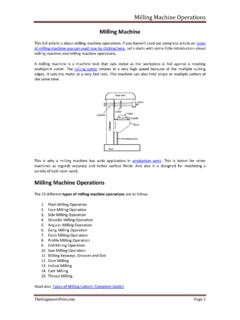
3 56 - 572 | Thread Milling Reference GUIDEWhat We OfferAccuThread 856 Solid CarbideThreadMills USA Solid CarbideAccuThread T3 Solid CarbideAccuThread 856 Bolt-in Style Indexable InsertsAccuThread 856 Pin Style Indexable InsertsThe all new software lets you choose the best Thread mill product for your application and create the program code for your machine. Insta-Code is available as a PC download app (that can be used offline) and an online web app available 24/7 at the wait. Get your program VersionDownload VersionOffline Version UpdateFind your Thread your Thread Milling Reference Guide | 3A Thread mill can be thought of as an end mill with the profile of the Thread on the side. Using multiple axes of a CNC machine allows you to helically interpolate the Thread profile into a work piece.
4 Unlike a tap, a Thread mill has a smaller diameter than the Thread size being produced because the mill must be able to enter into the drilled hole and interpolate. Thread Milling provides excellent control of the Thread s major diameter because it can be controlled using the machine s cutter Thread Mills4 | Thread Milling Reference GUIDET hread Terminology12610973548109 Thread Milling Reference Guide | 5 Thread TerminologyExternal Thread : The mating part with threads on the external Thread : The mating part with threads on the internal surface.(Nominal Diameter: The theoretical diameter of the threaded assembly.)Major Diameter: The largest diameter of either the internal or external Diameter: The smallest diameter of either the internal or external Diameter: A theoretical diameter used to correlate the dimensions between an internal and external Thread : The distance between like points on a Thread and is typically measured between Depth: The distance from root to crest when measuring perpendicular to the Thread s Angle: The included angle from crest to root of each : The surface area of each Thread s peak on either an internal or external : The surface area of each Thread s valley on either an internal or external | Thread Milling Reference GUIDER ight on size!
5 Using the machine s cutter compensation, a Thread s major diameter can easily be altered to produce precise threads. Tool life is increased over common tapping because wear can be compensated when using Thread more broken taps!When taps break it can be very costly to salvage the work piece. If a Thread mill breaks during a cut, a new Thread mill can re-enter into the hole and start from the beginning with very little time lost. Producing threads in large or expensive parts is no longer a risk. A presetter is suggested for tool height of Thread MillsMultiple diameters? No Thread mill is simply an end mill with the Thread form and a specific pitch. The machine can be programmed to helically interpolate to the desired diameter. A 1/4-20 Thread mill can produce a 1/2-20 or even a 7/8-20 Thread making it an excellent choice for uncommon Thread sizes or large diameter Milling Reference Guide | 7 Benefits of Thread MillsLeft and right handed threadsThread mills are not left hand or right hand specific.
6 While the Thread mill is interpolating, the Thread mill must move up or down 1 pitch in the Z axis to create the Thread s helix. If the Z axis is not moving, the Thread mill will just produce grooves inside of the hole. No more ordering a special left handed tap. One Thread mill provides multiple horsepower requiredThe diameter of a tap is completely engaged in the hole and requires more torque especially on large diameter threads. Cutting large diameter threads with coarse pitches becomes even more difficult. Thread mills only cut a portion of the circumference at a time which significantly reduces the torque and horse power requirements. Internal and external threadsUnlike tapping, threads can be milled inside of the hole or on the outside of the material; however, not all Thread forms have identical details for their internal and external mating surfaces.
7 Some threads may require an internal or external specific Thread mill. InternalExternal8 | Thread Milling Reference GUIDEG Codes and M CodesG CodesG00 Send to position with rapid feedG01 Send to position with linear movement and control by feed G02 Clockwise circular interpolationG03 Counter-clockwise circular interpolationG40 Cutter compensation cancelG41 Turn on left hand cutter compensationG42 Turn on right hand cutter compensationG54-59 Available workpiece coordinate settingsG90 Absolute positioningG91 Incremental positioningM CodesM00 Program stopM01 Program optional stopM03 Turn on spindle clockwise directionM04 Turn on spindle counter-clockwise directionM05 Turn off spindle rotationM06 Tool changeM08 Coolant onM09 Coolant offM30 Program end and reset to start of programTHREAD Milling Reference Guide
8 | 9 Climb Milling vs Conventional MillingWhen Milling a workpiece, the cutting tool can be fed in different directions along the workpiece. Both directions will achieve material removal but can have significant effects on the cutting tool and the milled MillingImproved Finish and Tool LifeLess Heat:Chips evacuate away from cutter Deflection:Cutting tooth enters the work-piece in a manner that creates a chip that s thicker at the beginning and thinner at the MillingPoor Finish and Tool LifeIncreased Heat:Chips evacuate in front of the cutting tool, allowing for the chips to be recut and generate Deflection:Cutting tooth enters the work-piece in a rubbing manner that creates a chip that s thinner at the beginning and thicker at the | Thread Milling Reference GUIDEI nternal ProgrammingClimb MillingInternal right hand threadInternal left hand threadConventional MillingInternal right hand threadInternal left hand threadM03G03Z-M03G03Z+M03G02Z+M03G02Z-TH READ Milling Reference Guide | 11 External ProgrammingClimb MillingExternal right hand threadExternal left hand threadConventional MillingExternal right hand threadExternal left hand threadZ+M03G02Z-M03G02Z-M03G03M03G03Z+12 | Thread Milling Reference GUIDEP rogramming GuideWhat you need to know Thread Milling can be easily accomplished with simple G code programming If your machine is
9 Capable of 3 axis (helical) interpolation, you can utilize Thread Milling Basic programming of a one pass Thread mill can be achieved in 6 basic stepsMajor Thread diameter of Thread (7/16 = )Threads per inch20 Number of threads per inch (20 is from 7/16-20 designation)Length of length of cutSFM475 Recommended surface footage for material to be cutFeed per feed rate per cutting edgeNumber of flutes4 Number of flutes on tool to be usedTool of cutting toolThe following are examples of how to calculate and program a 7/16-20 right hand Thread that will be 1/2 deep produced in one notes: The start point for the AMEC program is the X, Y, and Z center of the top of the hole. Your program should change to the Thread mill tool and move it into position.
10 Insert the Thread mill program at each location where the Thread mill sequence is desired. The AMEC program will switch the machine to incremental, machine one pitch, return to the top/center of the hole, and switch the machine back to interpolation Reference : When using a G02 or G03 for helical interpolation, the X and Y values are the landing location for the cutting tool. The I and J values are the center point for the rotation. The I value is relative to the X starting point, and the J value is relative to the Y starting Milling Reference Guide | 1 / Thread per inchRPM5416(SFM ) / Tool diameterLinear Feed per flute Number of flutesFeed rate for Thread feed ((Major Thread - Tool ) / Major Thread )Z axis move on arc (Pitch / 8)Z axis move for full (Pitch / 8) + Length of cutArc (Major Thread diameter - Tool diameter) / 4 Full rotation (Major Thread diameter - Tool diameter) / 2 Using the information on the previous page, the values can be calculated:Major Thread axis for arc on/off value (X,Y) of rotation value (X,Y) rate for Thread axis depth for full GuideWARNING: The program is based off the center of the tool.